
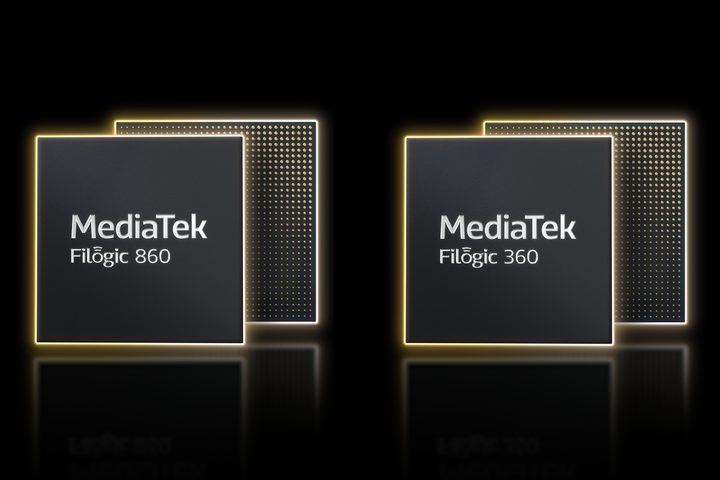
The next evolution of wireless technology, Wi-Fi 7, has been hitting its stride in recent months. Now, MediaTek is giving it a big boost with a duo of new Filogic chips that will power a whole new generation of Wi-Fi 7-capable devices, from enterprise access points and wireless mesh systems to smartphones and set-top boxes.
Unsurprisingly, MediaTek was one of the first chipmakers on board when Wi-Fi 7 made its debut at CES 2022, promising to deliver top speeds more than twice as fast as current Wi-Fi 6 and Wi-Fi 6E technologies. While Wi-Fi 7 is still in its nascent stages — few consumer devices support it, and the spec has yet to receive its final ratification — MediaTek’s second-generation Filogic chips will ensure that smartphones, laptops, and routers are ready to deliver the best of what the new standard has to offer.
“MediaTek stands out with the most comprehensive connectivity portfolio on the market, and we’re continuing this legacy with our two new advanced Wi-Fi 7 solutions designed for mainstream applications,” said Alan Hsu, MediaTek’s corporate vice president and general manager of Intelligent Connectivity Business in a press release. “Filogic 860 and Filogic 360 offer the same technology as our premium solutions with exceptional reliability in busy network environments, ultra-fast speeds with reduced latency and enhanced range.”
The Filogic 860 for premium routers
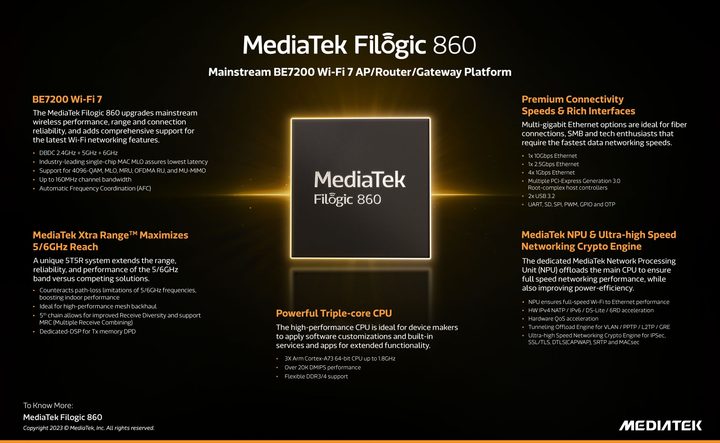
The flagship of the new duo is the Filogic 860, which will provide dual-band access and network processing to power back-end technologies in homes and businesses. With a triple-core Arm Cortex-A73 CPU, this provides enough horsepower to meet the demands of large corporations and service providers, but it’s also likely to find its way into some high-end Wi-Fi 7 routers.
Thanks to its hardware acceleration, the Filogic 860 will be able to power advanced tunneling and security features for use in Virtual Private Network (VPN) and firewall applications while also being able to seamlessly route Wi-Fi 7 traffic between nodes in a wireless mesh network.
The dual-band Wi-Fi support in the new chip also promises to deliver 7.2Gbps of maximum throughput. Those are the highest dual-band speeds currently available in the industry when using multi-link operations (MLO), a new Wi-Fi 7 enhancement that allows client devices to communicate with a router using multiple bands simultaneously — the 2.4GHz and 5GHz bands in this case.
Naturally, the Filogic 860 will support all the other advanced features of the Wi-Fi 7 draft spec that’s expected to be finalized early next year, including 4096-QAM (4K-QAM), plus support for adding an extra receive antenna to speed up dynamic frequency selection (DFS) and boost receiving range using MediaTek’s Filogic Xtra range support feature.
The Filogic 360 for client devices

On the other end, MediaTek’s Filogic 360 is a standalone chip that will provide Wi-Fi 7 support for consumer electronics like smartphones, laptops, set-top boxes, smart TVs, and more.
The Filogic 360 integrates triple-band Wi-Fi that supports 2.4GHz, 5GHz, and 6GHz frequencies and can handle speeds up to 2.9Gbps. The Wi-Fi 7 technology is joined by two Bluetooth 5.4 cores to provide enough throughput for gaming and Bluetooth Low Energy (BLE) audio, which features an integrated digital signal processor (DSP) that can handle the newest LC3 codec.
Since Wi-Fi and Bluetooth can operate in the same 2.4GHz band, MediaTek has also baked advanced technology into the Filogic 360 to ensure that the radios don’t step on each other, plus Filogic Xtra range support to boost the usable distance of devices incorporating the new chip by using a “unique Hybrid MLO solution.”
MediaTek has already begun sending out samples of the Filogic 860 and Filogic 360 chips to its manufacturing customers. The first Wi-Fi 7 capable devices incorporating the new chips are expected to arrive around mid-2024.


