
As a phablet pioneer with the Note series, Samsung has led the way toward ever-bigger smartphones and it’s responsible for some of the best options out there. Last year’s Galaxy S9 Plus and Note 9 are a pair of big beauties, but the South Korean manufacturer has stepped things up for the 10th anniversary of the Galaxy S range with an astounding device called the Galaxy S10 Plus.
Whether you’re looking to upgrade, or just shopping for a new plus-sized Samsung smartphone, we’re here to help. We’ll explain the differences between the S10 Plus, S9 Plus, and Note 9, so you can pick the right one for you.
Specs
| Samsung Galaxy S10 Plus | Samsung Galaxy S9 Plus | Samsung Galaxy Note 9 | |
| Size | 157.6 × 74.1 × 7.8 mm (6.20 × 2.91 × 0.30 inches) | 157.7 x 73.8 x 8.5 mm (6.21 x 2.91 x 0.33 inches) | 161.9 x 76.4 x 8.8 mm (6.37 x 3 x 0.34 inches |
| Weight | 175 grams (6.17 oz) | 189 grams (6.67 ounces) | 201 grams (7.09 ounces) |
| Screen size | 6.4-inch Dynamic AMOLED | 6.2-inch Super AMOLED display | 6.4-inch Super AMOLED display |
| Screen resolution | 3,040 × 1,440 pixels (526 pixels per inch) | 2,960 x 1,440 pixels (531 pixels per inch) | 2,960 x 1,440 pixels (516 pixels per inch) |
| Operating system | Android 9.0 Pie | Android 9.0 Pie | Android 9.0 Pie |
| Storage space | 128GB, 512GB, 1TB | 64GB, 128GB, 256GB | 128GB, 512GB |
| MicroSD card slot | Yes | Yes | Yes |
| Tap-to-pay services | Google Pay, Samsung Pay | Google Pay, Samsung Pay | Google Pay, Samsung Pay |
| Processor | Qualcomm Snapdragon 855 | Qualcomm Snapdragon 845 | Qualcomm Snapdragon 845 |
| RAM | 8GB, 12GB | 6GB | 6GB, 8GB |
| Camera | Triple lens 16-megapixel ultra wide-angle, 12MP standard, and 12MP telephoto rear, 10MP and 8MP front dual lens | Dual 12MP (with dual OIS) rear, variable aperture, 8MP front | Dual 12MP (with dual OIS) rear, variable aperture, 8MP front |
| Video | 2160p at 60 frames per second, 1080p at 240 fps, 720p at 960 fps | 2160p at 60 frames per second, 1080p at 240 fps, 720p at 960 fps | 2160p at 60 frames per second, 1080p at 240 fps, 720p at 960 fps |
| Bluetooth version | Bluetooth 5.0 | Bluetooth 5.0 | Bluetooth 5.0 |
| Ports | 3.5mm headphone jack, USB-C | 3.5mm headphone jack, USB-C | 3.5mm headphone jack, USB-C |
| Fingerprint sensor | Yes, ultrasonic in display | Yes, back | Yes, back |
| Water resistance | IP68 | IP68 | IP68 |
| Battery | 4,100mAh
QuickCharge 2.0 Qi wireless charging |
3,500mAh
QuickCharge 2.0 Qi wireless charging |
4,000mAh
QuickCharge 2.0 Qi wireless charging |
| App marketplace | Google Play Store | Google Play Store | Google Play Store |
| Network support | T-Mobile, AT&T, Verizon, Sprint | T-Mobile, AT&T, Verizon, Sprint | T-Mobile, AT&T, Verizon, Sprint |
| Colors | Prism Black, Prism White, Prism Blue, Flamingo Pink, Ceramic Black, Ceramic White | Midnight Black, Coral Blue, Lilac Purple | Ocean Blue, Lavender Purple |
| Price | $1,000 | $840 | $1,000 |
| Buy from | Buy at Walmart.com | Samsung, Amazon | AT&T, Verizon, T-Mobile, Sprint, Amazon, Samsung |
| Review score | 4 out of 5 stars | 4.5 out of 5 stars | 4 out of 5 stars |
Performance, battery life, and charging

The Samsung Galaxy S10 Plus has a big advantage straight out of the gate because it has this year’s flagship chip, the Qualcomm Snapdragon 855, while the older two Samsung smartphones have last year’s Snapdragon 845. The S10 Plus is faster, more efficient, and has a few extra tricks up its sleeve. You’ll also find 8GB of RAM and 128GB of storage in the newer phone, with the option to go all the way up to 12GB and 1TB.
Samsung has managed to pack a bigger battery into the S10 Plus as well. It boasts a 4,100mAh capacity, while the Note 9 has 4,000mAh and last year’s S9 Plus has 3,500mAh. We expect the S10 Plus to outlast its siblings, though probably not by much compared to the Note 9. All three support Quick Charge 2.0 and Qi wireless charging.
Winner: Samsung Galaxy S10 Plus
Design and durability


Bezels have been melting away gradually, but Samsung has taken clean, elegant design to a whole new level with the S10 Plus. A hole-punch camera takes a dainty bite out of the 6.4-inch screen and the slimmest of bezels remain top and bottom as the edges curve into the metal frame. On the back, the fingerprint scanner has been cleared away and the triple-lens camera suite is horizontally arranged. If you love the minimalist look, you’ll love this phone. The Note 9 is taller, wider, and thicker, while the S9 Plus retains bigger bezels and a busier back.
All three are glass, so you’ll definitely want cases, but they do all offer IP68 water-resistance, which means they can survive a dip into shallow water.
Winner: Samsung Galaxy S10 Plus
Display
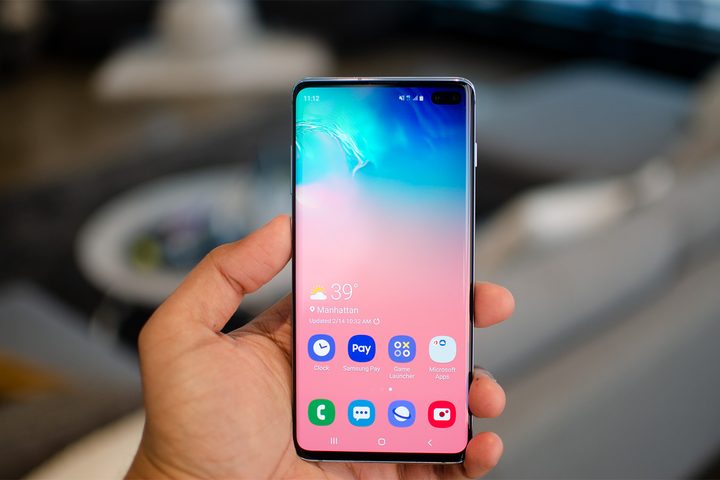
Both the Note 9 and the S9 Plus sport Super AMOLED screens at 6.4 and 6.2 inches respectively. They’re excellent by any measure, but the S10 Plus has a 6.4-inch Dynamic AMOLED screen that boasts improved brightness levels, HDR10+ certification, incredibly accurate colors, and a reduced level of blue light.
The S10 Plus also has a slightly higher resolution, as it switches from a 18.5:9 aspect ratio to 19:9, though it does also have that dual hole-punch camera at the top right.
Winner: Samsung Galaxy S10 Plus
Camera
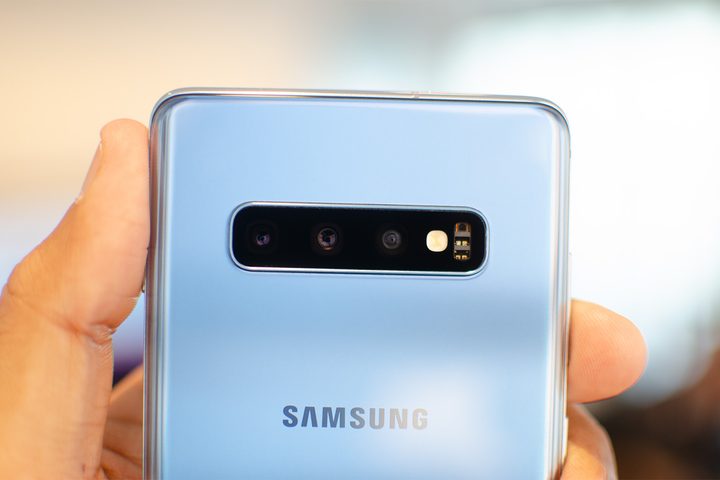
Perhaps the biggest advantage the Galaxy S10 Plus has over its predecessors comes in the camera department. There’s a triple-lens main camera that combines a 12-megapixel standard lens with a variable aperture (f/1.5 to f/2.4), an ultrawide-angle 16-megapixel lens with a 123 degree field of view and an f/2.2 aperture, and a 12-megapixel telephoto lens with an f/2.4 aperture that allows for 2x optical zoom. The S9 Plus and the Note 9 lack the ultrawide lens.
It’s a similar story around front, where the S10 Plus pairs a 10-megapixel lens with a secondary 8-megapixel lens for capturing depth. The other two phones make do with a solitary 8-megapixel lens. In addition to taking superior selfies, the front-facing camera in the S10 Plus can shoot 4K video.
Winner: Samsung Galaxy S10 Plus
Software and updates

All three of these phones have Android 9.0 Pie, with Samsung’s One UI over the top. The older two launched with Android 8.0 Oreo and the Samsung Experience UI, but they’ve been updated. That means you should expect a virtually identical software experience across the board here. It’s likely the S10 Plus will be updated for a little longer than its predecessors, but Samsung can be a bit slow with Android version updates.
Winner: Samsung Galaxy S10 Plus
Special features


Samsung loves to pack in the extras, though it’s debatable how useful a lot of them are. You’ll find the Bixby assistant, virtual and augmented reality support, the DeX desktop mode, Samsung Pay, and a handful of other special features in all three of these phones. Only the Note 9 has the S Pen, a pop-out stylus that can also act as a remote control.
The S10 Plus boasts that ultrasonic in-display fingerprint scanner and Wireless PowerShare, which means it can wirelessly charge any Qi-certified device, including an iPhone XS.
Winner: Tie – Samsung Galaxy S10 Plus and Samsung Galaxy Note 9
Price and availability
The Samsung Galaxy S10 Plus starts from $1,000, just like the Galaxy Note 9. That’s a fair jump on the Galaxy S9 Plus ,which started at $840. If you shop around, you can find the older two for a fair bit less than those list prices now.
All three are available from all major U.S. carriers and they’ll work with any carrier network. The S10 Plus is available for pre-order now and you can snag free Galaxy Buds if you order before the March 8 release.
Overall winner: Samsung Galaxy S10 Plus
You may be able to save a little cash by opting for the older S9 Plus or Note 9, but the S10 Plus is definitely the best phone of the three. With a gorgeous design, plenty of power, an amazing screen, a versatile camera suite, and some smart extras, it’s superior in every way. If you already have a Note 9 or S9 Plus, then the question of whether to upgrade to the S10 Plus is trickier — you might be better off waiting for the Galaxy S10 5G.


