
Apple’s Swift Playgrounds. Lego Mindstorms. Osmo.
STEM toys — that is, toys designed to teach kids basic science, technology, engineering, and math concepts — are all the rage right now. Thanks in part to new toy lines from Walmart, Toys “R” US, and Amazon’s curatorial STEM Club subscription service, the STEM toy market is projected to make up two to three percent of the $20 billion U.S. toy market.
There’s good reason for the demand: STEM toys have demonstrable cognitive benefits. A survey in the Netherlands found that 6th grade students who spent more free time in construction play performed better on a test of mathematics word problems than their peers, and a recent brain scan study found that 8-year-old children who play with STEM toys had an easier time solving spatial puzzles.
It’s an increasingly crowded field, but Sony’s not intimated by the competition. Last year in Japan and China, the electronics company released its take on STEM, a Lego-like robotics kit called the Koov, as part of its Global Education division and STEM101 project. And starting this week, Koov is coming to the U.S.
.gif)
The STEM toy competition may be fierce, but Sony says it’s uniquely positioned to deliver a better experience than most. It took inspiration from the processes in Sony’s Creative Center — the engineering wing responsible for designing the PlayStation and Bravia TVs — and worked with Japanese educators to refine Koov’s curricular components. And it stressed that software updates will make Koov better over time.
The Koov, which ships in two starter kits, comprises seven different kinds of interlocking building blocks; fifteen different actuators, motors, proximity sensors, and accelerometers; and one Koov Core, a customized Arduino microcontroller. Instead of a printed instruction manual, it ships with a companion app (on Apple’s iOS and MacOS and Microsoft’s Windows operating systems) that serves as a game-like hub for Koov activities, and has kids code their creations using a Blockly-like visual programming language.
Koov’s onboarding tutorial demonstrates the fundamentals. From there, kids advance their way through levels that run the gamut from LED basics to block design. Sony said that in total, the Koov app boasts more than 30 hours of educational material.
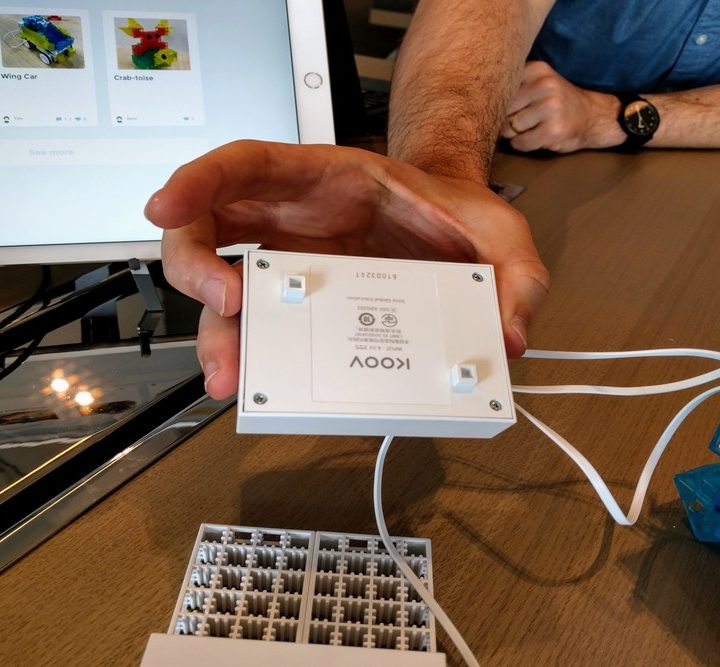
Once kids wrap their heads around the basics, they’re ready to advance to the next phase: Coursework. The Koov app packs 35 different lesson plans for them to follow, each focused on a single robot design and sequence of digital programming blocks
But Koov keeps the creative juices flowing in other ways. The app packs a self-contained sharing features that lets kids share, like, comment on, and publish their favorite creations. Users can choose from a gallery of avatar pictures, and snap pictures of their inventions using the Koov’s photo tool, and viewers can comment on, “like,” favorite, and download the programming of works that strike their fancy.
Sony’s been pleased by the response to Koov’s social networking features, which it launched last year — one crowdsourced design used a Koov kit and a snack box to deter sweets thieves. But the company says it’s been careful to balance sharing with oversight. Koov will be fully compliant with the Children’s Online Privacy Protection Act, the U.S. law that prohibits online services and websites from collecting certain information about kids under 13 years of age. And Sony’s employed two full-time moderators vet and approve every piece of content, including comments, project descriptions, and pictures.
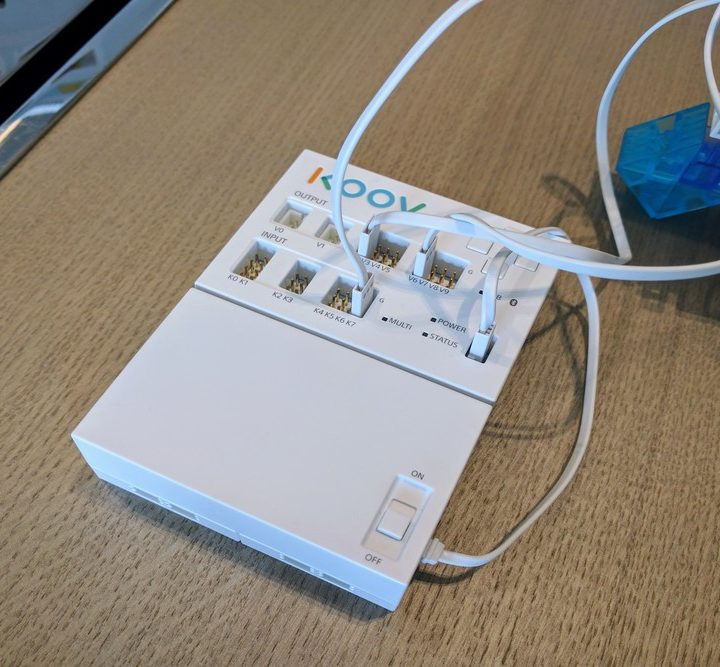
Ultimately, Sony sees Koov as a platform for all ages. Young kids get an introduction to robotics and coding, and older players get a versatile robotics platform to play around with. Sony said that even the Koov Core, the programmable “brains” of Koov creations, can be disassembled and customized.
Interestingly, Sony’s launching Koov on Indiegogo ahead of traditional brick-and-mortar chains. That’s partly because it wants to gauge the market’s response before committing to launch, the company says, but also because it hopes to solicit feedback from the platform’s most passionate fans.
In return for backers’ patronage, Sony’s cutting a 10 to 40 percent discount on the Koov’s suggested retail price and shipping units ahead of the tentative November launch month.
Koov pre-orders will be available for a limited time beginning on June 21, with units scheduled to ship to backers in December. The Koov Starter Kit starts at $360, and the Koov Advanced Kit ships for $500.
A cheaper, slimmed-down kit, Koov Basic Kit, is priced at $200. It ships with 115 blocks and accessories, and has an estimated ship date of November 2017.
Update: We’ve added pricing and availability information regarding the Koov Basic Kit.


