

“Why you can trust Digital Trends – We have a 20-year history of testing, reviewing, and rating products, services and apps to help you make a sound buying decision. Find out more about how we test and score products.“
We knew someone would put a 4K display in a smartphone eventually, but it was still a bit of a surprise when Sony unveiled the new Z5 Premium at IFA. Ever since Apple coined the retina name for its displays there has been some debate about just how sharp a screen really needs to be.
What is the limit of the human eye? Is it pointless to push pixel density beyond a certain point? It’s hard to say for sure, because the clarity of a picture also has a lot to do with the distance you view it from, and with smartphones we all like to get up close and personal.
To put this in some perspective, the majority of flagship smartphones right now have a 1,920 x 1,080 pixel display. The LG G4 went up to 2,560 x 1,440. The Sony Xperia Z5 Premium has a resolution of 3,840 x 2,160, which gives it an absurd pixel per inch (PPI) of 806. The iPhone 6 display is just 326 PPI.
Specs aside, what does it actually look like? It is eye-catchingly perfect, but it’s not immediately obvious that this is a 4K display. It’s only up close that you get an idea of just how sharp this screen is. You can put it as close as you like to your eyeballs and you will not be able to detect a hint of pixelation. Look at it side by side with a 1080p display, however, and the difference is stark: the colors are lush, the detail is impressive, and you get a greater sense of depth.
You can put it as close as you like to your eyeballs and you will not be able to detect a hint of pixel.Premium from top to bottom.
Sony’s industrial design language is a well established fusion of metal and glass. In the flagship Xperia Z line it has gradually softened. The angular edges were rounded off, the glass back became matte, and the bezels have shrunk. The annoying flap for the charging port has also gone, without losing the waterproof IP65/68 rating.
The Premium is the real flagship for Sony and that may be why it is distinguished from the regular Xperia Z5 and Z5 Compact by the mirrored back. You can get the Z5 Premium in black, chrome, or gold and you’ll find that mirror effect back on each one. It’s an expensive look, and it’s classy, but there’s an obvious problem — smudgy fingerprints are inevitable. If you want your Z5 Premium to keep that alluring look, you’re going to want to carry a microfiber cloth around with you.
In terms of size, that display is 5.5-inches, but it doesn’t feel much bigger than previous Xperia Z releases because more of the face is screen, and the bezels have gotten smaller. It’s also pretty light at 180g, and it’s comfortable to hold and slide into the pocket.
Fingerprint sensor and snappy shooter
Beyond the 4K screen, there are two features Sony highlighted in the reveal: the fingerprint sensor, which is also the power button on the right edge of the phone, and the 23-megapixel camera, which is supposed to be the fastest camera in a smartphone, capable of focussing and snapping in a fraction of a second.

The fingerprint sensor is absolutely great. It’s a very quick way of unlocking your phone, and it’s something you can do easily, one-handed, which isn’t always the case with Touch ID or Samsung’s Home button.
The camera is a little harder to test on the show floor, but it’s certainly fast, responsive, and seems to take high quality photos. Although the large sensor is rated at 23-megapixels it scales down to 8-megapixels. This means you can zoom in on photos without losing all the detail.
Hot stuff
Heat and battery life are obvious areas of concern for the Z5 Premium. A 4K display is going to require serious processing power and juice to keep it running. The phone packs a 64-bit Qualcomm Snapdragon 810 processor under the hood with 3GB of RAM.
Perhaps a couple of days between charges, even with the 4K display, isn’t an impossible dream.
There were issues with overheating in the early versions of the 810, and it’s something Sony has struggled with in previous Xperia Z phones, especially when it comes to 4K recording. I found the Z5 Premium wasn’t running especially hot when I used it. Recording video definitely turned up the temperature, but it never reached uncomfortable levels.
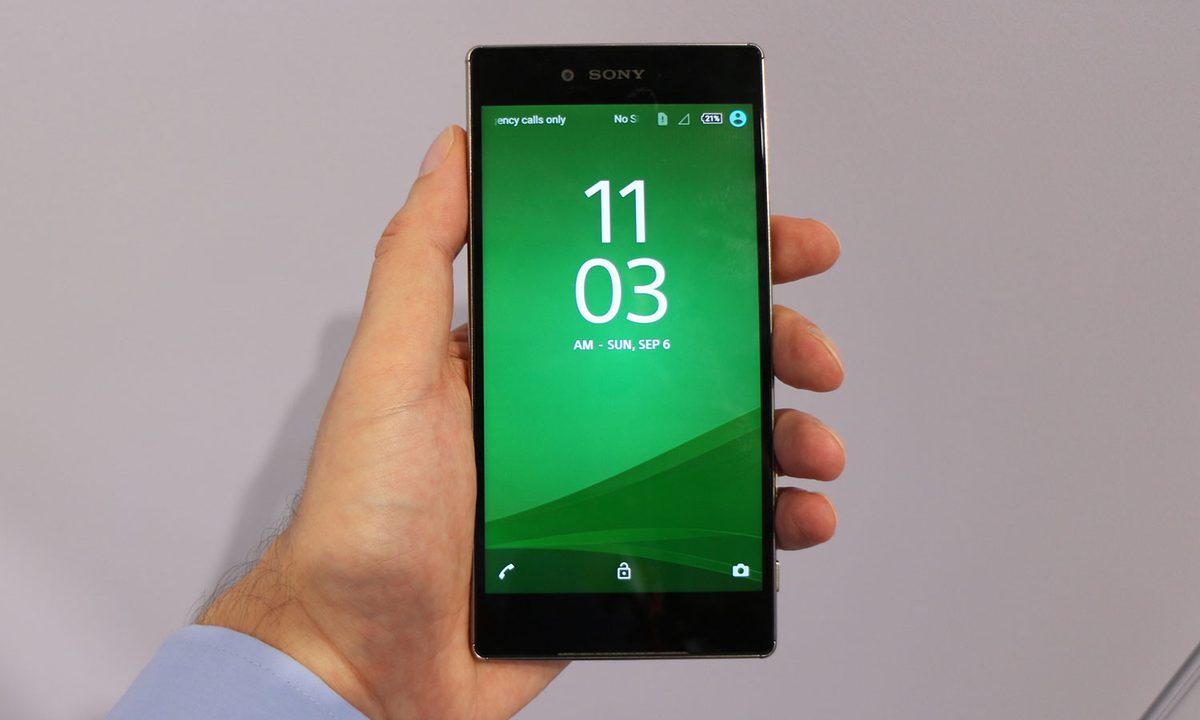
Sony has put a hefty 3,430mAh battery in the Z5 Premium. When I dipped into the power management page and took a look at battery usage, I could see that the demo model had been running all day yesterday and for a couple of hours this morning without being charged and it had 21 percent left in the tank. Perhaps a couple of days between charges, even with the 4K display, isn’t an impossible dream.
Paying a premium
The Xperia Z5 Premium is the most expensive smartphone Sony has ever offered. It’s being listed at £629 in the UK, which is $955 right now. It will no doubt be reduced in price over the next few months. But whichever way you slice it, that’s a lot of money for a phone.
Is it worth paying a premium like that for Sony’s 4K smartphone? If it sounds too expensive then you should probably avoid picking one up, because this is the kind of seductive smartphone that you’ll be reluctant to put down again.
Highs
- Gorgeous 4K display
- Fingerprint sensor
- Fast camera
- Beautiful design
Lows
- Expensive
- Possible poor battery life or lag (though we haven’t experienced it)


