  1. Home
  2. Phones
  3. Mobile
  4. News

T-Mobile beats out Verizon for title of fastest mobile network in U.S.

Add as a preferred source on Google

For the first time in PCMag’s 12 years of testing mobile networks in the United States, T-Mobile has been named the fastest mobile network. With average download speeds of 162.3Mbps, T-Mobile greatly outperformed the competition in most cities. After years of lagging behind, how did T-Mobile turn it around?

Investing in C-band

In the race to provide 5G service, the major carriers pursued different strategies. Verizon and AT&T expanded their use of mmWave, a band of spectrum that provides high speeds but doesn’t travel far. Indoor places with heavy traffic like airports are perfect for mmWave, but it’s unsuitable for outdoor broadband, especially in less-populated areas like the rural stretches between cities.

Recommended Videos

What did T-Mobile do differently? It bought Sprint. The acquisition gave T-Mobile access to a cache of midband airwaves, increasing their capacity to offer 5G service. T-Mobile was the only carrier with nationwide 5G that was considerably faster than 4G. In cities like Chicago, Las Vegas, New York, and Tucson, Arizona, T-Mobile 5G phones made use of 5G around 90% of the time.
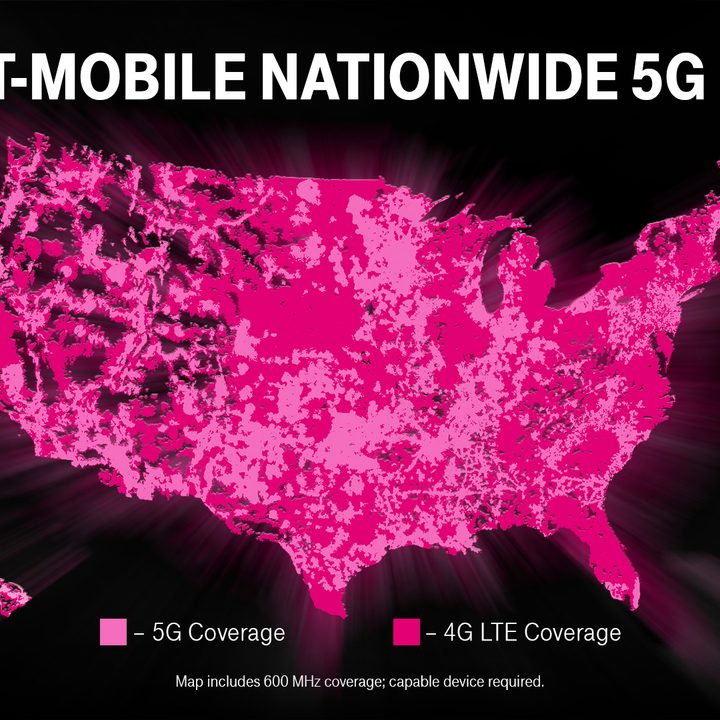
Image used with permission by copyright holder

What about the competition?

Verizon and AT&T showed a decline in overall speed, but that’s probably about to change. Those two companies spent almost $70 billion on C-band licenses at a Federal Communications Commission (FCC) auction in February 2021. They’ll begin deploying 5G on that spectrum starting in December.

T-Mobile’s 5G service was the fastest overall, but its coverage is lacking in small cities and rural regions. AT&T outperformed T-Mobile in those regions, particularly in the Northwest and the Carolinas. AT&T’s average download speed was 98.2Mbps, much slower than T-Mobile’s, but that doesn’t make a difference if T-Mobile doesn’t provide coverage in your area.

At 93.7Mbps, Verizon’s average download speed was slightly lower than AT&T’s. The company bought more C-band licenses than any other, so it’s poised to offer faster speeds in the near future as it rolls out 5G service.

If you haven’t already upgraded to a 5G phone, it’s going to be worth doing soon regardless of which carrier you use. The difference between 4G and 5G has been underwhelming, but T-Mobile’s win proves that midband 5G is going to change that.

Sandra Stafford
Sandra Stafford is a Mobile team writer. She has three years of experience writing about consumer technology. She writes…
Apple wants you to verify your identity before you get Education discount on products
Apple moving the US Education Store off the honor system also seems about making a globally consistent verification infrastructure that could eventually support more aggressive Education Store expansion.
Computer, Electronics, Laptop

Getting an Apple Education discount in the United States used to be as simple as claiming you’re a student or a teacher; it didn’t need a formal verification. That era is officially over. 

Starting May 8, 2026, Apple now requires formal identity verification for all Education Store purchases in the US, ending the informal honor system that was in place for years (via MacRumors). 

Read more
Whoop’s response to Fitbit Air and Google Health is real doctors, not just an AI chatbot.
In the race to own your health data, Google chose an AI, and Whoop chose a doctor. That single decision may define which fitness tracker serious health users reach for in 2026 and beyond.
A person wearing the Whoop 5.0.

Recently, Google launched the Fitbit Air as a direct rival to the Whoop screenless fitness band, rebranded the Fitbit app to Google Health, and released a Gemini-powered AI coach. Exactly one day later, Whoop has responded with on-demand video consultations with licensed clinicians for US users. 

The contrast is hard to ignore. While Google is betting on AI as your general health advisor, Whoop is doubling down on real, licensed doctors, and making the case that they can serve its fitness-focused users considerably better (via CNBC).

Read more
Apple leak prophesizes a Spatial iPhone with a holographic 3D screen. It’s about time!
Samsung is reportedly building the holographic display, with a tentative 2030 target.
Apple-spatial-iphone-concept-image

Holograms on your iPhone sound like science fiction. But according to a fresh leak, Apple may actually be working on it. A leaker on X known as "Schrödinger" claims Apple is developing a "Spatial iPhone" with a holographic display, reportedly being built by Samsung.

The display is codenamed "MH1" (Mobile Holographic 1), and the details being floated are quite wild. You should take all of this with appropriate skepticism, though, as none of it is officially confirmed.

Read more