
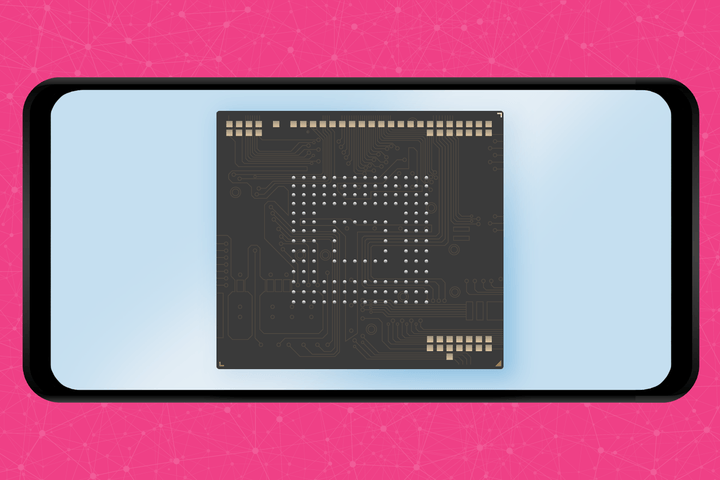
There was a little bit of buzz about UFS 3.0 with the release of the OnePlus 7 Pro, but you’d be forgiven for wondering what it is. UFS stands for Universal Flash Storage and it’s a common storage standard in smartphones and other devices like digital cameras. Think of it as like Solid State Drive (SSD) technology, but for phones instead of computers.
It’s not a specification that’s usually prominently listed or advertised, but it can have a fairly big impact on your phone’s performance. The new standard, version 3.0, is much faster than the previous standard, version 2.1, and much, much faster than other popular memory standards, like embedded MultiMediaCard (eMMC), which is what many smartphones use today.
The benefits
UFS 3.0 offers up two times the data rate capability over UFS 2.1 (faster read/write speeds), while lowering power consumption. In layman’s terms, it means storage performance is closer to SSDs, but with longer battery life. That’s according to a spokesperson from the Joint Electron Device Engineering Council, also known as JEDEC. It’s the organization that develops the standards for UFS and the microelectronics industry.
As the standard has developed, speed and multitasking capabilities have improved dramatically. UFS 3.0 allows data transfer speeds of up to 23.2 Gbps. That’s based on two lanes capable of transferring 11.6 Gbps each. These data transfer speeds determine how fast your phone can read something from storage or write something to it, so they can impact how quickly a game or app loads or how long it takes to copy a video file into storage so you can watch it.
UFS 3.0 offers up two times the data rate capability over UFS 2.1 (faster read/write speeds), while lowering power consumption.
How important the kind of snappy read and write speeds UFS 3.0 offers are to you depends on what you’re doing with your phone, but no one likes to wait longer than necessary. We want games and apps to load and save quickly, and as 4K video recording grows more popular, and 8K looms on the horizon, UFS is going prove increasingly useful.
“UFS uses full duplex differential signaling that ensures a series of advantages,” the spokesperson from JEDEC said. “Easier design of devices, simultaneous read and write operations, low power consumption and the exploitation of low power states that reduces the current drain to a minimum when the device is not being accessed.”
The UFS standard has been developed specifically for devices like smartphones and tablets where power consumption has to be as low as possible. Battery life is still a leading concern for phone owners, so this can only be a good thing.
“Devices adopting the UFS 3.0 standard will deliver the consumer an enhanced user experience while maximizing a smartphone’s battery life,” the spokesperson said. “UFS 3.0 was developed over time (in this case, two years) in an open collaborative effort among OEMs, memory vendors, and chipset makers,” the JEDEC spokesperson said. “The continuous collaboration among these companies, ensured by regular meetings, allows JEDEC standards to match the latest technologies to the future market demands.”
JEDEC relies upon 3,000 volunteers from 300 different companies, including the likes of Apple, Google, IBM, and Microsoft.
5G, and advancing further
The organization is already hard at work on the next version, trying to squeeze in even faster performance and better power optimization as it looks ahead to 5G adoption.
While any reduction in power consumption is going to be a good thing for smartphones, there isn’t much chance that you’ll need the kinds of speeds UFS 3.0 is capable of today. Smartphones like the Samsung Galaxy S10 and Google Pixel 3 have UFS 2.1 storage and it’s perfectly capable of running the most challenging games and VR apps, or playing back 4K video seamlessly.
There isn’t much chance that you’ll need the kinds of speeds UFS 3.0 is capable of today.
But eMMC, which is what you’ll find in budget phones and even midrange devices — like the Pixel 3a — is much slower, topping out around 400 MBps. It’s also only capable of one-way traffic in a single lane, rather than the two lane simultaneous read and write capability of UFS.
Though you may not need UFS 3.0 now, we hope to see every manufacturer shift to some UFS standard soon. As our phones grow ever more powerful and our networks get faster and more reliable, the opportunity to realize the full potential of UFS 3.0 will unfold.


