  1. Home
  2. Space
  3. News

Digital Trends may earn a commission when you buy through links on our site. Why trust us?

Amazon to build $120M facility at Kennedy for internet-from-space project

Add as a preferred source on Google
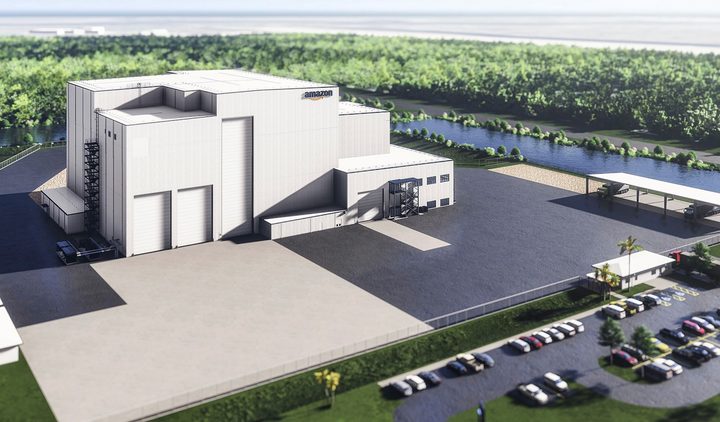
Amazon's new Project Kuiper facility in Florida.
Amazon

Amazon has a bold plan to take on SpaceX’s internet-from-space Starlink service, but there’s plenty of preparation work to be done before it can begin commercial operations.

Like Starlink, Amazon’s Project Kuiper service will be powered by several thousand small satellites in low-Earth orbit designed to provide fast, affordable broadband to unserved and underserved communities around the world.

Recommended Videos

Moving toward its goal, the company recently announced that it will invest $120 million in a satellite-processing facility at Space Florida’s Launch and Landing Facility at the Kennedy Space Center.

The 100,000-square-foot facility will prepare and integrate the satellites with a United Launch Alliance (ULA) or Blue Origin rocket in the final step prior to being blasted into space from the nearby Cape Canaveral launch site.

“We have an ambitious plan to begin Project Kuiper’s full-scale production launches and early customer pilots next year, and this new facility will play a critical role in helping us deliver on that timeline,” said Steve Metayer, vice president of Kuiper Production Operations.

Metayer added: “We look forward to adding more talent to our skilled operations and manufacturing team. These employees will play an important part in our mission to connect tens of millions of customers worldwide.”

Amazon said it’s planning to launch two prototype satellites in the coming months to test its network and subsystems.

The company will also start satellite production at a facility in Kirkland, Washington, before the end of this year. Once built, the satellites will be sent to Amazon’s new satellite-processing facility in Florida for final preparations ahead of launch. The site will have a 100-foot-tall clean room that’s able to accommodate the payload fairing of new heavy-lift rockets like Blue Origin’s New Glenn and ULA’s Vulcan Centaur.

In March, Amazon unveiled the terminals that Project Kuiper customers will use to connect to the internet service. Amazon said at the time that it wanted a design that offered something “smaller, more affordable, and more capable” than those offered by the likes of SpaceX for Starlink, though pricing details for the hardware and service have yet to be revealed.

Trevor Mogg
Contributing Editor
Not so many moons ago, Trevor moved from one tea-loving island nation that drives on the left (Britain) to another (Japan)…
Amazon’s Starlink rival just crossed a major milestone, but don’t expect perfect internet just yet
Amazon finally showed up to the space internet party
Amazon Leo satellite layout across all launch vehicles

Amazon has taken a significant step toward launching its long-awaited satellite internet service. Following its latest rocket launch, the company now has 396 Project Kuiper satellites in low-Earth orbit, enough to begin offering continuous service across select regions. The milestone keeps Amazon on track for its previously announced goal of launching commercial service by mid-2026.

https://twitter.com/Weber44Chris/status/2072575499461963938?ref_src=twsrc%5Etfw%7Ctwcamp%5Etweetembed%7Ctwterm%5E2072575499461963938%7Ctwgr%5Ed727a1b853cbf519585e7bf2655943afb2f91bb8%7Ctwcon%5Es1_&ref_url=https%3A%2F%2Fwww.theverge.com%2Fscience%2F960563%2Famazon-leo-service-tipping-point

Read more
Amazon’s Starlink rival is set to launch satellite internet later this year
After launching nearly 400 satellites, Amazon says its Leo broadband service will go live later this year.
Atlas V launches 29 Amazon Leo satellites from Cape Canaveral, Florida

Amazon's long-awaited answer to SpaceX's Starlink is finally nearing liftoff. According to an exclusive report from Reuters, the company plans to begin offering its Leo satellite internet service later this year, after its latest rocket launch pushed the constellation to 394 satellites in orbit.

The pieces are finally falling into place for Project Kuiper

Read more
NASA is investing $590 million in private contractors to build humanity’s first Moon outpost
NASA is counting on private companies to land its Moon Base dream.
Artist impression of a Moon Base concept, with solar arrays for energy generation, greenhouses for food production, and habitats shielded with regolith.

Building a permanent base on the Moon sounds like science fiction, but NASA is making it feel a lot more real. The agency just handed $590 million in contracts to three private companies for four uncrewed lunar lander missions launching in late 2028.

These missions are part of Phase 1 of NASA's broader $30 billion Moon Base program, which needs to deliver landers, rovers, and scientific cargo up there before astronauts eventually move in. These efforts are closely tied NASA's Artemis program, which sent humans on a lunar flyby in April for the first time since the Apollo era.

Read more