1. Home
  2. Space
  3. Emerging Tech
  4. News

Blue Origin is working on the BE-4, a rocket engine that can launch 100 missions

Add as a preferred source on Google
Image used with permission by copyright holder

Look out, SpaceX. You may not be the belle of the ball in the industry forever. This week, Blue Origin, the rocket company founded by Jeff Bezos, announced that its new rocket engine would have the capacity to launch “100 full missions,” as per CEO Bob Smith. And while it has yet to begin any commercial operations, that could soon change. The BE-4 engine is well on its way to becoming a rocket engine to contend with, and is slated to send the New Glenn orbital launch vehicle into space.

As Smith told CNBC’s Morgan Brennan at the 34th Space Symposium at Colorado Springs, Colorado, the BE-4 engine has proven that it “works, and works well.” The company recently tested the engine for almost two minutes at about 75 percent of full power. Thus far, Blue Origin seems pleased by how hardy the engine is. Indeed, the rocket was designed to be reused, which is part of why production has taken a longer stretch of time.

Recommended Videos

New test video of Blue’s 550K lbf thrust, ox-rich staged combustion, LNG-fueled BE-4 engine. The test is a mixture ratio sweep at 65% power level and 114 seconds in duration. Methane (or LNG) has proved to be an outstanding fuel choice. @BlueOrigin #GradatimFerociter pic.twitter.com/zWV0jWXIvx

— Jeff Bezos (@JeffBezos) March 13, 2018

As Smith noted, “… We’ve spent … over seven years developing this engine to make it reusable,” Smith said. “This engine will actually perform 100 starts — 100 full missions that we’d actually be able to go do.”

The BE-4 was preceded by the BE-3 engine, which Smith says “was designed with the same kind of principles.” This engine managed to launch the New Shepard rocket, which successfully deployed an unmanned capsule back in December. In keeping with the reusability principle, the New Shepard rocket was launched a total of five times without ever removing the BE-3 engine. The BE-4, then, is really “just a five times larger” version of the same thing.

“We’re excited about the commercial opportunities that’s going to give us: when we fly it on New Glenn and when we hopefully get selected by United Launch Alliance for its vehicle, Vulcan, as well,” Smith said. That particular alliance is a partnership between Boeing and Lockheed Martin, and the two companies are currently determining what engine will be chosen to send its next-generation rocket into space.

“We certainly are demonstrating all the technical characteristics that they need, for their vehicles,” Smith said. “But we’re going to offer it to whoever else will come out and say they need a new engine.”

Even if Blue Origin doesn’t manage to land the United Launch Alliance deal, the company is still looking to send tourists to space before the end of 2018 on its existing New Shepard rocket. But of course, safety will be key, and Smith says that launch will only take place when the company is fully ready. “We want to make sure it’s completely safe for our passengers,” Smith said.

Lulu Chang
Fascinated by the effects of technology on human interaction, Lulu believes that if her parents can use your new app…
Lightsails have hit another speed bump on the road to interstellar travel
The coolest interstellar travel idea may get betrayed by the light pushing it
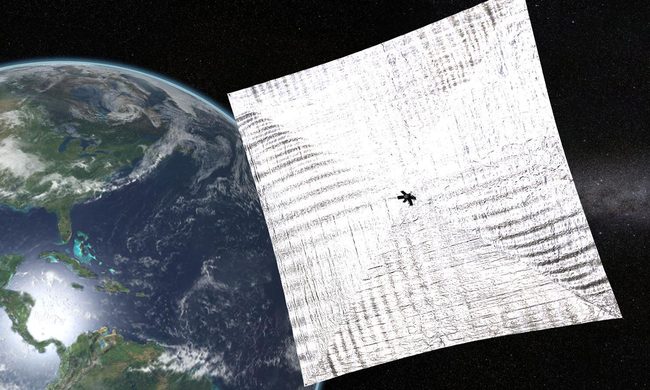
LightSail in Earth orbit

Laser-powered lightsails are one of the coolest answers to spaceflight. It might not be as sci-fi-sounding as a warp drive, but now, its practicality has also come under question. Using lightsails, a spacecraft could unfurl an ultra-thin reflective sail and let a powerful laser push it toward another star, without relying on fuel.

The tech was simple and elegant--except it's also more complicated than it sounds. A new preprint from researchers Chao Shen and Jiaze Li of the Harbin Institute of Technology suggests that relativistic lightsails may run into a hidden propulsion problem once they start moving extremely fast.

Read more
The galaxy has an exoplanet size mystery, and NASA’s EVE mission wants to solve it
This planet-hunting mission wants to catch baby worlds before they grow up
Artist’s Illustration of Exoplanets Orbiting Barnard’s Star

Mankind venturing into space ended up creating more questions than it answered, and one of the dilemmas is related to the planet sizes. Astronomers have found plenty of rocky super-Earths and plenty of puffier sub-Neptunes, but far fewer planets with a radius of about 1.8 times Earth’s.

That gap is known as the radius valley, and a proposed mission called the Early eVolution Explorer, or EVE, wants to figure out why it exists. NASA has a simple plan: look at planets while they are still young. The mission concept, detailed in a new arXiv preprint and covered by Phys.org, would focus on newly formed star clusters to see what small planets look like before billions of years of evolution.

Read more
We just got a hot signal that a Tesla and SpaceX merger could happen, after all
Tesla

For years, the idea of Tesla and SpaceX becoming a single company has lived somewhere between ambitious business theory and Elon Musk fan fiction. The two companies already share DNA, leadership influence, engineering talent, and long-term goals. But every time the topic surfaced, it felt more like an interesting thought experiment than a realistic possibility. Now, one of the most important people at SpaceX has added fresh fuel to the conversation.

Speaking in a recent CNBC interview, SpaceX President and COO Gwynne Shotwell was asked about the possibility of closer ties between Tesla and SpaceX. Her response wasn’t a flat-out denial. In fact, she suggested that bringing the two companies together could make life a little easier for Musk. That may sound like an offhand comment, but coming from Shotwell, it’s noteworthy. She’s been at SpaceX since its earliest days and remains one of the company's most influential executives.

Read more