  1. Home
  2. Space
  3. News

See first-ever image of monstrous black hole at the heart of the Milky Way

Add as a preferred source on Google

The Event Horizon Telescope (EHT) project, which famously captured the first-ever image of a black hole in 2019, has done it again — this time capturing an image of a black hole within our own galaxy.

They have released an image of the enormous supermassive black hole at the center of the Milky Way, called Sagittarius A* or Sgr A* (pronounced “sadge-ay-star”). This monster black hole has a mass 4.3 million times the mass of the sun — though that makes it considerably smaller than the black hole previously imaged at the heart of Messier 87, which was calculated to be an almost incomprehensible 6.5 billion times the mass of the sun.
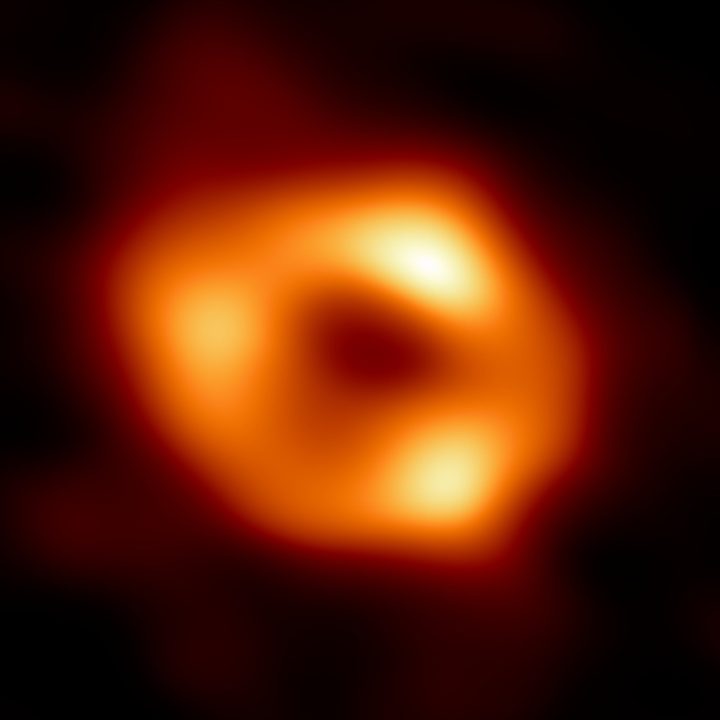
 This is the first image of Sagittarius A* (or Sgr A* for short), the supermassive black hole at the centre of our galaxy. It’s the first direct visual evidence of the presence of this black hole. It was captured by the Event Horizon Telescope (EHT), an array which linked together eight existing radio observatories across the planet to form a single “Earth-sized” virtual telescope. The telescope is named after the “event horizon”, the boundary of the black hole beyond which no light can escape.
This is the first image of Sagittarius A* (or Sgr A* for short), the supermassive black hole at the center of our galaxy. EHT Collaboration

Imaging a black hole is no easy task as these objects are so dense that they absorb anything that comes near them, even light. But that doesn’t mean that they are invisible, as the gas which comes close to them but has not yet been sucked into them glows brightly.

Recommended Videos

It is this glowing gas that the EHT astronomers searched for, which forms a ring with a distinctive dark shadow region in the center which represents the black hole itself.

“We were stunned by how well the size of the ring agreed with predictions from Einstein’s Theory of General Relativity,” said EHT Project Scientist Geoffrey Bower from the Institute of Astronomy and Astrophysics, Academia Sinica, Taipei, in a statement. “These unprecedented observations have greatly improved our understanding of what happens at the very center of our galaxy, and offer new insights on how these giant black holes interact with their surroundings.”

Imaging this black hole required international cooperation, as the EHT project brings together astronomers and telescopes from across the entire planet. To image Sagittarius A*, which is located 27,000 light-years away from Earth, the EHT project used data from eight radio observatories around the globe to create an enormous virtual telescope equivalent in size to the whole planet. It was the power of this virtual telescope collecting data across multiple nights which was able to create the image seen above.

Even though Sagittarius A* is much closer to Earth than Messier 87, imaging it was much harder due to Sagittarius A*’s smaller size, with the gas around it completing an orbit much faster. That meant the gas moved and changed as the astronomers tried to observe it, so they had to develop new software to allow for this. The project as a whole took more than five years and the work of over 300 researchers from 80 different institutions.

The result is this remarkable image, which is a stunning demonstration of the value of collaborative science in achieving that which was previously thought to be impossible. The discovery has been hailed by members of the space community around the world, including NASA Administrator Bill Nelson:

“The Event Horizon Telescope has captured yet another remarkable image, this time of the giant black hole at the center of our own home galaxy,” Nelson said in an emailed statement. “Looking more comprehensively at this black hole will help us learn more about its cosmic effects on its environment, and exemplifies the international collaboration that will carry us into the future and reveal discoveries we could never have imagined.”

The research is published in The Astrophysical Journal Letters.

Georgina Torbet
Georgina has been the space writer at Digital Trends space writer for six years, covering human space exploration, planetary…
We just got a hot signal that a Tesla and SpaceX could happen, after all
Tesla

For years, the idea of Tesla and SpaceX becoming a single company has lived somewhere between ambitious business theory and Elon Musk fan fiction. The two companies already share DNA, leadership influence, engineering talent, and long-term goals. But every time the topic surfaced, it felt more like an interesting thought experiment than a realistic possibility. Now, one of the most important people at SpaceX has added fresh fuel to the conversation.

Speaking in a recent CNBC interview, SpaceX President and COO Gwynne Shotwell was asked about the possibility of closer ties between Tesla and SpaceX. Her response wasn’t a flat-out denial. In fact, she suggested that bringing the two companies together could make life a little easier for Musk. That may sound like an offhand comment, but coming from Shotwell, it’s noteworthy. She’s been at SpaceX since its earliest days and remains one of the company's most influential executives.

Read more
Astronauts reportedly took shelter after work on Russia’s leaky ISS module triggered concerns
The ISS really picked a stressful time to start leaking again
The International Space Station.

Astronauts aboard the International Space Station reportedly took precautionary shelter measures after maintenance work on a long-troubled Russian module raised fresh safety concerns about air leaks aboard the orbiting laboratory.

According to reports, the incident involved Russia’s Zvezda service module, which has experienced recurring air leak problems for several years. During repair work and pressure tests connected to the leak investigation, astronauts were instructed to isolate themselves in safer sections of the ISS as engineers monitored the station’s integrity and pressure stability.

Read more
Blue Origin’s massive New Glenn rocket explodes in a fiery blaze during tests
The incident leaves NASA's Moon Base ambitions and Amazon's Kuiper constellation without their primary launch vehicle at the worst possible moment.
Explosion, Fire, Nuclear Explosion

Blue Origin's New Glenn rocket exploded during a static fire test at Launch Complex 36 in Cape Canaveral, Florida. The incident took place on the night of May 28, 2026. 

The explosion was captured on a live stream by NASASpaceflight.com and footage of the explosion spread rapidly across X. The Space Launch Complex 45 has confirmed in an official statement (shared by Spaceflight Now on X) that all personnel have been accounted for and there have been no injuries or fatalities.

Read more