  1. Home
  2. Space
  3. News

These three planets spin so fast that they’re about to tear themselves apart

Add as a preferred source on Google

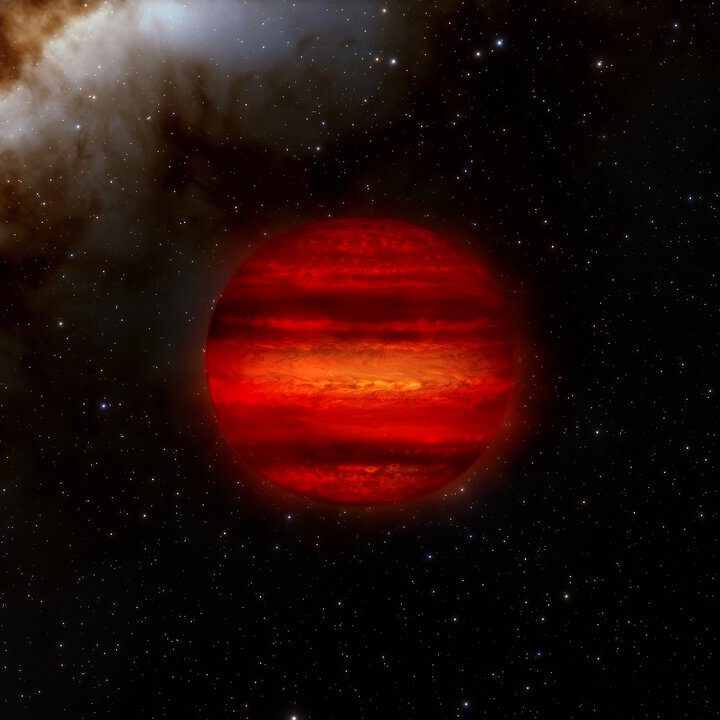
Brown dwarfs are often called “failed stars.” They form like stars but are not massive enough to fuse hydrogen into helium as stars do. More like giant planets, brown dwarfs can often have storms in their atmospheres, as depicted in this illustration. Astronomers have recently discovered three brown dwarfs that spin faster than any other ever discovered. Each one completes a single rotation in roughly an hour, about 10 times faster than normal.
Brown dwarfs are often called “failed stars.” They form like stars but are not massive enough to fuse hydrogen into helium as stars do. More like giant planets, brown dwarfs can often have storms in their atmospheres, as depicted in this illustration.  Astronomers have recently discovered three brown dwarfs that spin faster than any other ever discovered. Each one completes a single rotation in roughly an hour, about 10 times faster than normal.  NOIRLab/NSF/AURA/J. da Silva

A team of astronomers has identified three brown dwarfs which are spinning ten times as fast as a typical planet, making them the fastest ever discovered.

Recommended Videos

Brown dwarfs are bodies in between planets and stars in size. They are sometimes known as “failed stars” as they don’t become large enough to sustain fusion of hydrogen. These particular brown dwarfs are notable because they are the fastest spinning examples of their type ever discovered. With a full rotation completed every hour, they are spinning so fast that they are on the verge of being torn apart. That helps researchers see the limits on how these bodies can form.

“We seem to have come across a speed limit on the rotation of brown dwarfs,” said Megan Tannock, the Western University physics and astronomy graduate student who led the discovery, in a statement. “Despite extensive searches, by our own team and others, no brown dwarfs have been found to rotate any faster. In fact, faster spins may lead to a brown dwarf tearing itself apart.”

These brown dwarfs were originally detected by NASA’s Spitzer Space Telescope, which ceased science operations last year. Then, further observations were made using the Gemini North telescope in Hawaii and the Magellan Baade in Chile. The researchers look at how light from the dwarfs was altered by the Doppler effect and used these alternations to figure out how fast the planets were spinning. They discovered that they spin extremely fast; at 10 times the speed of rotation of Jupiter.

“These unusual brown dwarfs are spinning at dizzying speeds,” said Sandy Leggett, an astronomer at Gemini North who studies brown dwarfs. “At about 350,000 kilometers per hour, the relatively weak gravity of the brown dwarfs is barely holding them together. This exciting discovery by the Tannock team has identified rotational limits beyond which these objects may not exist.”

Georgina Torbet
Georgina has been the space writer at Digital Trends space writer for six years, covering human space exploration, planetary…
Blue Origin successfully re-uses a New Glenn rocket for the first time ever
Blue Origin achieves first New Glenn reflight despite payload setback
Blue Origin

Blue Origin has achieved a major milestone in its spaceflight ambitions by successfully reusing a booster from its heavy-lift New Glenn rocket for the first time. The historic launch, conducted on April 19, marks a significant step forward for Jeff Bezos’ space company as it seeks to compete with rivals like SpaceX in the rapidly evolving commercial launch market.

A Milestone With A Mixed Outcome

Read more
Stunning close-up footage shows NASA’s moon rocket roaring to space
On its first crewed flight, NASA's lunar rocket displays its awesome power.
NASA's SLS rocket roars skyward at the start of the Artemis II mission on April 1, 2026.

As NASA’s Artemis II astronauts journey back to Earth following their breathtaking close encounter with the moon earlier this week, the space agency has just shared some stunning footage (below) of the rocket launch that sent the crew on its way on April 1.

The close-up tracking shot shows the awesome power of the Space Launch System (SLS) rocket’s four core RS-25 engines together and its two solid rocket boosters as the 98-meter-tall vehicle roars away from the launchpad at the Kennedy Space Center in Florida.

Read more
How to watch NASA’s moon crew splash down at end of historic mission
The Orion spacecraft's final moments before splashdown will be the most perilous of the entire mission.
Earth and the moon as seen from the Orion spacecraft during the Artemis II mission in April 2026.

The Artemis II astronauts have looped around the moon, captured some extraordinary imagery (above), set a slew of records, and are now on their way back to Earth.

The 10-day mission will reach its climax on Friday, April 10, during a dramatic homecoming that will see the Orion spacecraft enter our planet’s atmosphere at a speed of nearly 25,000 miles per hour.

Read more