  1. Home
  2. Space
  3. News

NASA’s Crew-7 astronauts splash down safely off the coast of Florida

Add as a preferred source on Google

NASA’s Crew-7 mission has splashed down without incident off the coast of Florida, with the four astronauts on board returning safely from the International Space Station (ISS). The crew spent a total of 199 days orbiting the Earth and are now headed to NASA’s Johnson Space Center in Houston to rest and recover.

The crew traveled in a SpaceX Dragon capsule that undocked from the ISS on Monday, March 11, and splashed down at 5:47 a.m. ET on Tuesday, March 12. The group arrived at the station in late August 2023, and spent their time in orbit performing research and maintenance tasks.
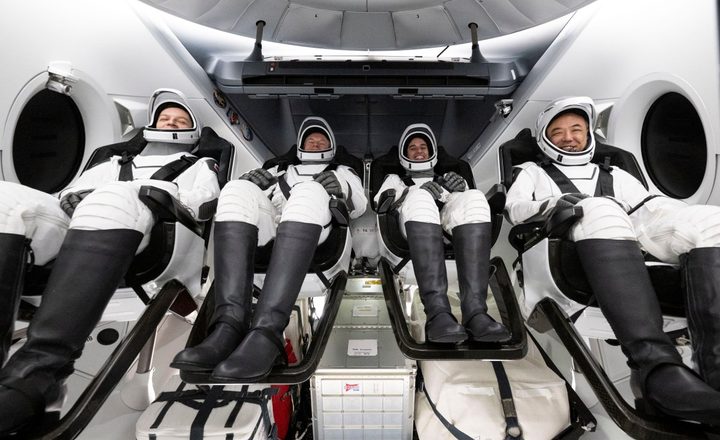
Roscosmos cosmonaut Konstantin Borisov, left, ESA (European Space Agency) astronaut Andreas Mogensen, NASA astronaut Jasmin Moghbeli, and Japan Aerospace Exploration Agency (JAXA) astronaut Satoshi Furukawa are seen inside the SpaceX Dragon Endurance spacecraft onboard the SpaceX recovery ship MEGAN shortly after having landed in the Gulf of Mexico off the coast of Pensacola, Florida, Tuesday, March 12, 2024. Moghbeli, Mogensen, Furukawa, and Borisov are returning after nearly six-months in space as part of Expedition 70 aboard the International Space Station.
Roscosmos cosmonaut Konstantin Borisov, from left, ESA (European Space Agency) astronaut Andreas Mogensen, NASA astronaut Jasmin Moghbeli, and Japan Aerospace Exploration Agency (JAXA) astronaut Satoshi Furukawa smile while inside the SpaceX Dragon Endurance spacecraft onboard the SpaceX recovery ship MEGAN shortly after having landed in the Gulf of Mexico off the coast of Pensacola, Florida, on Tuesday, March 12, 2024. NASA/Joel Kowsky

“After more than six months aboard the International Space Station, NASA’s SpaceX Crew-7 has safely returned home,” said NASA Administrator Bill Nelson in a statement. “This international crew showed that space unites us all. It’s clear that we can do more – we can learn more – when we work together. The science experiments conducted during their time in space will help prepare for NASA’s bold missions at the moon, Mars, and beyond, all while benefiting humanity here on Earth.”

Recommended Videos

The crew consists of NASA astronaut Jasmin Moghbeli, European Space Agency astronaut Andreas Mogensen, Japan Aerospace Exploration Agency (JAXA) astronaut Satoshi Furukawa, and Roscosmos cosmonaut Konstantin Borisov. According to NASA, the group traveled a total of 84,434,094 miles while on board the space station and completed over 3,000 orbits around the Earth.

Among the work performed by Crew-7 was research into how the human immune system is affected by spaceflight and how microgravity affects liver cells in a way similar to aging. They also tested a new system for purifying wastewater. Members of the group also spoke to Nelson from the space station, talking about the research they were performing and about their life in orbit.

The astronauts have been replaced at the space station by the recently arrived Crew-8, which consists of three NASA astronauts and a Russian cosmonaut. This group is working alongside one other NASA astronaut and two Russian cosmonauts who arrived in September 2023 on a Russian Soyuz vehicle, bringing the current ISS crew to seven people.

Georgina Torbet
Georgina has been the space writer at Digital Trends space writer for six years, covering human space exploration, planetary…
Astronauts reportedly took shelter after work on Russia’s leaky ISS module triggered concerns
The ISS really picked a stressful time to start leaking again
The International Space Station.

Astronauts aboard the International Space Station reportedly took precautionary shelter measures after maintenance work on a long-troubled Russian module raised fresh safety concerns about air leaks aboard the orbiting laboratory.

According to reports, the incident involved Russia’s Zvezda service module, which has experienced recurring air leak problems for several years. During repair work and pressure tests connected to the leak investigation, astronauts were instructed to isolate themselves in safer sections of the ISS as engineers monitored the station’s integrity and pressure stability.

Read more
Blue Origin’s massive New Glenn rocket explodes in a fiery blaze during tests
The incident leaves NASA's Moon Base ambitions and Amazon's Kuiper constellation without their primary launch vehicle at the worst possible moment.
Explosion, Fire, Nuclear Explosion

Blue Origin's New Glenn rocket exploded during a static fire test at Launch Complex 36 in Cape Canaveral, Florida. The incident took place on the night of May 28, 2026. 

The explosion was captured on a live stream by NASASpaceflight.com and footage of the explosion spread rapidly across X. The Space Launch Complex 45 has confirmed in an official statement (shared by Spaceflight Now on X) that all personnel have been accounted for and there have been no injuries or fatalities.

Read more
Orbot Robotics’ space robot has four arms, but its Goro physique has a purpose
This four-armed robot could make routine space-station work easier for astronauts
Robot with four arms

Helios is a new four-armed robot from Zurich-based Orbit Robotics, and at first glance, it reminded me of Goro from Mortal Kombat. But unlike the prince from Outworld, Helios is not built for combat. It is designed to help astronauts on space stations with the repetitive, time-consuming work that keeps life in space running.

Orbit Robotics says that in microgravity, legs are not much help. Instead of walking or standing, Helios needs to move through tight station interiors, hold itself steady, and handle cargo, tools, or equipment. Its four-arm design turns extra limbs into both mobility aids and working hands.

Read more