  1. Home
  2. Space
  3. News

First indications of a rare, rainbow ‘glory effect’ on hellish exoplanet

Add as a preferred source on Google

Just from looking at our own solar system, we can see that planets come in a wide variety of colors — from the dusty red of Mars to the bright blues of Uranus and Neptune. Planets like Jupiter have beautiful bands of color caused by variations in the atmosphere, while it’s hard to even see the surface of Venus because its atmosphere is so thick. But there are other variations in color which planets can display, like a stunning rainbow-hued set of circular rings called a glory.

Glories are observed on Earth, and have been seen just once on another planet, Venus. But now, researchers believe they may have identified a glory on a planet outside our solar system for the first time. The extreme exoplanet WASP-76b could be host to the first known extrasolar glory, observed by the European Space Agency (ESA)’s Characterising ExOplanet Satellite (Cheops).
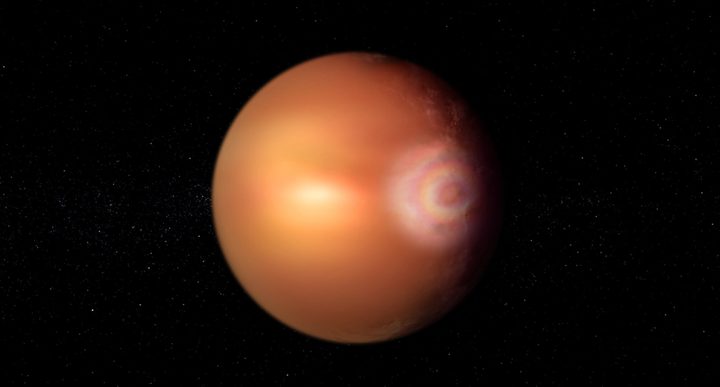
For the first time, potential signs of the rainbow-like ‘glory effect’ have been detected on a planet outside our Solar System. Glory are colourful concentric rings of light that occur only under peculiar conditions. Data from ESA’s sensitive Characterising ExOplanet Satellite, Cheops, along with several other ESA and NASA missions, suggest this delicate phenomenon is beaming straight at Earth from the hellish atmosphere of ultra-hot gas giant WASP-76b, 637 light-years away.
For the first time, potential signs of the rainbow-like ‘glory effect’ have been detected on a planet outside our Solar System. Glory are colorful concentric rings of light that occur only under peculiar conditions. Data from ESA’s sensitive Characterising ExOplanet Satellite, Cheops, along with several other ESA and NASA missions, suggest this delicate phenomenon is beaming straight at Earth from the hellish atmosphere of ultra-hot gas giant WASP-76b, 637 light-years away. ESA. Work performed by ATG under contract for ESA

“There’s a reason no glory has been seen before outside our Solar System – it requires very peculiar conditions,” said lead author of the research, Olivier Demangeon of the Instituto de Astrofísica e Ciências do Espaço in a statement. “First, you need atmospheric particles that are close-to-perfectly spherical, completely uniform and stable enough to be observed over a long time. The planet’s nearby star needs to shine directly at it, with the observer – here Cheops – at just the right orientation.”

Recommended Videos

The glory effect occurs when light bounces off clouds in a planet’s atmosphere, though it’s not clear what substance the clouds could be composed of for this to happen. The clouds would need to have spherical droplets and to be stable over time.

WASP-76b is already famous as an extreme exoplanet, with an atmosphere heated to a scorching 2,000 degrees Celsius, which is so hot it rains iron there. The planet is tidally locked, meaning one side of it always faces its star and one side always faces out into space, causing a massive temperature difference between these two sides. It is also puffed up to a huge size given its mass.

Even though the planet is well studied, it’s still very hard to see details of what is happening there, as it is located over 600 light-years away. Researchers warn that it’s hard to be certain that what is being seen is truly a glory effect.

“What’s important to keep in mind is the incredible scale of what we’re witnessing,” said Matthew Standing, an ESA Research Fellow studying exoplanets. “WASP-76b is several hundred light-years away – an intensely hot gas giant planet where it likely rains molten iron. Despite the chaos, it looks like we’ve detected the potential signs of a glory. It’s an incredibly faint signal.”

The indications have exoplanet scientists intrigued, however, as they could help to shed light on this planet’s dramatic atmosphere. “Further proof is needed to say conclusively that this intriguing ‘extra light’ is a rare glory,” said Theresa Lüftinger, Project Scientist for ESA’s upcoming Ariel mission. “Follow-up observations from the NIRSPEC instrument onboard the NASA/ESA/CSA James Webb Space Telescope could do just the job. Or ESA’s upcoming Ariel mission could prove its presence. We could even find more gloriously revealing colors shining from other exoplanets.”

Georgina Torbet
Georgina has been the space writer at Digital Trends space writer for six years, covering human space exploration, planetary…
We just got a hot signal that a Tesla and SpaceX could happen, after all
Tesla

For years, the idea of Tesla and SpaceX becoming a single company has lived somewhere between ambitious business theory and Elon Musk fan fiction. The two companies already share DNA, leadership influence, engineering talent, and long-term goals. But every time the topic surfaced, it felt more like an interesting thought experiment than a realistic possibility. Now, one of the most important people at SpaceX has added fresh fuel to the conversation.

Speaking in a recent CNBC interview, SpaceX President and COO Gwynne Shotwell was asked about the possibility of closer ties between Tesla and SpaceX. Her response wasn’t a flat-out denial. In fact, she suggested that bringing the two companies together could make life a little easier for Musk. That may sound like an offhand comment, but coming from Shotwell, it’s noteworthy. She’s been at SpaceX since its earliest days and remains one of the company's most influential executives.

Read more
Astronauts reportedly took shelter after work on Russia’s leaky ISS module triggered concerns
The ISS really picked a stressful time to start leaking again
The International Space Station.

Astronauts aboard the International Space Station reportedly took precautionary shelter measures after maintenance work on a long-troubled Russian module raised fresh safety concerns about air leaks aboard the orbiting laboratory.

According to reports, the incident involved Russia’s Zvezda service module, which has experienced recurring air leak problems for several years. During repair work and pressure tests connected to the leak investigation, astronauts were instructed to isolate themselves in safer sections of the ISS as engineers monitored the station’s integrity and pressure stability.

Read more
Blue Origin’s massive New Glenn rocket explodes in a fiery blaze during tests
The incident leaves NASA's Moon Base ambitions and Amazon's Kuiper constellation without their primary launch vehicle at the worst possible moment.
Explosion, Fire, Nuclear Explosion

Blue Origin's New Glenn rocket exploded during a static fire test at Launch Complex 36 in Cape Canaveral, Florida. The incident took place on the night of May 28, 2026. 

The explosion was captured on a live stream by NASASpaceflight.com and footage of the explosion spread rapidly across X. The Space Launch Complex 45 has confirmed in an official statement (shared by Spaceflight Now on X) that all personnel have been accounted for and there have been no injuries or fatalities.

Read more