  1. Home
  2. Space
  3. News

Stars sparkle and shine in Hubble image of a distant globular cluster

Add as a preferred source on Google

Another week, another beautiful image of space captured by the Hubble Space Telescope. This week’s image shows the globular cluster NGC 6717, located over 20,000 light-years away in the constellation of Sagittarius.

A global cluster is a dense group of stars, often thousands or even millions of stars strong, which is bound together by gravity. The clusters form roughly spherical shapes and mostly consist of less massive stars, each one typically less than the mass of our sun. As you can see in the image below, the stars are packed closer together nearer the center of the cluster and are more spaced out around its edges.
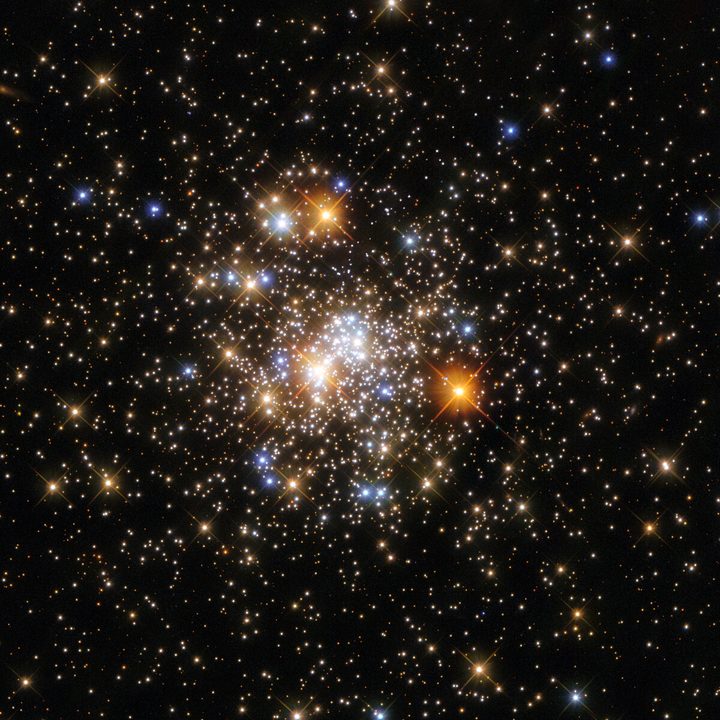
A star-studded image from the NASA/ESA Hubble Space Telescope depicts NGC 6717, which lies more than 20,000 light-years from Earth in the constellation Sagittarius.
This star-studded image from the NASA/ESA Hubble Space Telescope depicts NGC 6717, which lies more than 20,000 light-years from Earth in the constellation Sagittarius. NGC 6717 is a globular cluster, a roughly spherical collection of stars tightly bound together by gravity. Globular clusters contain more stars in their centers than their outer fringes, as this image aptly demonstrates; the sparsely populated edges of NGC 6717 are in stark contrast to the sparkling collection of stars at its center. ESA/Hubble and NASA, A. Sarajedini

As well as the globular cluster, you can see a few very bright stars shining out near the center of the image. These stars aren’t actually a part of the cluster, but rather are located between it and Earth.

Recommended Videos

Studying globular clusters is important to astronomers because they are some of the oldest objects in the universe, so looking at them can reveal how early stars and galaxies formed. However, imaging this globular cluster was a challenge because of where it is located. The constellation of Sagittarius is located in the same portion of the sky as the center of the Milky Way, where many stars in our galaxy shine brightly. The center of our galaxy is also full of dust and gas which absorb light and obscure the view behind it.

To capture this image through the dust and gas, Hubble used two of its instruments in combination: The Wide Field Camera 3 and the Advanced Camera for Surveys.

Georgina Torbet
Georgina has been the space writer at Digital Trends space writer for six years, covering human space exploration, planetary…
Blue Origin successfully re-uses a New Glenn rocket for the first time ever
Blue Origin achieves first New Glenn reflight despite payload setback
Blue Origin

Blue Origin has achieved a major milestone in its spaceflight ambitions by successfully reusing a booster from its heavy-lift New Glenn rocket for the first time. The historic launch, conducted on April 19, marks a significant step forward for Jeff Bezos’ space company as it seeks to compete with rivals like SpaceX in the rapidly evolving commercial launch market.

A Milestone With A Mixed Outcome

Read more
Stunning close-up footage shows NASA’s moon rocket roaring to space
On its first crewed flight, NASA's lunar rocket displays its awesome power.
NASA's SLS rocket roars skyward at the start of the Artemis II mission on April 1, 2026.

As NASA’s Artemis II astronauts journey back to Earth following their breathtaking close encounter with the moon earlier this week, the space agency has just shared some stunning footage (below) of the rocket launch that sent the crew on its way on April 1.

The close-up tracking shot shows the awesome power of the Space Launch System (SLS) rocket’s four core RS-25 engines together and its two solid rocket boosters as the 98-meter-tall vehicle roars away from the launchpad at the Kennedy Space Center in Florida.

Read more
How to watch NASA’s moon crew splash down at end of historic mission
The Orion spacecraft's final moments before splashdown will be the most perilous of the entire mission.
Earth and the moon as seen from the Orion spacecraft during the Artemis II mission in April 2026.

The Artemis II astronauts have looped around the moon, captured some extraordinary imagery (above), set a slew of records, and are now on their way back to Earth.

The 10-day mission will reach its climax on Friday, April 10, during a dramatic homecoming that will see the Orion spacecraft enter our planet’s atmosphere at a speed of nearly 25,000 miles per hour.

Read more