  1. Home
  2. Space
  3. News

Hubble images a pair of galaxies caught in the process of merging

Add as a preferred source on Google

After last week’s image of the week from the Hubble Space Telescope showed a cluster of galaxies that appeared to be very close to each other but actually weren’t, this week’s image shows two images that are practically on top of each other. The two galaxies shown in the image below, NGC 6040 and LEDA 59642, are so close that they are interacting and have a shared name as a pair, Arp 122.
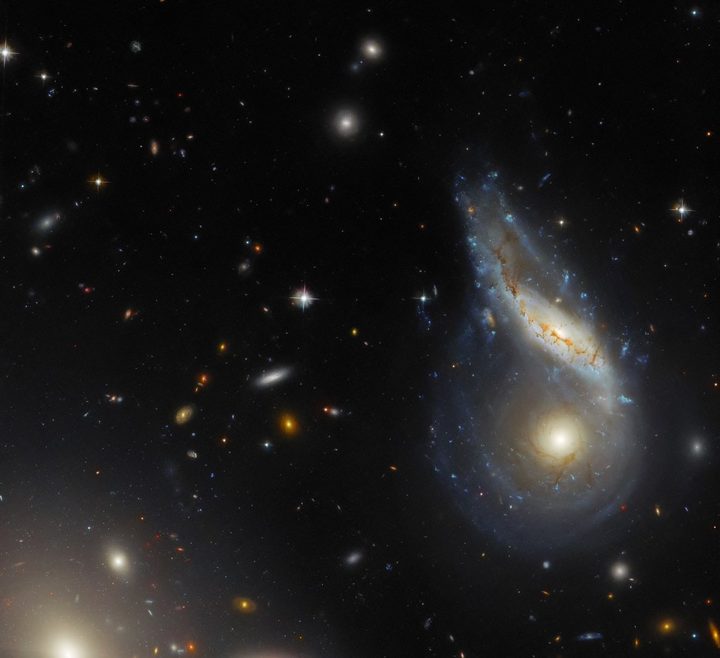
This NASA/ESA Hubble Space Telescope image features Arp 122, a peculiar galaxy that in fact comprises two galaxies – NGC 6040, the tilted, warped spiral galaxy and LEDA 59642, the round, face-on spiral – that are in the midst of a collision.
This NASA/ESA Hubble Space Telescope image features Arp 122, a peculiar galaxy that in fact comprises two galaxies – NGC 6040, the tilted, warped spiral galaxy and LEDA 59642, the round, face-on spiral – that are in the midst of a collision. ESA/Hubble & NASA, J. Dalcanton, Dark Energy Survey/DOE/FNAL/DECam/CTIO/NOIRLab/NSF/AURA Acknowledgement: L. Shatz

NGC 6040 is the galaxy on the top, which is stretched into a long, thin shape by the tremendous force of gravity from the rounder, face-on galaxy in the center-right, LEDA 59642. When galaxies come close together, the forces of gravity from both massive objects can interact and twist or distort one or both of the galaxies into unusual shapes, as has happened here.

Recommended Videos

The colliding of two galaxies is an epic event, and it can result in the destruction of one galaxy. At other times, the two colliding galaxies can merge into one. After hundreds of millions of years, the two can become one even larger galaxy, as may happen to Arp 122.

“Galaxies are composed of stars and their solar systems, dust, gas, and invisible dark matter. In galactic collisions, therefore, these constituent components may experience enormous changes in the gravitational forces acting on them,” Hubble scientists explain. “In time, this completely changes the structure of the two (or more) colliding galaxies, and sometimes ultimately results in a single, merged galaxy. That may well be what results from the collision pictured in this image.”

Our own galaxy, the Milky Way, is scheduled to collide with our galactic neighbor, the Andromeda galaxy, in around four billion years. That collision would likely create a giant elliptical galaxy as a merger between the two.

However, another theory states that before that happens, the Milky Way could collide with a smaller satellite galaxy called the Large Magellanic Cloud in around two billion years’ time. This theory states that the forces of the two colliding galaxies could spur the supermassive black hole at the center of our galaxy into overdrive, causing it to swell in size and send out powerful jets of radiation.

Georgina Torbet
Georgina has been the space writer at Digital Trends space writer for six years, covering human space exploration, planetary…
We just got a hot signal that a Tesla and SpaceX could happen, after all
Tesla

For years, the idea of Tesla and SpaceX becoming a single company has lived somewhere between ambitious business theory and Elon Musk fan fiction. The two companies already share DNA, leadership influence, engineering talent, and long-term goals. But every time the topic surfaced, it felt more like an interesting thought experiment than a realistic possibility. Now, one of the most important people at SpaceX has added fresh fuel to the conversation.

Speaking in a recent CNBC interview, SpaceX President and COO Gwynne Shotwell was asked about the possibility of closer ties between Tesla and SpaceX. Her response wasn’t a flat-out denial. In fact, she suggested that bringing the two companies together could make life a little easier for Musk. That may sound like an offhand comment, but coming from Shotwell, it’s noteworthy. She’s been at SpaceX since its earliest days and remains one of the company's most influential executives.

Read more
Astronauts reportedly took shelter after work on Russia’s leaky ISS module triggered concerns
The ISS really picked a stressful time to start leaking again
The International Space Station.

Astronauts aboard the International Space Station reportedly took precautionary shelter measures after maintenance work on a long-troubled Russian module raised fresh safety concerns about air leaks aboard the orbiting laboratory.

According to reports, the incident involved Russia’s Zvezda service module, which has experienced recurring air leak problems for several years. During repair work and pressure tests connected to the leak investigation, astronauts were instructed to isolate themselves in safer sections of the ISS as engineers monitored the station’s integrity and pressure stability.

Read more
Blue Origin’s massive New Glenn rocket explodes in a fiery blaze during tests
The incident leaves NASA's Moon Base ambitions and Amazon's Kuiper constellation without their primary launch vehicle at the worst possible moment.
Explosion, Fire, Nuclear Explosion

Blue Origin's New Glenn rocket exploded during a static fire test at Launch Complex 36 in Cape Canaveral, Florida. The incident took place on the night of May 28, 2026. 

The explosion was captured on a live stream by NASASpaceflight.com and footage of the explosion spread rapidly across X. The Space Launch Complex 45 has confirmed in an official statement (shared by Spaceflight Now on X) that all personnel have been accounted for and there have been no injuries or fatalities.

Read more