  1. Home
  2. Space
  3. News

Vegetables that are out of this world: Radishes grown in space for first time

Add as a preferred source on Google

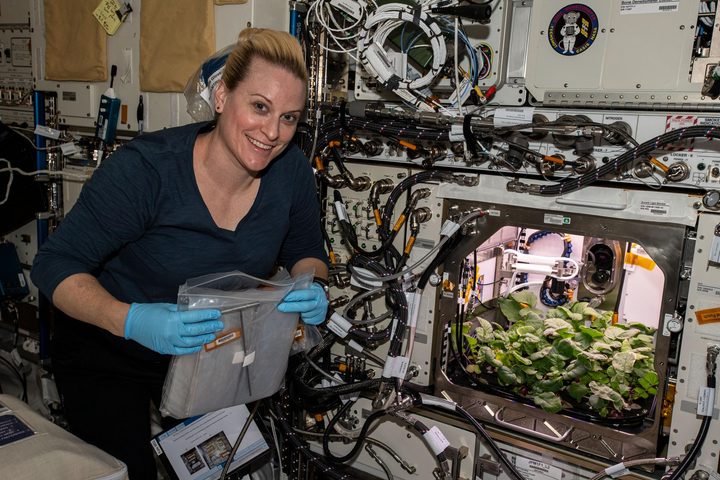
On Nov. 27, 2020, NASA astronaut and Expedition 64 Flight Engineer Kate Rubins checks out radish plants growing for the Plant Habitat-02 experiment that seeks to optimize plant growth in the unique environment of space and evaluate nutrition and taste of the plants.
On Nov. 27, 2020, NASA astronaut and Expedition 64 Flight Engineer Kate Rubins checks out radish plants growing for the Plant Habitat-02 experiment that seeks to optimize plant growth in the unique environment of space and evaluate nutrition and taste of the plants. Image used with permission by copyright holder

In a step forward toward true space foods, radishes have been grown and harvested on the International Space Station (ISS) for the first time. NASA astronaut Kate Rubins harvested the cosmic crop of 20 radishes from the station’s Advanced Plant Habitat (APH), before wrapping them up in little foil blankets to return them to Earth for study.

Recommended Videos

Researchers have been working on growing crops in space for some time, as fresh greens and vegetables provide valuable nutrition in astronauts’ diets as well as providing some much-needed variety and freshness in their food, which contributes to their mental well-being. Previous experiments in growing crops in space include lettuce and chili peppers, though growing anything is challenging as plants can behave strangely in microgravity. That’s why the harvesting of these radishes is such a big accomplishment.

“Radishes are a different kind of crop compared to leafy greens that astronauts previously grew on the space station, or dwarf wheat which was the first crop grown in the APH,” explained Nicole Dufour, NASA APH program manager at Kennedy Space Center, in a statement. “Growing a range of crops helps us determine which plants thrive in microgravity and offer the best variety and nutritional balance for astronauts on long-duration missions.”

Radishes are also a good tool for study as they grow quickly, coming to maturity in only 27 days. This crop was grown in a carefully controlled environment, using a careful blend of different minerals and LED lights to give them food and light to thrive. Their growth was recorded by a control camera and 180 different sensors so their progress could be checked at every stage of life, and so factors like temperature, humidity, and carbon dioxide levels could be regulated.

Radishes Growing in Space: 27 Days in 10 Seconds

The harvesting of this little radish crop doesn’t spell the end of the radish-related experiments on the ISS though. A second crop will be grown from a new set of radish seeds.

“The APH has two science carriers, so shortly after the first harvest, the second carrier will be used to repeat the experiment by planting another set of radish seeds,” Dufour said. “Replicating the plant experiment increases the sample size and improves scientific accuracy.”

Georgina Torbet
Georgina has been the space writer at Digital Trends space writer for six years, covering human space exploration, planetary…
We just got a hot signal that a Tesla and SpaceX could happen, after all
Tesla

For years, the idea of Tesla and SpaceX becoming a single company has lived somewhere between ambitious business theory and Elon Musk fan fiction. The two companies already share DNA, leadership influence, engineering talent, and long-term goals. But every time the topic surfaced, it felt more like an interesting thought experiment than a realistic possibility. Now, one of the most important people at SpaceX has added fresh fuel to the conversation.

Speaking in a recent CNBC interview, SpaceX President and COO Gwynne Shotwell was asked about the possibility of closer ties between Tesla and SpaceX. Her response wasn’t a flat-out denial. In fact, she suggested that bringing the two companies together could make life a little easier for Musk. That may sound like an offhand comment, but coming from Shotwell, it’s noteworthy. She’s been at SpaceX since its earliest days and remains one of the company's most influential executives.

Read more
Astronauts reportedly took shelter after work on Russia’s leaky ISS module triggered concerns
The ISS really picked a stressful time to start leaking again
The International Space Station.

Astronauts aboard the International Space Station reportedly took precautionary shelter measures after maintenance work on a long-troubled Russian module raised fresh safety concerns about air leaks aboard the orbiting laboratory.

According to reports, the incident involved Russia’s Zvezda service module, which has experienced recurring air leak problems for several years. During repair work and pressure tests connected to the leak investigation, astronauts were instructed to isolate themselves in safer sections of the ISS as engineers monitored the station’s integrity and pressure stability.

Read more
Blue Origin’s massive New Glenn rocket explodes in a fiery blaze during tests
The incident leaves NASA's Moon Base ambitions and Amazon's Kuiper constellation without their primary launch vehicle at the worst possible moment.
Explosion, Fire, Nuclear Explosion

Blue Origin's New Glenn rocket exploded during a static fire test at Launch Complex 36 in Cape Canaveral, Florida. The incident took place on the night of May 28, 2026. 

The explosion was captured on a live stream by NASASpaceflight.com and footage of the explosion spread rapidly across X. The Space Launch Complex 45 has confirmed in an official statement (shared by Spaceflight Now on X) that all personnel have been accounted for and there have been no injuries or fatalities.

Read more