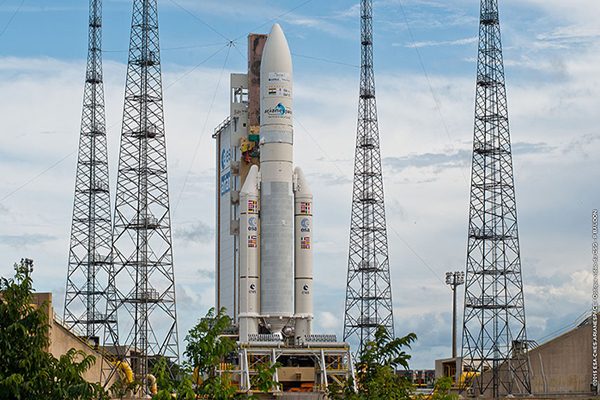
The Hubble Space Telescope’s days of ruling outer space appear to be numbered as the European Space Agency just announced its mammoth James Webb Telescope will officially launch into the wild blue yonder in roughly three years. Through a collaborative effort with NASA, the Canadian Space Agency, and the Space Telescope Science Institute, the ESA’s 21-foot telescope will ride aboard an Ariane 5 rocket scheduled to launch from French Guiana in October of 2018. Its purpose? To look further back in time than any telescope before it and to gather light from galaxies created during our universe’s genesis. No big deal.
Formerly dubbed the Next Generation Space Telescope, development of the JWST dates all the way back to around 1996 though initial research for a Hubble replacement began in the late 1980s. After getting a name change in 2002, the JWST was originally scheduled to make its maiden voyage into space in 2007, but a rash of rising costs and delays significantly stunted the project. In fact, Congress almost nixed the JWST altogether in 2011 while attempting to reduce NASA’s yearly budget. Luckily for those involved, the House and Senate instead decided to cap funding at $8 billion.
“The years of hard work and excellent collaboration between NASA, ESA and Arianespace teams that have made this possible are testimony to their dedication to the world’s next great space telescope,” said NASA’s JWST Program Director Eric Smith in a press release. “The agreement is a significant milestone for the JWST Program.”

It had long been the goal of the JWST team to launch the telescope in 2018 though without an actual launch contract signed, nothing was officially set in stone. Now, with the contract in tow, all that stands between the JWST and reaching its intended orbit roughly 1 million miles from Earth is a rocket failure or delayed launch — an incredibly positive turn of events considering its status just four years ago.
“With this key contract now in place with our long-standing partners, we are closer than ever to see scientific goals of this next-generation space observatory realized,” said Jan Woerner, the European Space Agency’s Director General.
Unlike the Hubble Space Telescope, which resides in low Earth orbit, the JWST will actually spend its life orbiting the Sun (as noted earlier, roughly 1 million miles from Earth). Dubbed the second Lagrange point (or L2), this special orbit path for the telescope allows it to stay in line with Earth as it moves around the Sun. This movement allows JWST’s massive sun shield the opportunity to protect it from the heat and light of the Sun, Earth, and Moon. Its shield is important since the JWST will primarily observe infrared signals from objects very far away, readings that are easily disrupted by other bright, hot sources (i.e. the Sun, Earth, and Moon).
As touched on above, these scientific goals are quite lofty. According to NASA, the JWST “will examine every phase of cosmic history” by serving four primary themes. First, it will essentially serve as a powerful time machine, possessing the capability to look back some 13.5 billion years using infrared vision. Scientists anticipate being able to see the first stars and galaxies formed in our early universe. This same infrared vision also allows scientists to compare early galaxies to today’s “grand spirals and ellipticals,” shedding light on the evolution of a galaxy over billions of years.
Furthermore, the JWST features the capacity to look right through massive clouds of dust (previously invisible to telescopes like Hubble), allowing scientists to see exactly where the birth of stars and planetary systems occur. Again utilizing its revolutionary infrared camera, it’ll be able to peer into parts of stars, nebulas, and otherwise that have never been seen before. Last, but not least, the telescope will also help scientists learn more about the atmospheres of extrasolar planets while searching for the building blocks of life.
“The James Webb Space Telescope will be a giant leap forward in our quest to understand the Universe and our origins,” NASA’s JWST landing page states. “JWST will examine every phase of cosmic history: from the first luminous glows after the Big Bang to the formation of the galaxies, stars, and planets to the evolution of our own solar system.”
Currently, the JWST is undergoing a series of final cryo-verification tests at NASA’s Goddard Space Flight Center. Though no exact date was provided in the press release, the ESA’s JWST Project Manager Peter Jensen says the project is “maintaining a steady pace towards” its expected launch in October of 2018.