1. Home
  2. Space
  3. Emerging Tech
  4. News

Mars is as near to Earth as it’s been in 15 years, so Hubble took some photos

Add as a preferred source on Google

For the past 28 years, the Hubble Space Telescope has captured some of the most iconic images of outer space. Now, as Mars and Saturn swing by Earth this summer, the legendary telescope has snapped a handful of beautiful images to add to the collection.

Recommended Videos

Although millions of miles away from Earth, the orbits of Mars and Saturn brought the planets relatively close this summer. Known as “opposition” — because we see the planets rise in the east as the sun sets in the west — this event gave astronomers a unique chance to capture detailed images of the planets, thanks to their proximity and full illumination from the sun.

Saturn orbited some 870 million miles away, while in opposition to Earth on June 27. A few weeks earlier, Hubble captured images of the planet’s six moons — Dione, Enceladus, Tethys, Janus, Epimetheus, and Mimas — appearing like specs in the sky. At the ringed-planet’s north pole, Hubble identified a hexagonal pattern first spotted 37 years ago during a flyby from Voyager 1.

NASA, ESA, and STScI

Just under two weeks before Mars reaches it’s closest approach to Earth in 15 years (around 36 million miles on July 27), Hubble captured a dense and massive dust storm enshrouding the red planet. The persistent storm has lasted for more than four months, which has caused trouble for the solar-powered Mars Opportunity rover. During the storm, NASA has been unable to connect with the rover. The image above shows just how dense the storm is.

“Since the NASA/European Space Agancy Hubble Space Telescope was launched, its goal has always been to study not only distant astronomical objects, but also the planets within our solar system,” the space agencies wrote in a statement. “Hubble’s high-resolution images of our planetary neighbors can only be surpassed by pictures taken from spacecraft that actually visit these bodies. However, Hubble has one advantage over space probes: It can look at these objects periodically and observe them over much longer periods than any passing probe could.”

Hubble has proven to be a workhorse during it’s nearly three decades in operation, while it’s successor, the James Webb Space Telescope, is fraught with delays and carries a hefty $9.66 billion price tag. NASA recently announced the telescope won’t be ready until at least March 30, 2021.

Dyllan Furness
Former Contributor
Dyllan Furness is a freelance writer from Florida. He covers strange science and emerging tech for Digital Trends, focusing…
Lightsails have hit another speed bump on the road to interstellar travel
The coolest interstellar travel idea may get betrayed by the light pushing it
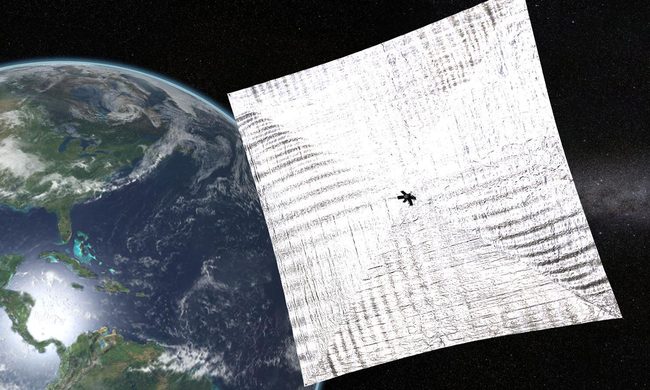
LightSail in Earth orbit

Laser-powered lightsails are one of the coolest answers to spaceflight. It might not be as sci-fi-sounding as a warp drive, but now, its practicality has also come under question. Using lightsails, a spacecraft could unfurl an ultra-thin reflective sail and let a powerful laser push it toward another star, without relying on fuel.

The tech was simple and elegant--except it's also more complicated than it sounds. A new preprint from researchers Chao Shen and Jiaze Li of the Harbin Institute of Technology suggests that relativistic lightsails may run into a hidden propulsion problem once they start moving extremely fast.

Read more
The galaxy has an exoplanet size mystery, and NASA’s EVE mission wants to solve it
This planet-hunting mission wants to catch baby worlds before they grow up
Artist’s Illustration of Exoplanets Orbiting Barnard’s Star

Mankind venturing into space ended up creating more questions than it answered, and one of the dilemmas is related to the planet sizes. Astronomers have found plenty of rocky super-Earths and plenty of puffier sub-Neptunes, but far fewer planets with a radius of about 1.8 times Earth’s.

That gap is known as the radius valley, and a proposed mission called the Early eVolution Explorer, or EVE, wants to figure out why it exists. NASA has a simple plan: look at planets while they are still young. The mission concept, detailed in a new arXiv preprint and covered by Phys.org, would focus on newly formed star clusters to see what small planets look like before billions of years of evolution.

Read more
We just got a hot signal that a Tesla and SpaceX merger could happen, after all
Tesla

For years, the idea of Tesla and SpaceX becoming a single company has lived somewhere between ambitious business theory and Elon Musk fan fiction. The two companies already share DNA, leadership influence, engineering talent, and long-term goals. But every time the topic surfaced, it felt more like an interesting thought experiment than a realistic possibility. Now, one of the most important people at SpaceX has added fresh fuel to the conversation.

Speaking in a recent CNBC interview, SpaceX President and COO Gwynne Shotwell was asked about the possibility of closer ties between Tesla and SpaceX. Her response wasn’t a flat-out denial. In fact, she suggested that bringing the two companies together could make life a little easier for Musk. That may sound like an offhand comment, but coming from Shotwell, it’s noteworthy. She’s been at SpaceX since its earliest days and remains one of the company's most influential executives.

Read more