  1. Home
  2. Space
  3. News

Odysseus lander mission expected to end early due to power issue

Add as a preferred source on Google

NASA and Intuitive Machines may have made history recently with the first U.S. lunar landing in more than 50 years, but it looks like the mission will come to an end much sooner than hoped. As the Odysseus lander came in for its descent last week, it caught on the surface and tipped over onto its side. Now, Intuitive Machines has announced that it expects the lander to stop communications on the morning of Tuesday, February 27 — cutting the mission shorter than the week or more on the surface that was originally hoped for.

Intuitive Machines also released a low-resolution image taken after the spacecraft pitched over, showing its view of the moon’s surface:
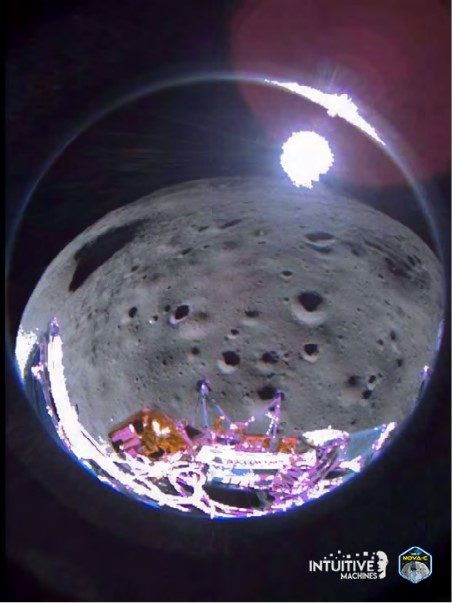
Odysseus captured this image approximately35 seconds after pitching over during its approach to the landing site. The camera is on the starboard aft-side of the lander in this phase
Odysseus captured this image approximately 35 seconds after pitching over during its approach to the landing site. The camera is on the starboard aft side of the lander in this phase. Image used with permission by copyright holder

“After understanding the end-to-end communication requirements, Odysseus sent images from the lunar surface of its vertical descent to its Malapert A landing site, representing the furthest south any vehicle has been able to land on the moon and establish communication with ground controllers,” the company wrote in an update.

Recommended Videos

The problem seems to be that the solar panels of the lander will soon stop collecting sunlight, so the lander will run out of power. “Based on Earth and moon positioning, we believe flight controllers will continue to communicate with Odysseus until Tuesday morning,” the company wrote.

In addition to this update, NASA also shared an image of the lander on the moon’s surface captured by the Lunar Reconnaissance Orbiter (LRO) spacecraft. It shows the dot of the lander as seen from orbit at an altitude of around 56 miles above the surface:
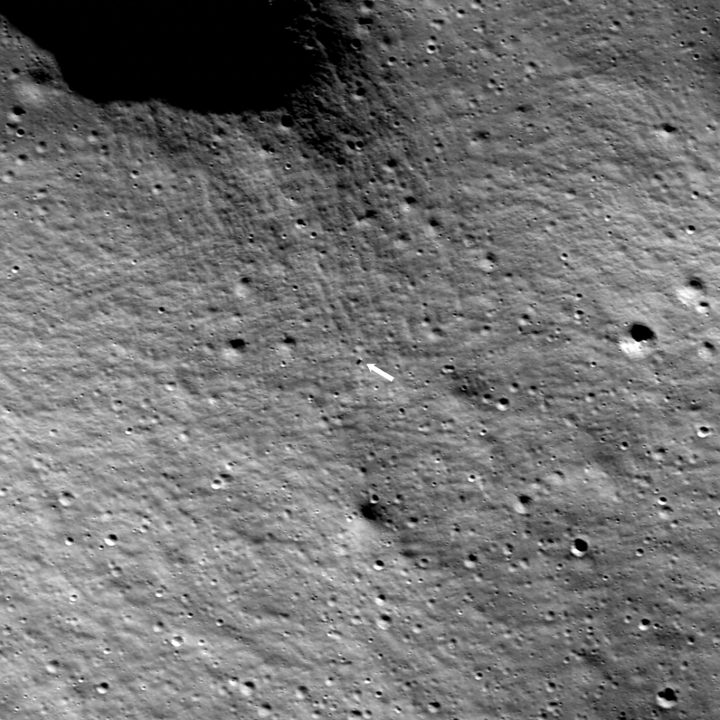
NASA’s Lunar Reconnaissance Orbiter captured this image of the Intuitive Machines’ Nova-C lander, called Odysseus, on the Moon’s surface on Feb. 24, 2024, at 1:57 p.m. EST). Odysseus landed at 80.13 degrees south latitude, 1.44 degrees east longitude, at an elevation of 8,461 feet (2,579 meters). The image is 3,192 feet (973 meters) wide, and lunar north is up.
NASA’s Lunar Reconnaissance Orbiter captured this image of the Intuitive Machines’ Nova-C lander, called Odysseus, on the moon’s surface on February 24, 2024. NASA/Goddard/Arizona State University

This shows that the lander is in a relatively steep crater of 12 degrees, which could have contributed to challenges with the landing.

It remains to be seen how much data the Odysseus lander will be able to collect and send to Earth given its limited supply of power. It’s also not fully known to what extent the tipping of the lander has impacted the payloads on board, although in an update last week, Intuitive Machines did say that at least some of the instruments were operational and collecting data.

Georgina Torbet
Georgina has been the space writer at Digital Trends space writer for six years, covering human space exploration, planetary…
Astronauts reportedly took shelter after work on Russia’s leaky ISS module triggered concerns
The ISS really picked a stressful time to start leaking again
The International Space Station.

Astronauts aboard the International Space Station reportedly took precautionary shelter measures after maintenance work on a long-troubled Russian module raised fresh safety concerns about air leaks aboard the orbiting laboratory.

According to reports, the incident involved Russia’s Zvezda service module, which has experienced recurring air leak problems for several years. During repair work and pressure tests connected to the leak investigation, astronauts were instructed to isolate themselves in safer sections of the ISS as engineers monitored the station’s integrity and pressure stability.

Read more
Blue Origin’s massive New Glenn rocket explodes in a fiery blaze during tests
The incident leaves NASA's Moon Base ambitions and Amazon's Kuiper constellation without their primary launch vehicle at the worst possible moment.
Explosion, Fire, Nuclear Explosion

Blue Origin's New Glenn rocket exploded during a static fire test at Launch Complex 36 in Cape Canaveral, Florida. The incident took place on the night of May 28, 2026. 

The explosion was captured on a live stream by NASASpaceflight.com and footage of the explosion spread rapidly across X. The Space Launch Complex 45 has confirmed in an official statement (shared by Spaceflight Now on X) that all personnel have been accounted for and there have been no injuries or fatalities.

Read more
Orbot Robotics’ space robot has four arms, but its Goro physique has a purpose
This four-armed robot could make routine space-station work easier for astronauts
Robot with four arms

Helios is a new four-armed robot from Zurich-based Orbit Robotics, and at first glance, it reminded me of Goro from Mortal Kombat. But unlike the prince from Outworld, Helios is not built for combat. It is designed to help astronauts on space stations with the repetitive, time-consuming work that keeps life in space running.

Orbit Robotics says that in microgravity, legs are not much help. Instead of walking or standing, Helios needs to move through tight station interiors, hold itself steady, and handle cargo, tools, or equipment. Its four-arm design turns extra limbs into both mobility aids and working hands.

Read more