The first exoplanet, or planet that orbits a star other than our own, was discovered in 1995. Between then and now astronomers have discovered the existence of thousands more, and just recently, we found a particularly intriguing one. Earlier this morning, NASA announced the discovery of a planet called Kepler-452b — the most Earth-like world we’ve found yet.
“You and I won’t be traveling to these planets, but our children’s children’s children could.”
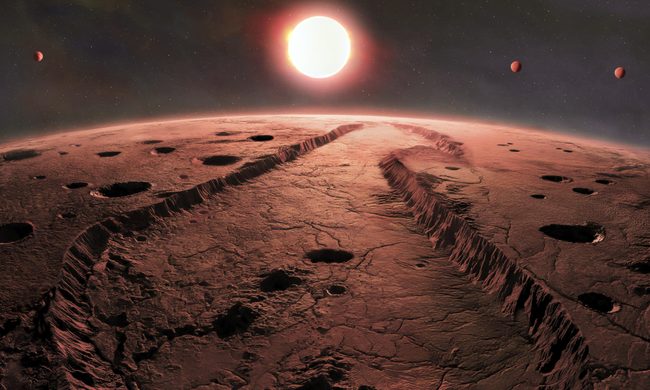
Despite the fact that it’s around 1,400 light-years away, Kepler-452b is remarkably similar to the planet we call home. Its radius is roughly 1.5 times that of Earth, and it circles a sun-like star in an orbit that takes roughly 385 days — just 5 percent longer than our own year. More important, it also orbits at an ideal distance. According to NASA, 452b is located in the “habitable zone” around its star, where temperatures are warm enough for liquid water to pool on the surface.
We still don’t know what the surface is like, though. The Kepler observatory can’t quite see it clearly enough to figure out if the planet is rocky or gaseous, but NASA’s top astronomers estimate that Kepler-452b has between a 50 percent chance and a 62 percent chance of being rocky. If it turns out to be solid, scientists say the mass of the planet would be somewhere around five times that of Earth (which would increase the force of gravity, and make getting out of bed in the morning quite a chore). That’s just an educated guess at this point, though, and much more data is needed in order to determine whether Kepler-452b could potentially be habitable for humans, or be home to alien life.
“Signs of life require advanced technology and instruments that would probably have to be in orbit,” explained John Jenkins, Kepler data analysis lead at NASA’s Ames Research Center. “What Kepler’s doing is telling us that there are worlds out there, and then we can follow up and look for bio-signatures for signs of life with other tools.”
And that’s exactly what NASA plans to do. The agency already has a number of missions planned that will help us gain more detailed information on Kepler 452b — the first of which are slated to begin in the next couple years.
“This is humankind’s first step,” said Jeff Conklin, a Kepler research scientist at the SETI Institute in Mountain View, California. “You and I probably won’t be traveling to these planets, but our children’s children’s children could be. One generation from now we might be able to get there. It gives humanity something to aim for.”