  1. Home
  2. Space
  3. News

NASA’s Lucy mission will soon be heading out to investigate Trojan asteroids

Add as a preferred source on Google

A NASA mission will soon be blasting off to investigate the Trojans, a lesser-studied group of asteroids in the outer solar system. The Lucy mission, named after the famed Australopithecus fossil which was key to understanding early human evolution, will be launching later this month and could help teach us about how the solar system formed.
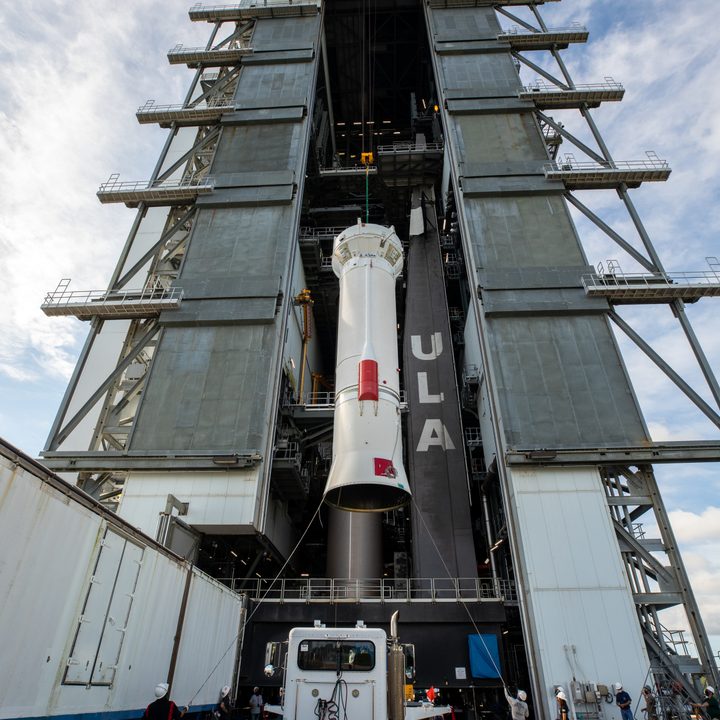
The (ULA) Centaur stage for NASA’s Lucy mission is lifted by crane into the Vertical Integration Facility.
The United Launch Alliance (ULA) Centaur stage for NASA’s Lucy mission is lifted by crane into the Vertical Integration Facility near Space Launch Complex 41 at Cape Canaveral Space Force Station in Florida on Thursday, Sept. 16, 2021. NASA/Kim Shiflett

The spacecraft has been brought to Florida, ready for its launch from Space Launch Complex 41 at Cape Canaveral Space Force Station on Saturday, October 16. Lucy will be launched on a United Launch Alliance Atlas V 401 rocket from Pad 41, from where it will head through Earth’s atmosphere, out of Earth’s orbit, and through the solar system to the Trojan asteroids.

Recommended Videos

The Trojans are located in the orbit of Jupiter, in two groups — one ahead of the planet and one behind it. Astronomers think these asteroids are leftovers of some of the material which formed the planets in the earliest days of the solar system, so studying them can help us understand how planets are formed.

“With Lucy, we’re going to eight never-before-seen asteroids in 12 years with a single spacecraft,” said Tom Statler, Lucy project scientist at NASA Headquarters. “This is a fantastic opportunity for discovery as we probe into our solar system’s distant past.”

An artist's concept of the Lucy Mission.
An artist’s concept of the Lucy Mission. SwRI

“There has been a lot of hands-on work,” said Donya Douglas-Bradshaw, Lucy project manager at NASA’s Goddard Space Flight Center in Greenbelt, Maryland. “This summer has gone by so fast; it’s hard to believe we’re nearly at launch.”

With the spacecraft preparing for launch, its fuel tanks have been filled with a mix of liquid hydrazine and liquid oxygen which will allow it to maneuver between asteroids. It also has its solar panels to recharge its science instruments from the sun.

“Launching a spacecraft is almost like sending a child off to college – you’ve done what can for them to get them ready for that next big step on their own,” said Hal Levison, the principal investigator of the Lucy mission, based at the Southwest Research Institute in Boulder, Colorado.

Georgina Torbet
Georgina has been the space writer at Digital Trends space writer for six years, covering human space exploration, planetary…
We just got a hot signal that a Tesla and SpaceX merger could happen, after all
Tesla

For years, the idea of Tesla and SpaceX becoming a single company has lived somewhere between ambitious business theory and Elon Musk fan fiction. The two companies already share DNA, leadership influence, engineering talent, and long-term goals. But every time the topic surfaced, it felt more like an interesting thought experiment than a realistic possibility. Now, one of the most important people at SpaceX has added fresh fuel to the conversation.

Speaking in a recent CNBC interview, SpaceX President and COO Gwynne Shotwell was asked about the possibility of closer ties between Tesla and SpaceX. Her response wasn’t a flat-out denial. In fact, she suggested that bringing the two companies together could make life a little easier for Musk. That may sound like an offhand comment, but coming from Shotwell, it’s noteworthy. She’s been at SpaceX since its earliest days and remains one of the company's most influential executives.

Read more
Astronauts reportedly took shelter after work on Russia’s leaky ISS module triggered concerns
The ISS really picked a stressful time to start leaking again
The International Space Station.

Astronauts aboard the International Space Station reportedly took precautionary shelter measures after maintenance work on a long-troubled Russian module raised fresh safety concerns about air leaks aboard the orbiting laboratory.

According to reports, the incident involved Russia’s Zvezda service module, which has experienced recurring air leak problems for several years. During repair work and pressure tests connected to the leak investigation, astronauts were instructed to isolate themselves in safer sections of the ISS as engineers monitored the station’s integrity and pressure stability.

Read more
Blue Origin’s massive New Glenn rocket explodes in a fiery blaze during tests
The incident leaves NASA's Moon Base ambitions and Amazon's Kuiper constellation without their primary launch vehicle at the worst possible moment.
Explosion, Fire, Nuclear Explosion

Blue Origin's New Glenn rocket exploded during a static fire test at Launch Complex 36 in Cape Canaveral, Florida. The incident took place on the night of May 28, 2026. 

The explosion was captured on a live stream by NASASpaceflight.com and footage of the explosion spread rapidly across X. The Space Launch Complex 45 has confirmed in an official statement (shared by Spaceflight Now on X) that all personnel have been accounted for and there have been no injuries or fatalities.

Read more