  1. Home
  2. Space
  3. News

NASA’s Perseverance rover is stacked and ready for launch to Mars

Add as a preferred source on Google

NASA’s Perseverance rover is gearing up for its mission to Mars in just two months’ time. The latest step in the launch preparations is readying the rover and its descent stage to be attached to the Atlas V rocket that will transport it in a process called vehicle stacking.

The rover’s descent stage, along with some other components including the recently-name Ingenuity helicopter, is carefully lifted and placed on top of the rover itself, then attached with three flight-separation bolts. The combined package is then placed inside a black shell along with its parachute, ready to be set onto the rocket.

Recommended Videos

“Attaching the rover to the descent stage is a major milestone for the team because these are the first spacecraft components to come together for launch, and they will be the last to separate when we reach Mars,” David Gruel, the Perseverance rover assembly, test, and launch operations manager at NASA’s Jet Propulsion Laboratory said in a statement. “These two assemblies will remain firmly nestled together until they are about 65 feet [20 meters] over the surface of Mars.”
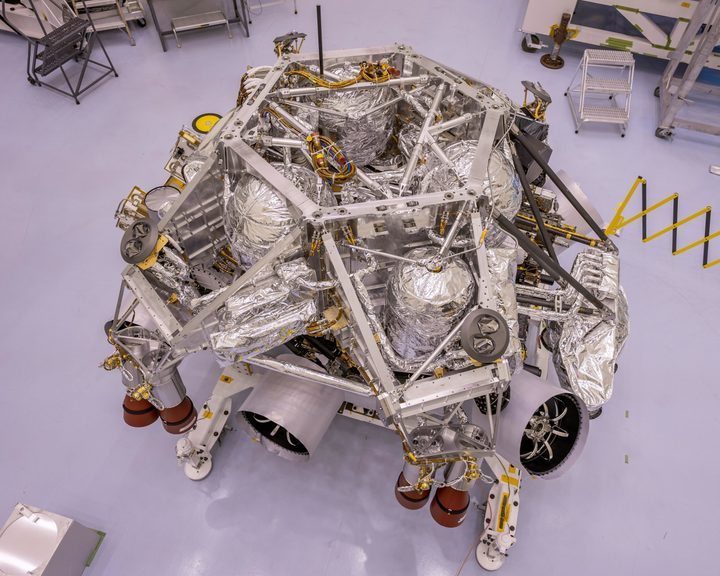
 the rocket-powered descent stage
This image of the rocket-powered descent stage sitting on to of NASA’s Perseverance rover was taken in a clean room at Kennedy Space Center on April 29, 2020. NASA/JPL-Caltech

Once the spacecraft arrives at Mars, the three bolts holding the descent stage and the rover together will be released using pyrotechnic charges, allowing a part of the decent procedure called the “sky crane maneuver” to begin.

Because the Perseverance rover is larger and heavier than previous Mars rovers, it cannot use an airbag landing system like those before the Curiosity rover. Instead, the sky crane system has nylon ropes hanging from the descent stage which hold the rover in place 25 feet (7.6 meters) below. When the rover touches down on the surface, it senses the contact and uses blades to cut the ropes, allowing the descent stage to lift off and move away. The advantage of this system is that Perseverance will land neatly on the surface with no parts of airbags or other components in its way.

The launch of the rover is scheduled for summer this year, will a launch window opening on July 17. If everything goes as planned, the rover should land on Mars in the Jezero Crater on February 18 2021, where it can begin its mission of searching for signs of ancient life.

Georgina Torbet
Georgina has been the space writer at Digital Trends space writer for six years, covering human space exploration, planetary…
Stunning close-up footage shows NASA’s moon rocket roaring to space
On its first crewed flight, NASA's lunar rocket displays its awesome power.
NASA's SLS rocket roars skyward at the start of the Artemis II mission on April 1, 2026.

As NASA’s Artemis II astronauts journey back to Earth following their breathtaking close encounter with the moon earlier this week, the space agency has just shared some stunning footage (below) of the rocket launch that sent the crew on its way on April 1.

The close-up tracking shot shows the awesome power of the Space Launch System (SLS) rocket’s four core RS-25 engines together and its two solid rocket boosters as the 98-meter-tall vehicle roars away from the launchpad at the Kennedy Space Center in Florida.

Read more
How to watch NASA’s moon crew splash down at end of historic mission
The Orion spacecraft's final moments before splashdown will be the most perilous of the entire mission.
Earth and the moon as seen from the Orion spacecraft during the Artemis II mission in April 2026.

The Artemis II astronauts have looped around the moon, captured some extraordinary imagery (above), set a slew of records, and are now on their way back to Earth.

The 10-day mission will reach its climax on Friday, April 10, during a dramatic homecoming that will see the Orion spacecraft enter our planet’s atmosphere at a speed of nearly 25,000 miles per hour.

Read more
Notable firsts of the Artemis II moon mission … so far
The Artemis II crew are now on their way home, so let's take a look at the mission's achievements so far.
The moon as seen from the Orion spacecraft during the Artemis II mission.

Having just looped around the moon in a historic flyby of our nearest neighbor, the Artemis II crew are now on their way back to Earth.

NASA’s Victor Glover, Reid Wiseman, and Christina Koch, along with the Canadian Space Agency’s Jeremy Hansen, launched aboard the Orion spacecraft from the Kennedy Space Center on April 1, lifted to space by the mighty SLS rocket.

Read more