  1. Home
  2. Emerging Tech
  3. News

NASA’s Mars 2020 rover will search for evidence of ancient life on red planet

Add as a preferred source on Google

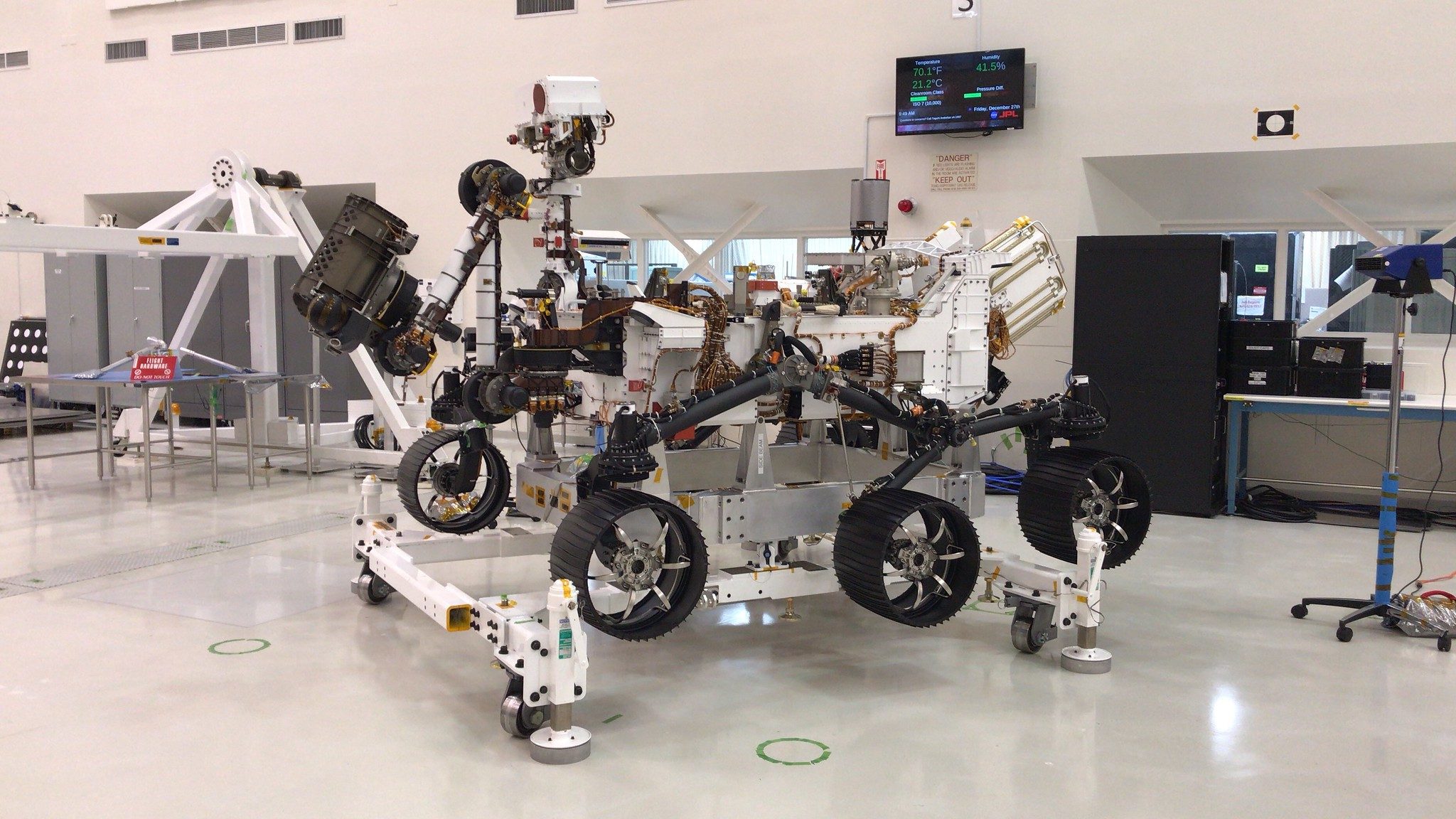
NASA's Mars 2020 Rover
NASA’s Mars 2020 Rover is shown off to journalists at the Jet Propulsion Laboratory on December 27 2019. NASA/JPL-Caltech

After years of work, NASA’s Mars 2020 rover is ready to explore an alien world. With construction and testing at NASA’s clean room facility now completed, the rover will be packed up and shipped to Florida ahead of final testing before it is strapped to a rocket and launched on its journey to Mars in a few months’ time.

Recommended Videos

The rover has an ambitious mission: To search for evidence that life once existed on the red planet. “Mars 2020 is looking for signs of ancient life,” Zach Ousnamer, a Mechanical Engineer on the Mars 2020 Rover project at the Jet Propulsion Laboratory, said in an interview posted by NASA. “We’re going to land in the Jezero Crater which is an ancient river delta, and here on Earth, we know those are hot spots for life. So we’re going to go to one on Mars in hopes of finding life there.”

NASA already has a number of instruments on and around Mars, including the Curiosity rover, the InSight lander, and the Mars Reconnaissance Orbiter spacecraft. But the Mars 2020 rover will have new tools and updated instruments which allow it to perform tasks which existing explorers can’t.

When Ousnamer was asked how the instruments on the Mars 2020 rover compare to those on Curiosity, he pointed to several new features on the latest rover. “We’re flying seven new instruments,” he said. “Some of them are similar to those flown on Curiosity but upgraded. We have, for instance, a new instrument MOXIE, which is generating oxygen on the surface of Mars.”

Being able to generate oxygen on the planet is a vital part of preparing for an eventual manned mission to the surface, both for breathing and creating fuel, and MOXIE should be able to produce around 10 grams of oxygen per hour by converting the carbon dioxide which is abundant in the Martian atmosphere.

Other tools in the rover are focused on scientific discovery. “We have SuperCam on the top of the head of the remote sensing mast, doing laser-induced breakdown spectroscopy,” Ousnamer explained. That will allow scientists to identify the chemical composition of rocks and soil that the rover encounters in the Martian environment.

“And then the big thing that is different from Curiosity is that inside the rover is the Adaptive Caching Assembly. That’s a whole suite which takes samples of Mars, puts them in a canister, hermetically seals them, and leaves those on the surface in the hope that in a future mission, we can bring them back to study here on Earth.”

The Mars 2020 mission is set to launch between July 17 and August 5 next year.

Georgina Torbet
Georgina has been the space writer at Digital Trends space writer for six years, covering human space exploration, planetary…
AI chatbots can often feed into your delusions. Researchers say you should look for three signs
Experts warn that chatbot design choices can reinforce unhealthy beliefs in vulnerable users.
ChatGPT on a smartphone

Artificial intelligence chatbots have become incredibly good at sounding human. But a new review paper by psychiatrist Marc Augustin and fellow researchers Thomas A. Pollak and Helen Morrin, published in NPP—Digital Psychiatry and Neuroscience, argues that existing AI research points to an overlooked psychological risk. The paper, highlighted by The Wall Street Journal, reviews previous studies and proposes a framework explaining how three common chatbot behaviors can combine to reinforce delusional thinking in vulnerable users, creating what the authors call an "amplification spiral."

Researchers say these are the three warning signs

Read more
Lost access to your crypto wallet? Don’t Google your way out of it
Security researchers warn that fake recovery tools are becoming the latest trap for crypto owners.
Bitcoin crypto wallet featured

Forgetting the recovery phrase to a crypto wallet can be stressful enough. Unfortunately, that's exactly the moment scammers are waiting for. A new warning highlights a growing scam in which cybercriminals disguise malware as cryptocurrency recovery software, tricking desperate users into handing over far more than just access to their wallets.

The fake recovery tool that's actually malware

Read more
Chinese AI lab says it can match Anthropic’s all-poweful Claude Mythos at sniffing security bugs
Security researchers say Z.ai's latest model can rival Anthropic's Mythos in one critical area.
China Z.Ai GLM-5.2 Featured Banner

For the past few weeks, Anthropic's Mythos has been viewed as the gold standard for AI-powered cybersecurity. That lead may already be shrinking. According to a new report from The Wall Street Journal, security researchers say Chinese AI startup Z.ai's GLM-5.2 can now match Mythos when it comes to finding software security vulnerabilities, even if it still trails Anthropic and OpenAI in broader reasoning tasks.

GLM-5.2 is closing the gap in one very important area

Read more