
The next group of four astronauts lucky enough to travel aboard SpaceX’s Crew Dragon capsule are close to completing their training for next month’s mission to the International Space Station (ISS), NASA has confirmed.
NASA astronauts Nicole Mann and Josh Cassada, together with Koichi Wakata of JAXA (Japan Aerospace Exploration Agency), and Anna Kikina of the Russian space agency Roscosmos, will be blasted to space by SpaceX’s workhorse Falcon 9 rocket from Launch Complex 39A at the Kennedy Space Center in Florida.
The mission’s first launch window opens on September 29 in what will be the fifth crew rotation mission of SpaceX’s human space transportation system — and its sixth astronaut flight — to the ISS for NASA’s Commercial Crew Program.
Notably, Kikina will be the first Russian to fly aboard SpaceX’s Crew Dragon spacecraft, as the nation’s spacefarers usually travel between Earth and the station using its own Soyuz spacecraft.
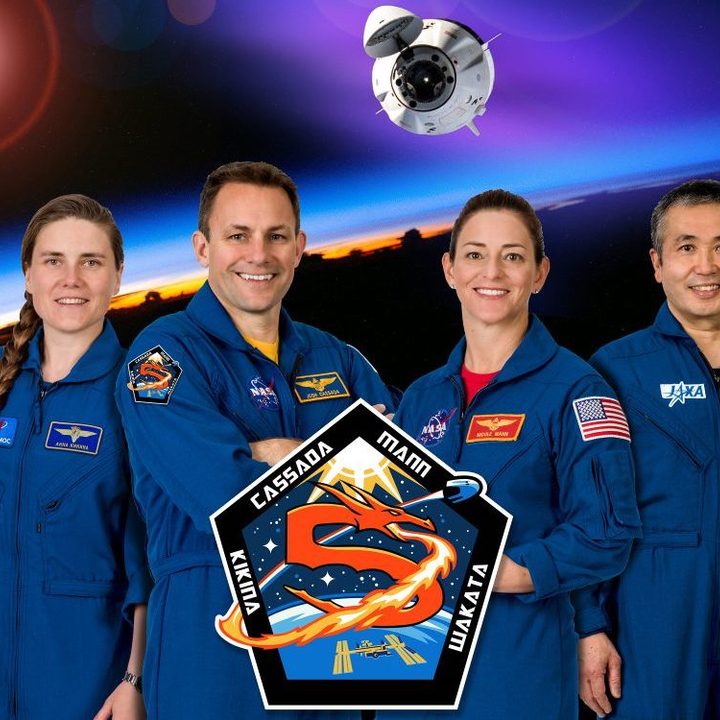
Training for the upcoming mission has been taking place at NASA’s Johnson Space Center in Houston, Texas, while training for the Crew Dragon flights to and from the station took place at SpaceX’s headquarters in Hawthorne, California.
In addition to getting to grips with space station systems, the four space travelers have also received training for spacewalks, which will be undertaken to upgrade the ISS or maintain current equipment. Russian language lessons for the three non-Russian crew members have also been part of the training package, with skills in robotics, T-38 jet flying, and science also taught.
“We really focus on what they’re going to need to perform the space station mission,” Cassie Rodriquez, Crew-5 chief training officer at Johnson, said in comments posted on NASA’s website.
Rodriquez added that the crewmembers have also been subjected to scenarios that will enable them to develop “teamwork and expeditionary skills; how to live and work with other people in very high-stress and dangerous situations. They have shown leadership, toughness, and focus in everything that they do. The dedication to human spaceflight, to making the mission a success — it’s very inspiring.”
SpaceX’s Crew Dragon is a reusable spacecraft and the Crew-5 astronauts will travel to the ISS aboard the one that transported the Crew-3 astronauts to and from the orbiting laboratory in November 2021.
Following years of development, and with heaps of useful data gathered from the successful flights of the crewless Cargo Dragon spacecraft, SpaceX sent the first astronauts to space aboard a Crew Dragon in a test mission in the summer of 2020. This set of images shows how the historic mission unfolded.


