  1. Home
  2. Space
  3. News

Saturn takes the crown for planet with the most moons

Add as a preferred source on Google

You’ve heard about the race to get humans back to the moon via the Artemis program, but there’s another moon race going on in our solar system, with planets vying for the title of most moons. Previously, Jupiter was the champion with its 95 known moons, but in an unexpected development, Saturn has pulled into the lead thanks to the recent discovery of 62 new moons there.

Astronomers observed Saturn’s rings and their immediate vicinity using new techniques that can detect fainter moons, and with the new discoveries, Saturn now boasts an impressive 145 moons. As well as being the planet in our solar system with the highest number of moons, it’s also the first planet with more than 100 known moons.
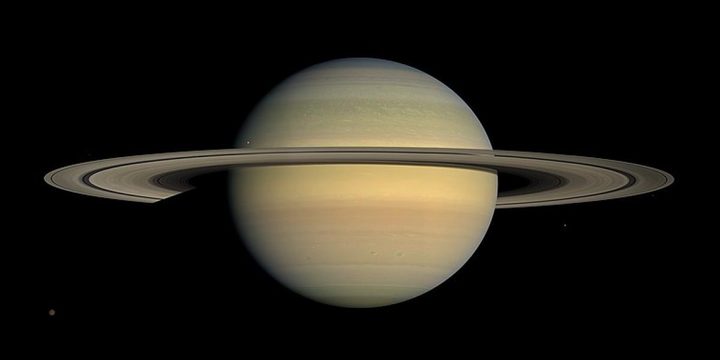
Saturn during Equinox
Saturn during Equinox. NASA / JPL / Space Science Institute

It’s difficult to see many of Saturn’s moons because they are so small and dim compared to the planet. The latest batch of moons was identified from data collected by the Canada France Hawaii Telescope (CFHT) using a technique called shift and stack, in which a set of sequential images is stacked into one to track the movement of a moon, allowing researchers to see objects that would be too dim to observe in a single image. That let the researchers go from seeing a selection of dots, which could be asteroids or other objects, to tracking distinct moons.

Recommended Videos

“Tracking these moons makes me recall playing the kid’s game [connect the dots], because we have to connect the various appearances of these moons in our data with a viable orbit,” said lead researcher Edward Ashton of the University of British Columbia in a statement. “But with about 100 different games on the same page and you don’t know which dot belongs to which puzzle.”

This method was useful for identifying irregular moons, which are unlike regular moons as they have elliptical orbits. Previously, Saturn had 24 known regular moons and 58 known irregular moons, but the new research was able to more than double the number of irregular moons to 121.

As well as being a neat finding, the study of these irregular moons could help us to learn about how moons form. It is thought that the irregular moons formed in groups from collisions, as regular moons collided and splintered to form many smaller irregular moons.

“As one pushes to the limit of modern telescopes, we are finding increasing evidence that a moderate-sized moon orbiting backwards around Saturn was blown apart something like 100 million years ago,” said fellow researcher Brett Gladman.

Georgina Torbet
Georgina has been the space writer at Digital Trends space writer for six years, covering human space exploration, planetary…
Astronauts reportedly took shelter after work on Russia’s leaky ISS module triggered concerns
The ISS really picked a stressful time to start leaking again
The International Space Station.

Astronauts aboard the International Space Station reportedly took precautionary shelter measures after maintenance work on a long-troubled Russian module raised fresh safety concerns about air leaks aboard the orbiting laboratory.

According to reports, the incident involved Russia’s Zvezda service module, which has experienced recurring air leak problems for several years. During repair work and pressure tests connected to the leak investigation, astronauts were instructed to isolate themselves in safer sections of the ISS as engineers monitored the station’s integrity and pressure stability.

Read more
Blue Origin’s massive New Glenn rocket explodes in a fiery blaze during tests
The incident leaves NASA's Moon Base ambitions and Amazon's Kuiper constellation without their primary launch vehicle at the worst possible moment.
Explosion, Fire, Nuclear Explosion

Blue Origin's New Glenn rocket exploded during a static fire test at Launch Complex 36 in Cape Canaveral, Florida. The incident took place on the night of May 28, 2026. 

The explosion was captured on a live stream by NASASpaceflight.com and footage of the explosion spread rapidly across X. The Space Launch Complex 45 has confirmed in an official statement (shared by Spaceflight Now on X) that all personnel have been accounted for and there have been no injuries or fatalities.

Read more
Orbot Robotics’ space robot has four arms, but its Goro physique has a purpose
This four-armed robot could make routine space-station work easier for astronauts
Robot with four arms

Helios is a new four-armed robot from Zurich-based Orbit Robotics, and at first glance, it reminded me of Goro from Mortal Kombat. But unlike the prince from Outworld, Helios is not built for combat. It is designed to help astronauts on space stations with the repetitive, time-consuming work that keeps life in space running.

Orbit Robotics says that in microgravity, legs are not much help. Instead of walking or standing, Helios needs to move through tight station interiors, hold itself steady, and handle cargo, tools, or equipment. Its four-arm design turns extra limbs into both mobility aids and working hands.

Read more