  1. Home
  2. Space
  3. News

Extreme solar storms create gorgeous views of auroras across the planet

Add as a preferred source on Google

NASA’s Solar Dynamics Observatory captured this image of a solar flare – as seen in the bright flash toward the middle of the image – on May 10, 2024. The image shows a subset of extreme ultraviolet light that highlights the extremely hot material in flares and which is colorized in gold.
NASA’s Solar Dynamics Observatory captured this image of a solar flare –  seen in the bright flash toward the middle of the image – on May 10, 2024. The image shows a subset of extreme ultraviolet light that highlights the extremely hot material in flares and which is colorized in gold. NASA/SDO

The sun has been unusually active this week, leading to stunning views of auroras across Europe and parts of the U.S. this weekend. On Friday, May 10, Earth was hit by the strongest solar storm in 20 years, and the activity has created light shows in the sky for many people who wouldn’t normally see them.

Recommended Videos

The sun is becoming more tempestuous as it ramps up to solar maximum, the point in its 11-year cycle when the sun is most active. When the sun lets out a huge burst of energy called a solar flare or a slower burst called a coronal mass ejection, this radiation spreads out through the solar system, and when it interacts with Earth’s atmosphere, it creates auroras like the Northern Lights. The sun has been producing powerful flares for the last several days, with the most recent observed just this afternoon.

Solar storms can cause problems with electronics, such as satellite communication systems, though they aren’t usually directly dangerous to those of us on the surface. At their most extreme, solar storms can cause blackouts on Earth as they can damage electrical grids, as happened with solar storms in 2003.
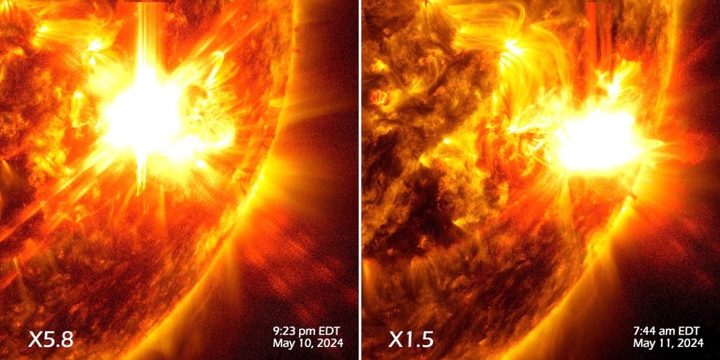
NASA’s Solar Dynamics Observatory captured images of the two solar flares on May 10 and May 11, 2024. The image shows a subset of extreme ultraviolet light that highlights the extremely hot material in flares created from a mixture of SDO’s AIA 193, 171 and 131 channels.
NASA’s Solar Dynamics Observatory captured images of two solar flares on May 10 and May 11, 2024. The images show a subset of extreme ultraviolet light that highlights the extremely hot material in flares. NASA/SDO

For most people, however, the recent increase in solar activity offers a chance to view auroras, which have been visible far outside the polar regions where they are most commonly seen. Beautiful images have been captured from the U.S., Canada, the U.K., Australia, and other places.

There should be more auroras visible tonight as well, so you should head out after dark and take a look. The appearance of auroras is hard to predict, but you’ll have better luck trying to view the lights if you are in a darker location, such as being away from city lights. You’ll need to have cloud-free skies and look after sundown for the best shot at seeing them.

Experts also advise to try taking photos of the auroras on your phone, as the camera sensors in phones are more sensitive to the particular wavelengths that auroras shine in than the human eye is. This is one of those rare occasions where photos might look even better than the view in real life.

Georgina Torbet
Georgina has been the space writer at Digital Trends space writer for six years, covering human space exploration, planetary…
Blue Origin successfully re-uses a New Glenn rocket for the first time ever
Blue Origin achieves first New Glenn reflight despite payload setback
Blue Origin

Blue Origin has achieved a major milestone in its spaceflight ambitions by successfully reusing a booster from its heavy-lift New Glenn rocket for the first time. The historic launch, conducted on April 19, marks a significant step forward for Jeff Bezos’ space company as it seeks to compete with rivals like SpaceX in the rapidly evolving commercial launch market.

A Milestone With A Mixed Outcome

Read more
Stunning close-up footage shows NASA’s moon rocket roaring to space
On its first crewed flight, NASA's lunar rocket displays its awesome power.
NASA's SLS rocket roars skyward at the start of the Artemis II mission on April 1, 2026.

As NASA’s Artemis II astronauts journey back to Earth following their breathtaking close encounter with the moon earlier this week, the space agency has just shared some stunning footage (below) of the rocket launch that sent the crew on its way on April 1.

The close-up tracking shot shows the awesome power of the Space Launch System (SLS) rocket’s four core RS-25 engines together and its two solid rocket boosters as the 98-meter-tall vehicle roars away from the launchpad at the Kennedy Space Center in Florida.

Read more
How to watch NASA’s moon crew splash down at end of historic mission
The Orion spacecraft's final moments before splashdown will be the most perilous of the entire mission.
Earth and the moon as seen from the Orion spacecraft during the Artemis II mission in April 2026.

The Artemis II astronauts have looped around the moon, captured some extraordinary imagery (above), set a slew of records, and are now on their way back to Earth.

The 10-day mission will reach its climax on Friday, April 10, during a dramatic homecoming that will see the Orion spacecraft enter our planet’s atmosphere at a speed of nearly 25,000 miles per hour.

Read more