  1. Home
  2. Space
  3. News

SpaceX performs Falcon 9 static fire test ahead of second crew mission to ISS

Add as a preferred source on Google

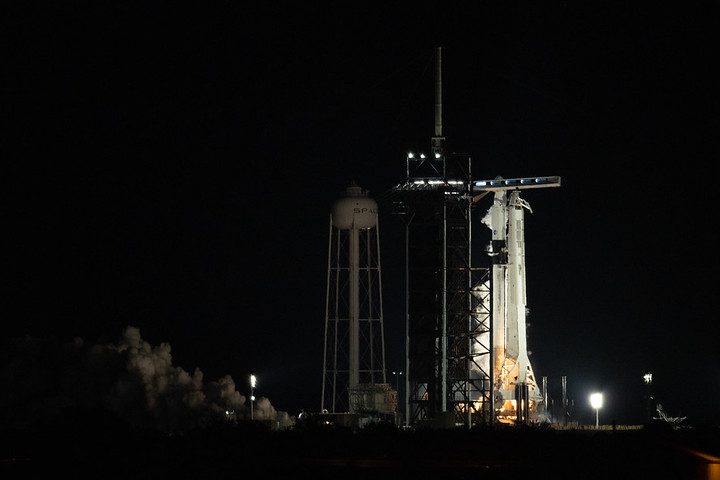
A SpaceX Falcon 9 rocket with the company’s Crew Dragon spacecraft onboard is seen on the launch pad at Launch Complex 39A during a brief static fire test ahead of NASA’s SpaceX Crew-2 mission, Saturday, April 17, 2021, at NASA’s Kennedy Space Center in Florida.
A SpaceX Falcon 9 rocket with the company’s Crew Dragon spacecraft onboard is seen on the launch pad at Launch Complex 39A during a brief static fire test ahead of NASA’s SpaceX Crew-2 mission, Saturday, April 17, 2021, at NASA’s Kennedy Space Center in Florida. NASA/Joel Kowsky

A new batch of astronauts will shortly be traveling to the International Space Station (ISS) aboard a SpaceX Crew Dragon craft. This will be the second operational flight of the Crew Dragon, which underwent its historic first crewed test flight in 2020. Ahead of the new mission, named Crew-2, SpaceX has performed a static fire test of the Falcon 9 rocket which will launch the Crew Dragon capsule.

Recommended Videos

The static fire test, in which the rocket is fueled and prepared as if for launch and then fires its engines for several seconds while remaining tethered to the ground, went ahead early in the morning of Saturday, April 17. The test was performed at Launch Complex 39A at the agency’s Kennedy Space Center in Florida and consisted of a seven-second firing of the rocket’s nine first-stage Merlin engines.

With the test results looking good, NASA and SpaceX are now preparing for the launch, scheduled for 6:11 a.m. ET on Thursday, April 22.

The first stage of the Falcon 9 to be used for this mission is the same first stage previously used in the Crew-1 mission in November last year. In addition, the Crew Dragon being used is the same one that was used in the first crewed test flight, called Demo-2. According to SpaceX, this marks the first time that astronauts will be transported using both a previously-flown Falcon 9 and Dragon capsule.

The astronauts who will be boarding the Dragon for Crew-2 are NASA astronauts Shane Kimbrough and Megan McArthur, plus JAXA (Japan Aerospace Exploration Agency) astronaut Akihiko Hoshide, and ESA (European Space Agency) astronaut Thomas Pesquet. They will join the crew of the International Space Station as part of Expedition 65.

Between the four-person crew, they have previous experience on both Space Shuttle and Soyuz missions. McArthur spoke about seeing the transition from Shuttle to Soyuz to Dragon flights in an interview on NASA TV, saying “We’re all very excited to be a part of it now. It’s neat that there is, amongst these four crew members, the experience from three different vehicles. We’re fortunate to get to draw on all of that for this upcoming mission.”

Georgina Torbet
Georgina has been the space writer at Digital Trends space writer for six years, covering human space exploration, planetary…
Blue Origin successfully re-uses a New Glenn rocket for the first time ever
Blue Origin achieves first New Glenn reflight despite payload setback
Blue Origin

Blue Origin has achieved a major milestone in its spaceflight ambitions by successfully reusing a booster from its heavy-lift New Glenn rocket for the first time. The historic launch, conducted on April 19, marks a significant step forward for Jeff Bezos’ space company as it seeks to compete with rivals like SpaceX in the rapidly evolving commercial launch market.

A Milestone With A Mixed Outcome

Read more
Stunning close-up footage shows NASA’s moon rocket roaring to space
On its first crewed flight, NASA's lunar rocket displays its awesome power.
NASA's SLS rocket roars skyward at the start of the Artemis II mission on April 1, 2026.

As NASA’s Artemis II astronauts journey back to Earth following their breathtaking close encounter with the moon earlier this week, the space agency has just shared some stunning footage (below) of the rocket launch that sent the crew on its way on April 1.

The close-up tracking shot shows the awesome power of the Space Launch System (SLS) rocket’s four core RS-25 engines together and its two solid rocket boosters as the 98-meter-tall vehicle roars away from the launchpad at the Kennedy Space Center in Florida.

Read more
How to watch NASA’s moon crew splash down at end of historic mission
The Orion spacecraft's final moments before splashdown will be the most perilous of the entire mission.
Earth and the moon as seen from the Orion spacecraft during the Artemis II mission in April 2026.

The Artemis II astronauts have looped around the moon, captured some extraordinary imagery (above), set a slew of records, and are now on their way back to Earth.

The 10-day mission will reach its climax on Friday, April 10, during a dramatic homecoming that will see the Orion spacecraft enter our planet’s atmosphere at a speed of nearly 25,000 miles per hour.

Read more