  1. Home
  2. Space
  3. News

SpaceX sees its eight-year-long flawless Falcon 9 launch streak broken

Add as a preferred source on Google
SpaceX

SpaceX has established itself as a champion of reusable commercial rockets, with the enormous success of its Falcon 9 rocket making the company the benchmark against which other commercial launch operations are judged. The Falcon 9, which carries satellites for commercial entities and space agencies into low-Earth orbit, had a long string of flawless launches. But its most recent launch failed to deploy its payloads correctly, breaking that streak and serving as a reminder that even with well-trusted technology, space operations are still a challenge.

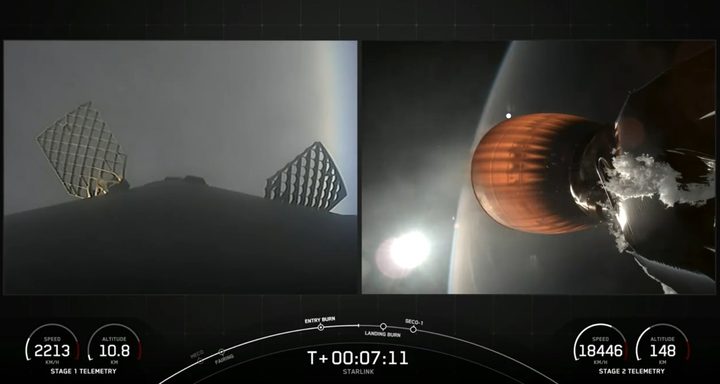
The launch was scheduled for yesterday, July 11, from Space Launch Complex 4E at Vandenberg Space Force Base in California. The Falcon 9 rocket was carrying 20 Starlink satellites to be added to SpaceX’s communications network. The booster separated from the rocket as planned and landed on SpaceX’s droneship for reuse, but a problem occurred with the rocket’s upper stage due to a leak of liquid oxygen.

Recommended Videos

This leak meant that the rocket could not fire its Merlin vacuum engine as expected and did not complete its second burn. The satellites were released, but not at the correct orbit, which means that they will fall back to Earth and burn up rather than entering low-Earth orbit as planned.

“The team worked overnight to make contact with the satellites in order to send early burn commands, but the satellites were left in an enormously high-drag environment only 135 kilometers above the Earth (each passthrough perigee removed 5+ km of altitude from the orbit’s apogee, or the highest point in the satellite orbit),” SpaceX wrote in a statement. “At this level of drag, our maximum available thrust is unlikely to be enough to successfully raise the satellites. As such, the satellites will reenter Earth’s atmosphere and fully demise. They do not pose a threat to other satellites in orbit or to public safety.”

This was a now-rare failure for the Falcon 9 rocket, which has competed 364 successful launches to date. The last time a Falcon 9 launch failed was in 2016, when a rocket exploded on the launchpad.

Yesterday’s failure will result in the grounding of the Falcon 9 until the Federal Aviation Administration (FAA) can investigate, CNBC reports. The FAA may require corrective actions before the rocket is allowed to launch once again.

Georgina Torbet
Georgina has been the space writer at Digital Trends space writer for six years, covering human space exploration, planetary…
We just got a hot signal that a Tesla and SpaceX could happen, after all
Tesla

For years, the idea of Tesla and SpaceX becoming a single company has lived somewhere between ambitious business theory and Elon Musk fan fiction. The two companies already share DNA, leadership influence, engineering talent, and long-term goals. But every time the topic surfaced, it felt more like an interesting thought experiment than a realistic possibility. Now, one of the most important people at SpaceX has added fresh fuel to the conversation.

Speaking in a recent CNBC interview, SpaceX President and COO Gwynne Shotwell was asked about the possibility of closer ties between Tesla and SpaceX. Her response wasn’t a flat-out denial. In fact, she suggested that bringing the two companies together could make life a little easier for Musk. That may sound like an offhand comment, but coming from Shotwell, it’s noteworthy. She’s been at SpaceX since its earliest days and remains one of the company's most influential executives.

Read more
Astronauts reportedly took shelter after work on Russia’s leaky ISS module triggered concerns
The ISS really picked a stressful time to start leaking again
The International Space Station.

Astronauts aboard the International Space Station reportedly took precautionary shelter measures after maintenance work on a long-troubled Russian module raised fresh safety concerns about air leaks aboard the orbiting laboratory.

According to reports, the incident involved Russia’s Zvezda service module, which has experienced recurring air leak problems for several years. During repair work and pressure tests connected to the leak investigation, astronauts were instructed to isolate themselves in safer sections of the ISS as engineers monitored the station’s integrity and pressure stability.

Read more
Blue Origin’s massive New Glenn rocket explodes in a fiery blaze during tests
The incident leaves NASA's Moon Base ambitions and Amazon's Kuiper constellation without their primary launch vehicle at the worst possible moment.
Explosion, Fire, Nuclear Explosion

Blue Origin's New Glenn rocket exploded during a static fire test at Launch Complex 36 in Cape Canaveral, Florida. The incident took place on the night of May 28, 2026. 

The explosion was captured on a live stream by NASASpaceflight.com and footage of the explosion spread rapidly across X. The Space Launch Complex 45 has confirmed in an official statement (shared by Spaceflight Now on X) that all personnel have been accounted for and there have been no injuries or fatalities.

Read more