
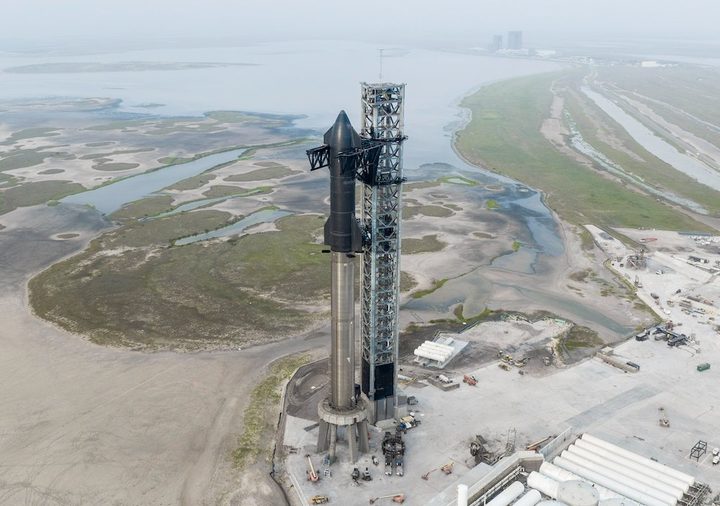
The Federal Aviation Administration (FAA) has completed its investigation into SpaceX’s second Starship flight, which took place in November last year and ended with mid-flight explosions of the first-stage Super Heavy booster and the upper-stage Starship spacecraft.
The Elon Musk-led spaceflight company is now awaiting approval to launch the Starship — the most powerful rocket ever to fly — on its third test flight, with the expectation that SpaceX could get the green light some time next month, with the rocket taking to the skies again a short while later.
Following November’s flight test, SpaceX led the investigation efforts with oversight from the FAA and participation from NASA and the National Transportation Safety Board.
“SpaceX identified, and the FAA accepts, the root causes and 17 corrective actions documented in SpaceX’s mishap report,” the FAA said in a statement released on Monday. “Prior to the next launch, SpaceX must implement all corrective actions and receive a license modification from the FAA that addresses all safety, environmental, and other applicable regulatory requirements.”
In a post on its website on Monday, SpaceX shared some details regarding its analysis of November’s flight, noting that it was the first Starship test to achieve stage separation after April’s maiden test flight failed just a few minutes after liftoff.
“Following stage separation, Super Heavy initiated its boostback burn, which sends commands to 13 of the vehicle’s 33 Raptor engines to propel the rocket toward its intended landing location,” SpaceX explained. “During this burn, several engines began shutting down before one engine failed energetically, quickly cascading to a rapid unscheduled disassembly (RUD) of the booster. The vehicle breakup occurred more than three-and-a-half minutes into the flight at an altitude of ~90 kilometers over the Gulf of Mexico.”
SpaceX said the most likely root cause for the booster RUD was “filter blockage where liquid oxygen is supplied to the engines, leading to a loss of inlet pressure in engine oxidizer turbopumps that eventually resulted in one engine failing in a way that resulted in loss of the vehicle.”
It said that to prevent this from happening again, it’s made hardware changes inside the booster oxidizer tanks to improve propellant filtration capabilities and also refined operations to increase reliability.
In the same test flight, the Starship spacecraft continued on its journey until a leak of liquid oxygen propellant caused “a combustion event and subsequent fires that led to a loss of communication between the spacecraft’s flight computers,” which resulted in the loss of the vehicle shortly after. SpaceX said it has since made hardware changes to improve leak reduction and fire protection.
“More Starships are ready to fly,” the company said as it awaits launch permission from the FAA.
SpaceX hopes to use its next-generation heavy-lift rocket for cargo and crew missions to the moon in the near future, and, looking further ahead, for similar flights to Mars, too.


