1. Home
  2. Space
  3. Emerging Tech
  4. News

Astronomers capture video of platinum-laden ‘trillion-dollar asteroid’ zooming past Earth

Add as a preferred source on Google

Earlier this month, an asteroid whipped past the Earth. Normally this isn’t a particularly special phenomenon — but this wasn’t your typical asteroid. Unlike all the other space rocks that come hurtling past our home planet every month, the asteroid known as 2011 UW158 happens to contain somewhere around $5.4 trillion dollars worth of platinum, give or take a few billion.

When it flew by on June 19, it missed Earth by about 1.5 million miles — roughly six times the distance between our planet and the moon. That might seem like a huge stretch of space — and it is — but it’s also remarkably close in when you consider how unimaginably massive the universe is. It’s so close, in fact, that scientists were able to observe the flyby as it happened.

Recommended Videos

Using images that were reconstructed from radar scan data, NASA was actually able to put together a short video of the rock as it zoomed by. It’s incredibly grainy and low-quality, but even so, you can clearly make out the rock’s shape and spin.

150728-0001Related: Asteroid mining: 19th-century gold rush meets outer space

You can’t tell just from the footage, but 2011 UW158 measures about 900 by 1,800 feet in size, and has an unusually fast spin, making a full rotation about once every 37 minutes. Most asteroids are really just a bunch of smaller rocks held together in a loose cluster by gravity, and therefore can’t handle that kind of spin, but UW158 can — which suggests that there’s something other than gravity holding it together.

The asteroid’s rare composition makes it a prime candidate for mining, but unfortunately, the world’s premiere asteroid mining company, Planetary Resources, wasn’t quite ready to lasso it. The company was only recently able to get its first spacecraft into orbit, and the craft they sent up is designed to do just a few basic tests equipped to conduct a few basic tests at this point.

We probably won’t have the technological capabilities to launch a legit space-mining operation for at least a few more decades, but by the time that 2011 UW158 circles back close to earth in 2108, there’s a good chance that Planetary Resources won’t be the only outfit waiting to catch it.

Drew Prindle
Former Senior Editor, Features
Drew Prindle is an award-winning writer, editor, and storyteller who currently serves as Senior Features Editor for Digital…
Lightsails have hit another speed bump on the road to interstellar travel
The coolest interstellar travel idea may get betrayed by the light pushing it
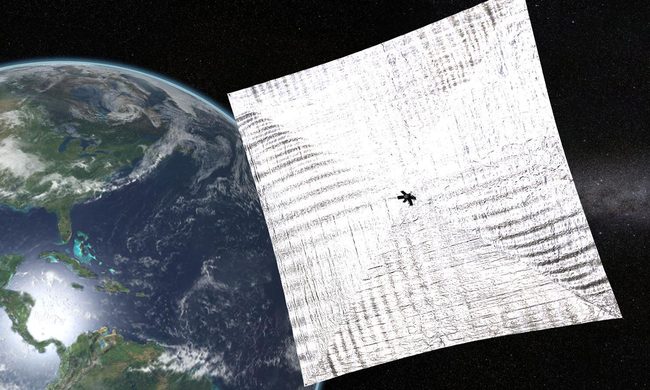
LightSail in Earth orbit

Laser-powered lightsails are one of the coolest answers to spaceflight. It might not be as sci-fi-sounding as a warp drive, but now, its practicality has also come under question. Using lightsails, a spacecraft could unfurl an ultra-thin reflective sail and let a powerful laser push it toward another star, without relying on fuel.

The tech was simple and elegant--except it's also more complicated than it sounds. A new preprint from researchers Chao Shen and Jiaze Li of the Harbin Institute of Technology suggests that relativistic lightsails may run into a hidden propulsion problem once they start moving extremely fast.

Read more
The galaxy has an exoplanet size mystery, and NASA’s EVE mission wants to solve it
This planet-hunting mission wants to catch baby worlds before they grow up
Artist’s Illustration of Exoplanets Orbiting Barnard’s Star

Mankind venturing into space ended up creating more questions than it answered, and one of the dilemmas is related to the planet sizes. Astronomers have found plenty of rocky super-Earths and plenty of puffier sub-Neptunes, but far fewer planets with a radius of about 1.8 times Earth’s.

That gap is known as the radius valley, and a proposed mission called the Early eVolution Explorer, or EVE, wants to figure out why it exists. NASA has a simple plan: look at planets while they are still young. The mission concept, detailed in a new arXiv preprint and covered by Phys.org, would focus on newly formed star clusters to see what small planets look like before billions of years of evolution.

Read more
We just got a hot signal that a Tesla and SpaceX merger could happen, after all
Tesla

For years, the idea of Tesla and SpaceX becoming a single company has lived somewhere between ambitious business theory and Elon Musk fan fiction. The two companies already share DNA, leadership influence, engineering talent, and long-term goals. But every time the topic surfaced, it felt more like an interesting thought experiment than a realistic possibility. Now, one of the most important people at SpaceX has added fresh fuel to the conversation.

Speaking in a recent CNBC interview, SpaceX President and COO Gwynne Shotwell was asked about the possibility of closer ties between Tesla and SpaceX. Her response wasn’t a flat-out denial. In fact, she suggested that bringing the two companies together could make life a little easier for Musk. That may sound like an offhand comment, but coming from Shotwell, it’s noteworthy. She’s been at SpaceX since its earliest days and remains one of the company's most influential executives.

Read more