  1. Home
  2. Space
  3. News

Scientists discover X-rays coming from Uranus

Add as a preferred source on Google

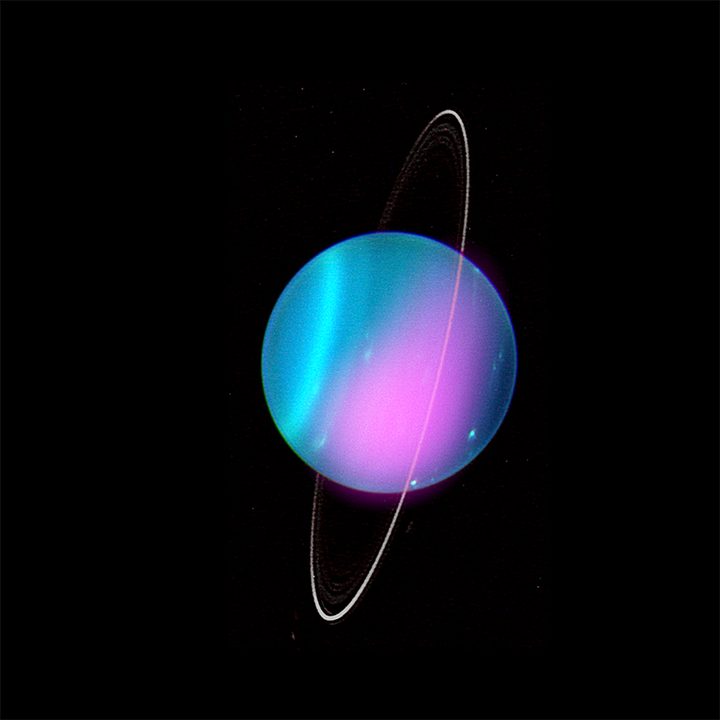
A composite image of Uranus, combining data from the optical and X-ray wavelengths.
A composite image of Uranus, combining data from the optical and X-ray wavelengths. X-ray: NASA/CXO/University College London/W. Dunn et al; Optical: W.M. Keck Observatory

For the first time, researchers have discovered X-rays being emitted by the planet Uranus.

Recommended Videos

The X-rays were detected using the NASA Chandra X-ray Observatory, by looking at previous observations of the planet from 2002 and 2017. Researchers found that the first set of observations showed clear evidence of X-rays, and there was a possible burst of X-rays in the later observations as well. From this data, they combined the findings with previous optical observations of Uranus to produce the image above.

The image shows the blue and white visible-light observations, which were captured using the Keck-1 Telescope at the W. M. Keck Observatory in Hawaii. Imposed on top are the X-ray observations in pink, captured using the Chandra X-ray Observatory.

As for where these X-rays are coming from, the answer is complicated. We know that X-ray emissions from Jupiter and Saturn are caused by the planets scattering sunlight, and a similar effect is seen on Uranus. But this scattering only explains part of the emissions — so where are the rest of the X-rays coming from? Scientists are still figuring that out.

“Our calculations suggest that Uranus was producing more X-rays than it should if the planet was only scattering the sun’s X-rays,” NASA guest blogger Affelia Wibisono wrote about the findings, “so could there be at least one other process at play and what are they? Are Uranus’ rings fluorescing like Saturn’s? Or could this oft-forgotten world have X-ray aurorae like Jupiter and the Earth? More observations of Uranus by Chandra and other X-ray telescopes are needed before we can give a definitive answer.”

The possibility that the X-rays could be related to auroras is an intriguing one, as auroras on Earth are created when particles traveling magnetic field lines interact with the atmosphere. Uranus has an unusual magnetic field, and the planet rotates almost entirely on its side — that is, it is “tipped over” relative to its orbit. But the magnetic field is tipped over by a different amount than the tilt of the planet. “This may cause its auroras to be unusually complex and variable,” NASA writes in a post. “Determining the sources of the X-rays from Uranus could help astronomers better understand how more exotic objects in space, such as growing black holes and neutron stars, emit X-rays.”

Georgina Torbet
Georgina has been the space writer at Digital Trends space writer for six years, covering human space exploration, planetary…
Orbot Robotics’ space robot has four arms, but its Goro physique has a purpose
This four-armed robot could make routine space-station work easier for astronauts
Robot with four arms

Helios is a new four-armed robot from Zurich-based Orbit Robotics, and at first glance, it reminded me of Goro from Mortal Kombat. But unlike the prince from Outworld, Helios is not built for combat. It is designed to help astronauts on space stations with the repetitive, time-consuming work that keeps life in space running.

Orbit Robotics says that in microgravity, legs are not much help. Instead of walking or standing, Helios needs to move through tight station interiors, hold itself steady, and handle cargo, tools, or equipment. Its four-arm design turns extra limbs into both mobility aids and working hands.

Read more
A billionaire crypto bro will lead humanity to Mars atop Musk’s Starship
Chun Wang could become one of the first humans to travel toward Mars
Chun Wang in a space suit

Neil Armstrong and Buzz Aldrin became the faces of the Moon landing era. Elon Musk’s Mars era may get a very different public face in Chun Wang, a cryptocurrency billionaire whose fortune traces back to Bitcoin mining.

Wang is expected to lead a future SpaceX Starship mission that would fly past Mars and return to Earth. SpaceX has not announced a launch date, and the plan still depends on Starship proving it can safely carry humans far beyond Earth's orbit.

Read more
Elon Musk will get a historical paycheck if he builds a colony of one milliion humans on Mars
SpaceX may hand Musk a historic payday, if Mars becomes a city
Elon Musk talks to the press as he arrives to to have a look at the construction site of the new Tesla Gigafactory near Berlin.

An executive's pay packages are typically tied to review, profit, share price, or operational targets. But SpaceX apparently has something different in mind. According to a Bloomberg report and details from SpaceX's IPO filing, Elon Musk's latest compensation plan includes a wild condition.

The company must establish a permanent human colony on Mars with at least 1 million inhabitants. However, this is only a part of the crazy deal.

Read more