
NASA’s Chandra Observatory has been investigating the universe in the X-ray wavelength since its launch in 1999, but it isn’t as well known as other observatories like Hubble or Spitzer. Part of the reason why is that the universe looks very different — sometimes almost unrecognizably so — in the X-ray wavelength. But this can be an invaluable source of information about distant galaxies and strange space phenomena, especially when X-ray data is combined with other wavelength data into a visible image.
That’s why NASA has released this collection of beautiful images that combine X-ray observations with other wavelength observations, to show how tools like Chandra can let us see the universe through different eyes.
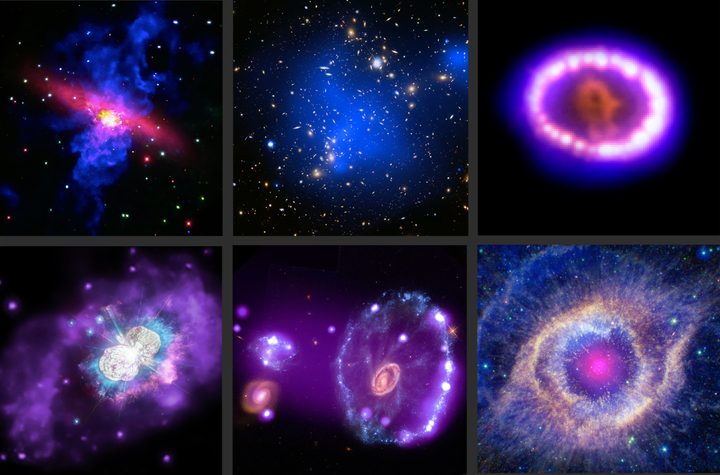
In the top left you see galaxy M82, with Chandra X-ray data showing gas outflows in blue and pink while visible light data from Hubble shows the galaxy itself in red and orange. The glowing gas in the outflows has temperatures above ten million degrees, having been heated over and over by multiple supernova explosions.
In the middle of the top row is a galaxy cluster called Abell 2744. This is a truly enormous collection of galaxies that are bound to each other through gravity and which also contain a vast cloud of hot gas which can be tens of millions of degrees. The heat of this gas makes it glow in the X-ray spectrum, shown here using Chandra data in blue overlaid with Hubble data in green, red, and blue.
On the top right is one of the brightest supernova explosions observed in the 1980s, called SN 1987a. Chandra data shows the explosion’s shock wave in blue, with Hubble data filling in the rest.
On the bottom right is a system on the verge of supernova called Eta Carinae, with two stars orbiting each other closely. This image is comprised not only of X-ray and visible light data but also ultraviolet data collected by Hubble, shown in cyan.
The bottom middle shows the famous Cartwheel Galaxy, which got its distinctive shape when a smaller galaxy violently collided with a larger one. Chandra data shows the hot gas being dragged by the collision in purple and Hubble data in red, green, and blue shows how the collision triggered star formation.
Finally, in the bottom right is the stunning Helix Nebula, which gives a glimpse into what our sun might look like in billions of years as it runs out of fuel and puffs out to a huge cloud of dust and gas. Here, infrared data from the Spitzer telescope is shown in green and red, optical light data from Hubble is shown in orange and blue, ultraviolet light from the Galaxy Evolution Explorer is shown in cyan, and Chandra data is shown in white, highlighting the dwarf star which is left at the heart of the nebula.


