1. Home
  2. Space
  3. News

How to watch the first launch of a new European rocket on Thursday

Add as a preferred source on Google

This week, the European Space Agency (ESA) will launch its new rocket, the Vega-C, on its first flight. An update to the previous Vega rocket, the new version has a mass of 210 tonnes at liftoff and provides a thrust of 4,500 kilonewtons (kN), meaning it can carry around 800 kilograms more payload than its previous version.

Vega-C inaugural launch: mission highlights

The inaugural flight of the Vega-C is set for Wednesday, July 13, at 7:13 a.m. ET (4:30 a.m. PT), in a mission called Flight VV21. The launch will take place from Europe’s spaceport at Kourou in French Guiana, located on the northern Atlantic coast of South America. The launch will be livestreamed by ESA, and we have the details below on how to watch.

Recommended Videos

What to expect from the launch

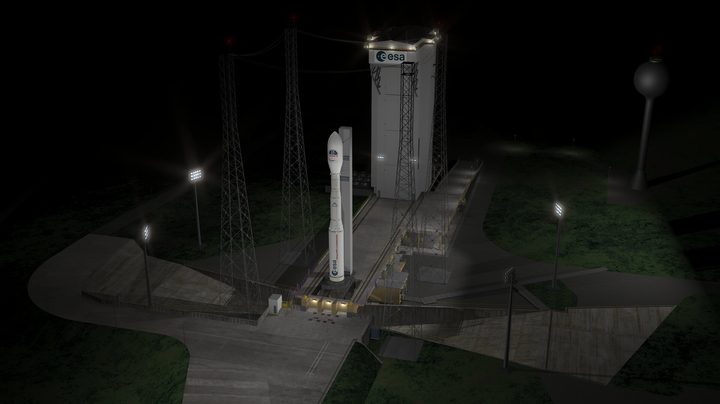
Vega-C on pad VV21 livery artist's impression.
Vega-C on pad VV21 livery artist’s impression. ESA-J. Huart

The new rocket will be used to deliver seven payloads into orbit, with one larger satellite called LARES-2 and six smaller CubeSats. LARES-2 is a scientific research satellite from the Italian Space Agency which will investigate a phenomenon called the frame-dragging effect. This effect is caused by distributions of mass and energy which distort space-time, as described by the theory of relativity.

The six CubeSats are from European countries including Italy, Slovenia, and France, and will be used to investigate topics like detecting biomolecules, growing plants in microgravity, and gathering data on Earth’s magnetosphere.

To carry these payloads, the new rocket requires changes to the launch configuration from the previous Vega rockets. “Vega-C features major enhancements from Vega, both in the rocket and its ground infrastructure,” said Renato Lafranconi, Vega programs manager, in a statement. “We’ve developed a new configuration with significant changes to many features of a proven concept, but the goal is to deliver major improvements in performance and competitiveness.”

How to watch the launch

Coverage of the launch begins at 6:45 a.m. ET (3:45 a.m. PT) on Wednesday, July 13. The livestream will be available on ESA Web TV, which you can watch here.

To get a feeling of what the launch process will consist of and what each step in the mission involves, ESA has created an animated preview of the flight showing the process from the rolling out of the rocket, through the liftoff, stage and fairing separations, and the deployment of first the LARES-2 satellite and then the six CubeSats. You can watch there here on YouTube.

Georgina Torbet
Georgina has been the space writer at Digital Trends space writer for six years, covering human space exploration, planetary…
Blue Origin successfully re-uses a New Glenn rocket for the first time ever
Blue Origin achieves first New Glenn reflight despite payload setback
Blue Origin

Blue Origin has achieved a major milestone in its spaceflight ambitions by successfully reusing a booster from its heavy-lift New Glenn rocket for the first time. The historic launch, conducted on April 19, marks a significant step forward for Jeff Bezos’ space company as it seeks to compete with rivals like SpaceX in the rapidly evolving commercial launch market.

A Milestone With A Mixed Outcome

Read more
Stunning close-up footage shows NASA’s moon rocket roaring to space
On its first crewed flight, NASA's lunar rocket displays its awesome power.
NASA's SLS rocket roars skyward at the start of the Artemis II mission on April 1, 2026.

As NASA’s Artemis II astronauts journey back to Earth following their breathtaking close encounter with the moon earlier this week, the space agency has just shared some stunning footage (below) of the rocket launch that sent the crew on its way on April 1.

The close-up tracking shot shows the awesome power of the Space Launch System (SLS) rocket’s four core RS-25 engines together and its two solid rocket boosters as the 98-meter-tall vehicle roars away from the launchpad at the Kennedy Space Center in Florida.

Read more
How to watch NASA’s moon crew splash down at end of historic mission
The Orion spacecraft's final moments before splashdown will be the most perilous of the entire mission.
Earth and the moon as seen from the Orion spacecraft during the Artemis II mission in April 2026.

The Artemis II astronauts have looped around the moon, captured some extraordinary imagery (above), set a slew of records, and are now on their way back to Earth.

The 10-day mission will reach its climax on Friday, April 10, during a dramatic homecoming that will see the Orion spacecraft enter our planet’s atmosphere at a speed of nearly 25,000 miles per hour.

Read more