  1. Home
  2. Space
  3. News

Stunning view of the Sombrero Galaxy captured by James Webb

Add as a preferred source on Google
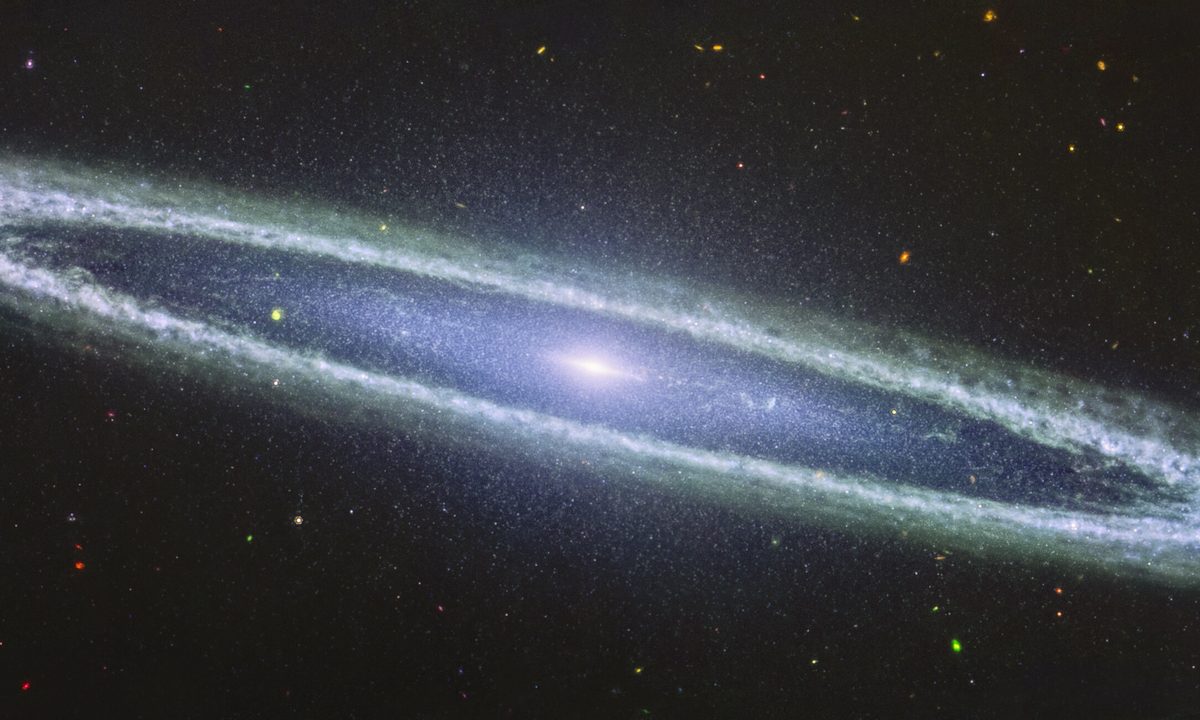
The NASA/ESA/CSA James Webb Space Telescope recently imaged the Sombrero galaxy with its MIRI (Mid-Infrared Instrument), resolving the clumpy nature of the dust along the galaxy’s outer ring. The mid-infrared light highlights the gas and dust that are part of star formation taking place among the Sombrero galaxy’s outer disk. The rings of the Sombrero galaxy produce less than one solar mass of stars per year, in comparison to the Milky Way’s roughly two solar masses a year. It’s not a particular hotbed of star formation. The Sombrero galaxy is around 30 million light-years from Earth in the constellation Virgo.
The NASA/ESA/CSA James Webb Space Telescope recently imaged the Sombrero galaxy with its MIRI (Mid-Infrared Instrument), resolving the clumpy nature of the dust along the galaxy’s outer ring. The mid-infrared light highlights the gas and dust that are part of star formation taking place among the Sombrero galaxy’s outer disk. The rings of the Sombrero galaxy produce less than one solar mass of stars per year, in comparison to the Milky Way’s roughly two solar masses a year. It’s not a particular hotbed of star formation. The Sombrero galaxy is around 30 million light-years from Earth in the constellation Virgo. NASA, ESA, CSA, STScI

A new image from the James Webb Space Telescope shows a stunning and fashionable sight: the Sombrero Galaxy, named for its resemblance to the traditional Mexican hat. With its wide, flat shape reminiscent of the hat’s wide brim, the galaxy, also known as Messier 104, has outer rings that are clearly visible for the first time.

The Sombrero Galaxy is located 30 million light-years away, in the constellation of Virgo, and it has been previously imaged by the Hubble Space Telescope. But while in the Hubble image, the galaxy appears as an opaque, pale disk, in the new Webb image you can see an outer blue disk, with a small bright core right at the center.
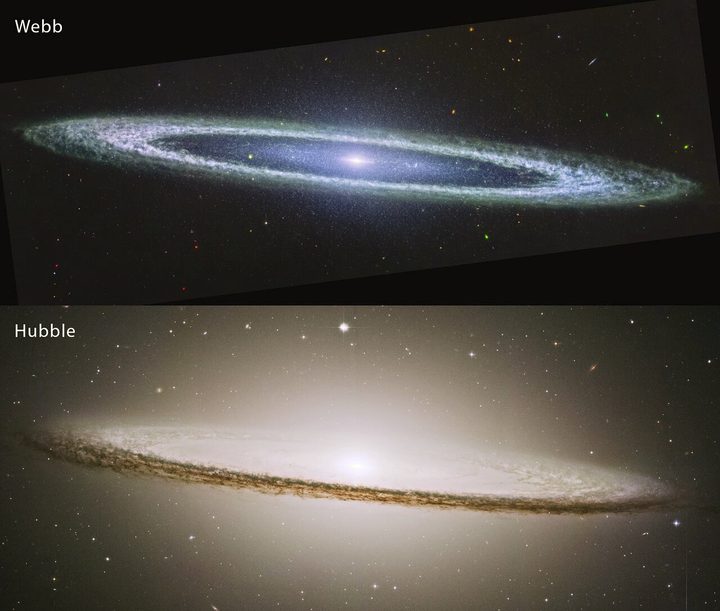
This image compares the view of the famous Sombrero Galaxy in mid-infrared light (top) and visible light (bottom). The James Webb Space Telescope’s MIRI (Mid-Infrared Instrument) reveals the smooth inner disk of the galaxy, while the Hubble Space Telescope’s visible light image shows the large and extended glow of the central bulge of stars.Both the Webb and Hubble images resolve the clumpy nature of the dust that makes up the Sombrero galaxy’s outer ring.
This image compares the view of the famous Sombrero Galaxy in mid-infrared light (top) and visible light (bottom). The James Webb Space Telescope’s MIRI (Mid-Infrared Instrument) reveals the smooth inner disk of the galaxy, while the Hubble Space Telescope’s visible light image shows the large and extended glow of the central bulge of stars. Both the Webb and Hubble images resolve the clumpy nature of the dust that makes up the Sombrero galaxy’s outer ring. NASA, ESA, CSA, STScI, Hubble Heritage Team (STScI/AURA)

The difference in the two images is because of the different wavelengths that the telescopes operate in. Hubble takes images primarily in the visible light part of the spectrum, which is the same wavelength as our eyes see, and galaxies with large amounts of dust like the Sombrero therefore appear opaque. But Webb operates in the infrared portion of the spectrum, meaning it can peer through the dust to see structures that would otherwise be invisible.

Recommended Videos

The Webb image also shows more detail about the dust that makes up the outer portion of the galaxy’s ring. If you look closely, you can see that the blue-white shape is clumpy, with dust unevenly distributed in pockets that are denser in some places than others. This region is interesting to scientists because it is contains molecules called polycyclic aromatic hydrocarbons that are usually found in regions where many young stars are forming. But the rate of star formation in this galaxy is quite low, with the rings of the Sombrero producing half as many stars per year as our own galaxy.

Another feature of this image is the bright glow at the galaxy’s center, which is an area around the galaxy’s supermassive black hole called an active galactic nucleus (AGN). This region isn’t as bright as some other AGNs, as the black hole at the center is relatively calm, not chowing down on huge amounts of material as is seen in some other galaxies.

Georgina Torbet
Georgina has been the space writer at Digital Trends space writer for six years, covering human space exploration, planetary…
Stunning close-up footage shows NASA’s moon rocket roaring to space
On its first crewed flight, NASA's lunar rocket displays its awesome power.
NASA's SLS rocket roars skyward at the start of the Artemis II mission on April 1, 2026.

As NASA’s Artemis II astronauts journey back to Earth following their breathtaking close encounter with the moon earlier this week, the space agency has just shared some stunning footage (below) of the rocket launch that sent the crew on its way on April 1.

The close-up tracking shot shows the awesome power of the Space Launch System (SLS) rocket’s four core RS-25 engines together and its two solid rocket boosters as the 98-meter-tall vehicle roars away from the launchpad at the Kennedy Space Center in Florida.

Read more
How to watch NASA’s moon crew splash down at end of historic mission
The Orion spacecraft's final moments before splashdown will be the most perilous of the entire mission.
Earth and the moon as seen from the Orion spacecraft during the Artemis II mission in April 2026.

The Artemis II astronauts have looped around the moon, captured some extraordinary imagery (above), set a slew of records, and are now on their way back to Earth.

The 10-day mission will reach its climax on Friday, April 10, during a dramatic homecoming that will see the Orion spacecraft enter our planet’s atmosphere at a speed of nearly 25,000 miles per hour.

Read more
Notable firsts of the Artemis II moon mission … so far
The Artemis II crew are now on their way home, so let's take a look at the mission's achievements so far.
The moon as seen from the Orion spacecraft during the Artemis II mission.

Having just looped around the moon in a historic flyby of our nearest neighbor, the Artemis II crew are now on their way back to Earth.

NASA’s Victor Glover, Reid Wiseman, and Christina Koch, along with the Canadian Space Agency’s Jeremy Hansen, launched aboard the Orion spacecraft from the Kennedy Space Center on April 1, lifted to space by the mighty SLS rocket.

Read more