Two of the most ultra smartwatches available right now shouldn’t come as any surprise. The Apple Watch Ultra 2 is the biggest and baddest smartwatch for iPhone owners, while Android fans now have the Samsung Galaxy Watch Ultra. Ultras for everyone!
Although I don’t participate in ultra-level activities like mountain climbing or diving, I love running. It’s the type of exercise I enjoy the most, and as such, I need my smartwatch to be a suitable running companion.
For much of this year, the Apple Watch Ultra has been my go-to running watch, and I quite like it. How does the Galaxy Watch Ultra compare? I found out.
How I tested the watches

For this test, I kept things pretty simple. I put the Apple Watch Ultra 2 on my left wrist and the Samsung Galaxy Watch Ultra on my right wrist, and I set off on a 2-mile run.
The watches are both very similar in their run-tracking. Both track your distance, calories, heart rate zones, elevation, cadence, and more. Each watch also has a dual-frequency GPS for accurate location tracking. Furthermore, both watches also have a workout button (Action Button on the Apple Watch, Quick Button on the Galaxy Watch) that you can use to start, pause, resume, and mark segments during your run.
In summary, both watches should deliver pretty similar running experiences — at least on paper.
Galaxy Watch Ultra vs. Apple Watch Ultra 2: the results
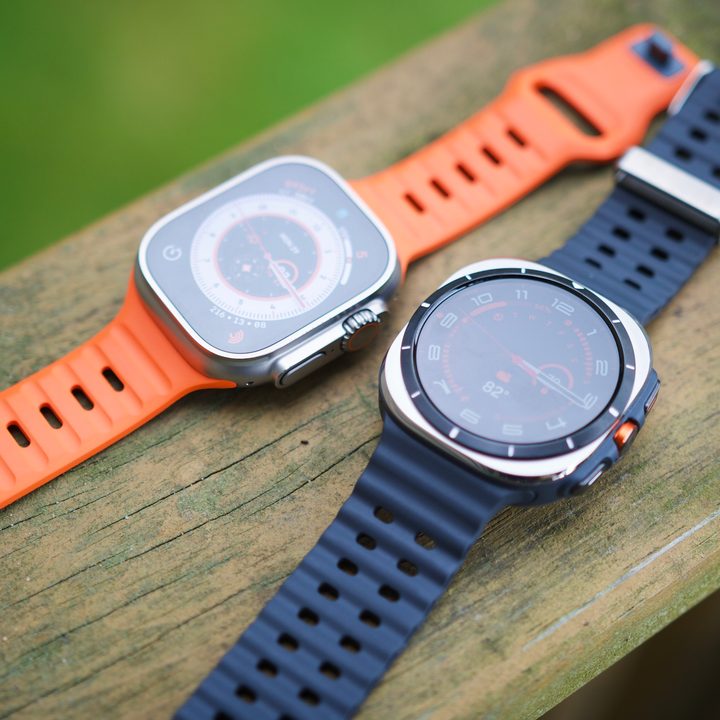
Now that you’re caught up on the specs and features, what did the results look like? Here you go:
| Samsung Galaxy Watch Ultra | Apple Watch Ultra 2 | |
|---|---|---|
| Duration | 17:06 | 17:05 |
| Distance | 2.04 miles | 2.01 miles |
| Active calories | 199 calories | 183 calories |
| Pace | 08’20” per mile | 08’28” per mile |
| Cadence | 146 spm | 144 spm |
| Heart rate | 179 bpm | 179 bpm |
| Elevation gain | 50 ft | 42 ft |
| Ground contact time | 203 ms | 284 ms |
| Vertical oscillation | 10.6 cm | 11.8 cm |
What stands out to me the most is the average heart rate. Both smartwatches recorded an average heart rate of 179 bpm for the run, which is something I did not expect going into this test. I kept my eye on both watches throughout my run, and almost every time I checked, they were within 1-2 bpm of each other — if not returning the exact same reading. I generally consider the Apple Watch Ultra 2 to have one of the best heart rate sensors on a smartwatch, so this is really impressive accuracy on Samsung’s part.
I’m also impressed by the active calories and cadence numbers being so similar. There are expected variations for other metrics (namely, elevation gain, ground contact time, and vertical oscillation), but none of them appear to be worryingly different.
I was also pleasantly surprised by the Galaxy Watch Ultra’s GPS performance. The Galaxy Watch Ultra told me I completed my 2-mile run just a couple of seconds sooner than the Apple Watch Ultra 2 did. Given complaints people have had about previous Galaxy Watch GPS reliability, it’s nice to see the new dual-frequency GPS in the Galaxy Watch Ultra is doing its job.

The other thing I’d like to mention is how all of this data is presented. The Samsung Health and Apple Fitness apps are both excellent, and they both showcase your exercise data in a clean, organized manner. However, I think Samsung does a better job presenting some of the “nerdier” metrics.
After a run, you can tap Advanced running metrics to see a breakdown of your asymmetry, contact time, flight time, regularity, vertical oscillation, and stiffness. Each one is graded as either Great, Good, or Improve. For ones that need work, you can tap on a Drills button to see a handful of exercise routines that can improve that specific area. This isn’t new to the Galaxy Watch Ultra, but it’s a much better layout compared to Apple, which just shows graphs of this data without any explanation.
Which smartwatch should you run with?

So, considering all of that, which smartwatch should you go running with? That’s ultimately decided by what kind of phone you have. If you’re an iPhone user, you can only use the Apple Watch. If you have an Android phone, your only choice is the Galaxy Watch. The Apple Watch Ultra 2 doesn’t work with Android phones, nor does the Galaxy Watch Ultra work with iPhones.
The big takeaway here is that, regardless of which Ultra smartwatch you end up choosing, you’re getting a pretty fantastic wearable. I’m thoroughly impressed by the Galaxy Watch Ultra’s performance in this test, and combined with some of the software advantages in the Samsung Health app, I’m seriously considering making it my go-to running smartwatch.
The Apple Watch Ultra 2 is still one of the best smartwatches you can buy, but if accurate and robust exercise tracking is high on your priority list, the Galaxy Watch Ultra isn’t far behind it.
Buy at Amazon