
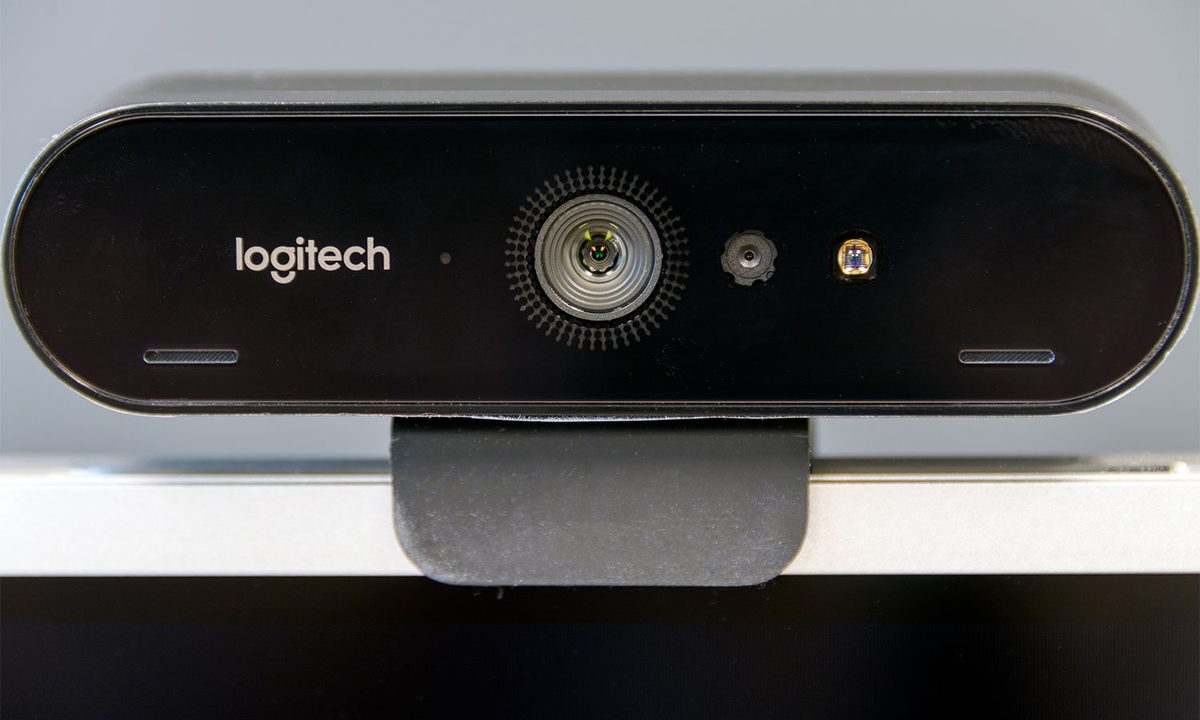
“Logitech’s Brio 4K webcam serves up dazzling image quality, though most people don't need this many pixels.”
- Sharp images
- Infrared depth-sensing
- Background replacement
- Plug and play support
- Barebones internal software
- Tinny microphone
- Few programs capture in 4K
“Why you can trust Digital Trends – We have a 20-year history of testing, reviewing, and rating products, services and apps to help you make a sound buying decision. Find out more about how we test and score products.“
With the rapid rise in streaming, YouTube content, and active vloggers, webcams have quickly gone from rarely-used peripheral to elegant all-in-one solution. Logitech’s Brio 4K webcam is the next obvious step in that evolution, with a massive pixel count and an infrared depth-sensing technology not unlike Intel’s RealSense.
You won’t find a lot of competition for the Brio, which is currently the only webcam we could find from a major brand with 4K video capture. The closest competitors feature-wise are Razer’s Stargazer, and oddly enough, Intel’s RealSense Developer kit.
At $200, the Brio is also the most expensive of the three. Are the extra pixels worth the extra bucks, or are you better off opting for something cheaper?
Smaller than you’d think
Despite its massive resolution, the Logitech Brio cuts a slim figure, with a glossy, black front panel and a dark gray housing. It sits on a bendable stand, not unlike the very popular Logitech C920, which hooks onto the front of your screen, and then holds firm against the back to keep it steady. It should work on a variety of laptops and monitors, without leaving any lasting damage or adhesive.


It connects over USB Type-C, but the included cable is USB 3.1 Type-A on the other end, so you don’t need a new computer to participate. There’s an included microfiber carrying case, with a divider in the middle to keep the cable and webcam separated during travel.
Easy to setup, not as easy to use
Like most USB webcams, the Brio is fully capable of performing at least its basic functions without any extra software. If you just need to have a quick Skype session, or take a selfie, you can just pop it onto the top of your screen and hit capture.
The stand should work on a variety of laptops and monitors, without the need for adhesive.
Finer controls over the camera require a third-party application — like Open Broadcasting Software, which required some tinkering from the default video settings — or the bundled Logitech software. It’s a simple application, with settings as specific as white balance, contrast, focus, color temperature, and as broad as zoom, pan, and brightness. Considering the high price point and resolution, we hoped for more professional controls in the built-in software.
The other issue is that most capture software isn’t setup for 4K recording and playback. Quicktime on a MacBook recognized the device immediately, and offered two quality settings, but neither was 4K. We tried to specially configure OBS, a streaming and recording program, to record at the higher resolution. When we did, we found it took an extraordinary amount of computing power to consistently record, enough that it was dropping frames and breaking our encoding settings.
At the end of the day, the only application we could use to capture 4K footage was the built-in Camera app in Windows 10. If you need to use anything else, you may be SOL without some software updates, or an extraordinarily powerful PC.
This many pixels can’t be wrong…right?
While we don’t normally expect a lot from a webcam, Logitech’s recent efforts have done wonders to change that reputation. The C920 set a new standard for webcams with great picture quality at 1080p. With way more pixels, and infrared depth-sensing, the Brio should improve upon that excellence with sharp picture quality.
Without any tinkering in the settings, the Brio produced a clear, high-quality image in any lighting situation, even the dreaded backlit portrait. That’s largely in part thanks to HDR 3 support, which allows the camera to see increased dark and white spots, without crushing details and shadows.
We showed it to one our video producers, Dan Baker, and let him take it out for a spin. Even he was pleasantly surprised at the Brio’s image quality. He noted that there was a bit of noise as you zoomed into the image, which appears as a sort of grain across some areas of the image. He noted this is often a good sign, as it can make an image feel more vibrant, and authentic, giving background areas a bit of life. In this case, however, it wasn’t as colorful as it could be, which isn’t as effective.
Audio is decent, but like most built-in microphones on webcams, relying on it will undercut the excellent video performance. It will work in a pinch, and you aren’t going to miss the point, but even a decent pair of gaming headphones will sound a lot better.
Our Take
The Brio is the first step towards higher-resolution video capture making its way out of the professional space, and there are few improvements to be made as people migrate. Image quality is great, it’s compact and attractive, and the price isn’t far out of reach compared to other high-end options. That said, adoption is going to be slow on 4K. It’s difficult to use effectively with current software and hardware.
How long will it last?
If anything, the Brio is a bit too future-proof. Most users who pick one up won’t end up recording at 4K, because it’s too resource-intensive, especially for livestreaming, and the software support for high-resolution video capture is still lacking. Depth-sensing technology is also a huge value add, and one that will continue to see stronger support over the years.
Is there a better alternative?
No, as the Brio is the only 4K webcam available. There are certainly high-end 1080p options, including Intel’s RealSense developer kits, and Razer’s Stargazer, but the Logitech Brio is the only option if you need video higher resolution than 1080p, short of buying a high-end camcorder.
Should you buy it?
No, at least not this early in the 4K webcam lifecycle. There are few high-end webcam options on the market, and the best cap out at 1080p. If, for whatever specific reason, you need the extra resolution, the Brio won’t disappoint. Yet for most users, those lower-resolution webcams are already more than enough, and will be for some time.


