“...the T30 could be a good travel PMP that, if lost, wouldn”
- Affordable; slim and compact size
- Poor interface; conversion required for video playback; difficult setup
“Why you can trust Digital Trends – We have a 20-year history of testing, reviewing, and rating products, services and apps to help you make a sound buying decision. Find out more about how we test and score products.“
Summary
For you Walmart, Kmart, or Canadian Tire (no joke) shoppers out there, the brand Nextar is a familiar name. Nextar prides itself in producing low cost electronics packed with cool features and designs. The latest attempt to woo customers is the T30 PMP (portable media player) with a 3.5-inch screen, 4GB of built-in memory, an SD slot for an additional 2GB of memory and more for the retail price of only $100.00 US. But like the old saying goes “you get what you pay for”.
Features and Design
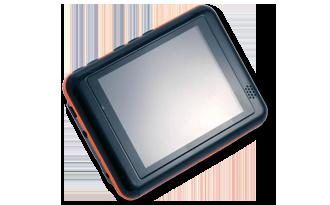
The Nextar T30 will surprise you with its overall dimensions, it’s a tiny thing at just a hair over 4 inches wide and 3 inches tall and less than a half inch thick. It’s super light and has a protective orange band around the body to help with small drops. The casing is a plastic polished piano black finish with the power, record, fast forward/rewind and return buttons on the top. Also on the top of the T30 is a slot for an external 2GB SD card. On the right side is the volume up and down with the play and pause key in the middle. The left side has the mini USB input, headphone jack and 5 volt DC power input; lastly there is also a miniature reset button.
On the face of the unit, Nextar crammed a huge 3.5-inch TFT screen and speaker. The speaker plays back your audio for both movies and MP3’s if you prefer to not use headphones. The screen has a resolution of 320×240 and can be seen well in the sun. The T30 is powered by an internal 1000mAH Li-Ion battery giving you around 8 hours of music or 4 hours of video enjoyment. The T30 supports MP3, WMA and DRM 9 playback on the audio side, and AVI on the video side. Nearly any video format can be played on the T30, but is required to be converted to the T30’s .AVI specs first. Even if you have a file encoded to AVI, expect to run it thru the included converting process before use. Nextar included an AVI converter program that did the job for us during testing.
The T30 also adds the ability to view photos in either JPEG or BMP, and even has EBOOK for you take the books on the go’ers out there. You can even read a book and listen to music at the same time on the T30. There is an FM tuner that can record your FM tunes for playback at a later time, and Nextar found room to cram in one more feature, a voice recorder. The T30 comes boxed with a set of toss away headphones, carrying case, USB cable, headphone adaptor cable, installation CD with drivers, and AVI converter program with the user’s manual.
Testing and Use
During our setup, we immediately had troubles getting the T30 to work on our regular Windows PC, and other PC test machines. At first we got the message that the PC couldn’t recognize the USB drive installed. We played with this for an hour and actually read thru the manual twice to ensure we didn’t miss a step. Finally we had to call in for help. It’s like asking for directions when driving, you’d rather steer off course until you simply give up or start hearing banjos. While we were waiting for assistance, a miracle happened and suddenly the T30 was recognized by the computer. We never confirmed the exact reason for this miraculous event, but came to the conclusion that perhaps the mini USB jack on the unit was the culprit. Out of the box it was hard to plug the cable into the T30, but after numerous attempts, we had nirvana. Once connected, we added our MP3 titles to the player, and started converting and uploading videos to the proper AVI specs. The music quality out of the tiny speaker was pretty shallow as expected, but using the headphone jack sounded good with aftermarket headphones.

The interface looks very simple – almost like an MP3 player from the 90’s
The video quality – at just 320×240 – looked good on the T30 and we were pleased. After each video ended, it automatically starts to play the next video in line. You may or may not like this as a feature, and we couldn’t find an option to change this in the settings folder. An oddity that kept showing up at the end of our video was the warning “File Format Error”, but the videos still played fine. One feature we were not pleased with is that when you want to change media sources on the T30 you have to go back 3-4 screens each time to the main menu and re-select either video, music, pictures etc. But in every category it gives you the option of choosing all 3 even though you can’t actually select them. This was extremely confusing and will certainly need to be changed in future models. This was clearly one of those gadgets that was put together by engineers, but not tested by actual users. Another oddity was every time you select the MP3 player, it automatically starts the last song you were playing, to make any changes, you are forced to go back a screen or two. This may be a feature you like, but there was not an option in the settings folder to adjust this to your own preferences.
Conclusion
If your savvy in the problem solving tech world, and don’t mind a bit of a challenge, the T30 could be a good travel PMP that, if lost, wouldn’t mean the end of the world. If you’re looking for a replacement for another PMP system, we would wait till Nextar works out the interface bugs and makes adding videos easier by not requiring a conversion program to do so.
Pros:
• Affordable
• Slim and manageable size
Cons:
• Horrible interface
• Required Conversion for video
• Difficult setup
• False error message(s)