At its big February 2023 Unpacked event, Samsung announced its long-awaited Galaxy S23 series of phones — including the S23, S23 Plus, and S23 Ultra. Though only the Ultra is getting the brand-new 200-megapixel main camera, the 50MP lens on the S23 and S23 Plus is still nothing to sneeze at. And all of the S23 devices will have Snapdragon 8 Gen 2, the floating camera design, and come in the same four muted colors: black, cream (white), green, and lavender.
But another thing that most of the lineup has in common is the base storage, which starts at 256GB for the S23 Plus and S23 Ultra. The regular S23 still starts at 128GB, but the two larger models now come with 256GB by default. Regardless, having most models with starting storage capacity of 256GB is a big change — and every other manufacturer, especially Apple, should follow suit.
64GB and 128GB aren’t enough anymore

Even though it’s 2023, it’s not uncommon to find phones still shipping with 64GB of base storage, or 128GB if you are lucky. 64GB of storage is really pushing it these days, and while 128GB is better, I honestly don’t think that’s enough either.
Let’s start with 64GB. I reviewed the Moto G Play (2023) that came out a few weeks ago, and that device only has 32GB of storage. I noticed during my testing that Android 12 took up almost half of that space, giving me around 18GB or so of space that I can use as I see fit. Given those facts (if the OS takes about 14–15GB), a 64GB Android smartphone may only have about 49GB of actual storage space for you to use, though you may be able to expand storage by using a microSD card. However, that’s an extra expense, and not everyone may feel like spending more money just to make the most out of their new device.
These days, most people use their smartphones to take photos and videos, listen to music and audio, watch television series and movies on the go, play games, and even work with large files — all on a phone. Over time, unless you are super minimal, that storage space will quickly get eaten up by photos and video, files, and apps. Those popular, graphically-intensive games can eat up just a few gigabytes alone. And then there are updates for apps and the OS itself, which can range from just a few hundred megabytes or be over a gigabyte.

Though some people may get by with just 64GB, having close-to-full internal storage can also slow down your device, giving you a suboptimal experience. And even if you are careful with the number of pictures you take or the number of apps and games you download, there’s the data that is cached in apps. Over time, if you send a lot of pictures to friends and family, for example, your messaging apps will take up more space than you realize — which may result in sluggish performance or lag.
128GB provides a bit more breathing room than 64GB, but I think that’s still not quite enough, contrary to some opinions around here. Even with 128GB, if you like to make the most out of your device, then you may need to be cautious with using it however you please. I blew past 128GB a long time ago on my 1TB iPhone 14 Pro (currently at 368.8GB used).
Apple, Google, and others need to make 256GB the new normal

As of right now, both Apple and Google offer 128GB as the starting storage on the iPhone 14 and Pixel 7 lineups. Apple goes up to 1TB on the iPhone 14 Pro models, and Google goes up to 512GB on the Pixel 7 Pro. Regardless, it would be better for both Apple and Google, as well as Samsung and other manufacturers, to just eliminate the paltry 128GB storage option and go with 256GB as the starting point.
For example, the 128GB iPhone 14 Pro is already hampered because of the storage size compared to the larger capacities. If you want to record ProRes video, the 128GB iPhone 14 Pro can only record at 1080p at 30 fps, whereas the 256GB/512GB/1TB options can all record ProRes at 4K at 30 fps.
It’s time to eliminate the paltry 128GB storage option and go with 256GB as the starting point.
This may be a limited use case, but it’s still a handicap of having the base storage option at 128GB. And if you want to shoot in 4K ProRes, a single minute of footage is over 1GB — even if the 128GB model could do 4K ProRes video, the storage on it would be eaten up very quickly.
I personally don’t understand why Apple would even release a 128GB version of the “Pro” iPhone if it is going to hinder its full potential. To me, it just seems like a waste, and there’s no point to the 128GB option besides wanting the most affordable “Pro” iPhone. Google doesn’t seem to have any limitations on the 128GB base model for its Pixel phones, but considering how good the Pixel 7 is for taking photos, it may be easy to go through that space if you’re like me and take photos of everything, on top of downloading a myriad of apps and games from the Google Play Store.
Samsung mostly raises the bar for phone storage
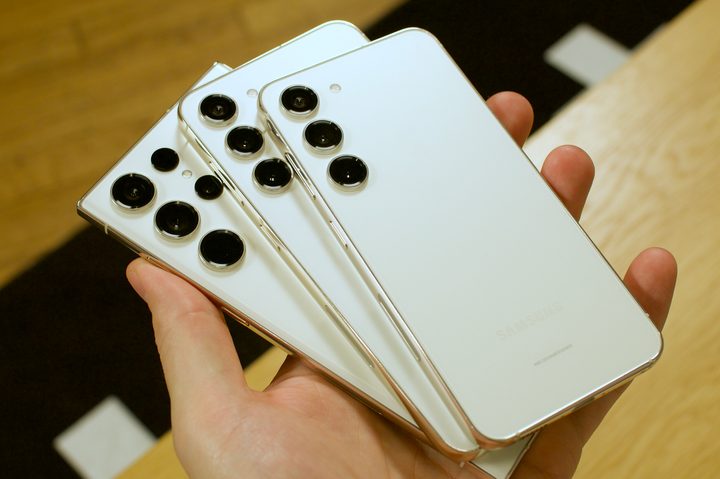
For some people, 128GB may be plenty of space. But I’m the kind of person who likes to have extra breathing room and not worry about running out of storage. I have a 1TB iPhone 14 Pro, after all.
I believe Samsung offering 256GB storage as the base storage option is a fantastic change, and more companies should follow suit. Even though the regular Galaxy S23 starts at 128GB and only goes up to 256GB (you’ll need to get an S23 Plus or S23 Ultra for larger capacities), I think 256GB is a good size for everyone.
What’s wrong with just enjoying your phone without having to worry about getting the dreaded “storage full” message later down the road? It’s a win-win for all — especially when the price stays the same. Galaxy S23 pre-orders are open now.