  1. Home
  2. Cars
  3. News

By 2021, you could be sleeping behind the wheel of an autonomous Volvo XC90

Add as a preferred source on Google
Ronan Glon/Digital Trends

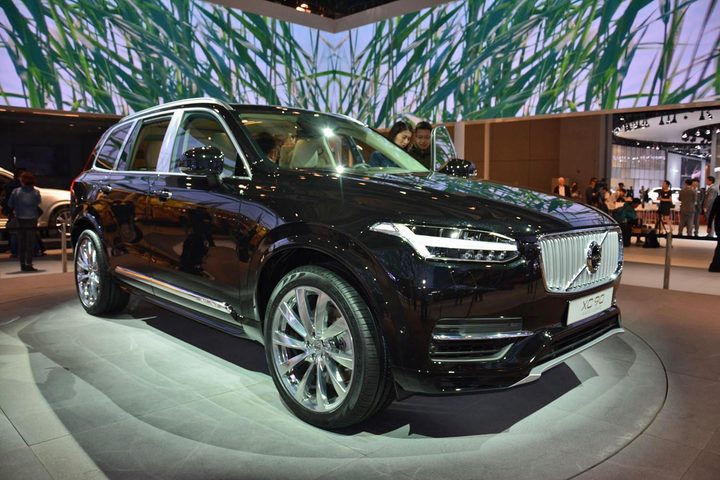
By 2021, you could be sitting behind the wheel of a truly driverless Volvo. The Swedish automaker’s research and development chief recently told The Car Connection that the company is planning to sell a Level 4 self-driving crossover SUV in 2021. Level 4 autonomy describes cars that can drive themselves without any human interaction, other than entering a final destination.

According to Volvo Senior Vice President Henrik Green, the next-generation XC90 will be assembled near Charleston, South Carolina, and should be able to take “sleeping passengers” from Point A to Point B. Of course, only limited roadways would be eligible for these cars to drive on, but even so, this could be a huge step forward in the world of autonomous vehicles. According to Green, the goal, for now, is to partially automate commutes.

Recommended Videos

The proposed technology would be dubbed Highway Assist, which sounds a whole lot like Pilot Assist, a feature Volvo already supports on its existing models. But don’t assume that Highway Assist will come standard on Volvo vehicles — rather, it would be a premium addition to the XC90, and would set back dedicated drivers (or non-drivers, as it were) “four figures.” Of course, that leaves quite a range to be considered, and we’ve yet to find out a concrete price tag.

Level 4 semi-self driving technology is not currently available to the public and is particularly differentiable in that it does not default to human driver control should emergency action be required. While Volvo has tested similar systems in and around its headquarters in Gothenburg, Sweden, it hasn’t done any such testing in the U.S.

Green further noted that the new Highway Assist feature would leverage information based in the cloud, like map data, in order to steer and route the car. It would not rely on vehicle-to-infrastructure communication systems, The Car Connection reports. Rather, Highway Assist would depend upon lidar, radar, and onboard cameras.

Volvo will have to work closely with both national and state regulators in order to win the green light for the autonomous system, which has presented a challenge to other carmakers. But it has three years to do it in order to make good on its promise.

Lulu Chang
Fascinated by the effects of technology on human interaction, Lulu believes that if her parents can use your new app…
This tiny sensor could help self-driving cars and robots see better in the dark
Penn State researchers have developed a light-adaptive photomemristor modeled on the human eye that achieves over 95% visual accuracy in shifting light conditions.
Waymo Jaguar I-PACE sensors close up

Penn State researchers have developed a light-adaptive sensor component that could make autonomous vehicle cameras and robots far more reliable in shifting lighting conditions. The work, published Monday in Nature Communications, takes direct cues from how the human eye adjusts between bright and dark environments.

Biology as a blueprint

Read more
Rivian R2 first drive: A mid-sized EV game-changer punching above its budget
Smart engineering meets real-world performance in a surprisingly premium $50K electric SUV
Rivian R2 First Drive Impressions

Rivian has officially launched the R2, a smaller, more affordable two-row electric SUV. Despite the lower price point, the company does not seem to have cut any corners on the new vehicle. Instead, many of the savings seem to have been achieved through more efficient engineering.

Examples of that efficiency can be seen in things like the vehicle’s wiring, which has ditched around two miles of cable when compared to the R1. A lot of the vehicle’s systems and chipsets have been compacted and condensed too.

Read more
Rivian R2 SUV deliveries have begun, just not for the version most buyers may want
The budget-friendly R2 is not here yet
Rivian R2 in Catalina Blue.

As promised, Rivian has started deliveries of its R2 electric SUV. The first version reaching buyers is the R2 Performance with Launch Package, which starts at $57,990 before fees.

That model gives early R2 customers the most powerful version in the confirmed lineup. It comes with dual-motor all-wheel drive, 656 horsepower, 609 lb-ft of torque, and an EPA-estimated range of up to 330 miles. Rivian claims it can go from 0 to 60 mph in 3.6 seconds.

Read more