
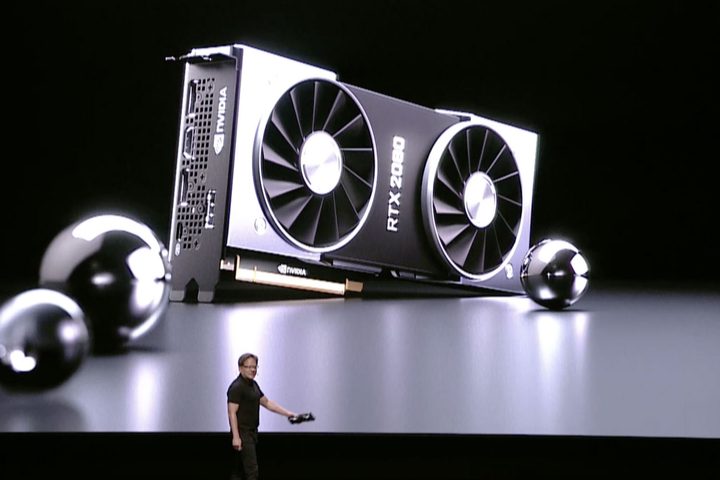
New performance details are trickling out about Nvidia’s newest offering, the RTX 2080, and the consumer graphics card is as powerful as Nvidia’s claims, which bodes well for gamers. Even if you’re planning on sticking with current titles — those that don’t support the ray tracing capabilities that are a hallmark of the new RTX chips — you’ll still see some sizable performance gains compared to the older GTX 1080 chips, with Nvidia claiming a 50 percent improvement for many titles.
“Games like PUBG, Shadow of the Tomb Raider, Hitman 2, Wolfenstein II, and Shadow of War will be around 50 percent faster on an RTX 2080 at 4K resolution,” The Verge reported. “Nvidia also claims 4K running at 60 fps is now possible with the RTX 2080 in games like Call of Duty WW2, Destiny 2, Far Cry 5, and Battlefield 1.”
Even greater performance improvements can be seen when developers enable Deep Learning Super-Sampling, also known as DLSS, which uses the Tensor Cores in the new Turing architecture to render objects using A.I. and deep learning. When enabled, Nvidia claims that games will see between a 75 to 100 percent improvement compared to the GTX 1080, meaning that the RTX 2080 has up to twice the performance of the GTX card.
“As you can see, NVIDIA is claiming a roughly a 40-60 percent performance uplift for a Turing-based GeForce RTX 2080 versus the GTX 1080 right out of the gate, and that’s with DLSS disabled,” Hot Hardware wrote. “Flip on DLSS in a compatible game engine, however, and that performance lift jumps up to over 2x in some cases, like the Infiltrator demo and Final Fantasy, while offering similar image quality. Though smaller, other games still get a sizeable performance boost as well.”
“We saw DLSS in action and a Nvidia RTX 2080 Ti was able to render Epic Infiltrator at a steady 85 frames per second (fps),” TechRadar confirmed. “Right next to the Turing rig was a Nvidia GTX 1080 Ti-powered system that struggled to keep the same experience running near 45 fps with temporal anti-aliasing and supersampling turned on.
Traditionally, the rendering of scenes in a game relies on the GPU’s hardware and memory. DLSS renders a scene by using inferencing and shifts the heavy workload to A.I. This frees up the GPU’s resources for other tasks.
“Powered by Turing’s Tensor Cores, which perform lightning-fast deep neural network processing, GeForce RTX GPUs also support Deep Learning Super-Sampling (DLSS), a technology that applies deep learning and A.I. to rendering techniques, resulting in crisp, smooth edges on rendered objects in games,” Nvidia said of the technique.
Nvidia states that developers can send in the game code, and Nvidia will use its DGX supercomputer to build DLSS into the game code at no charge. The finalized code will be sent back to developers.
Although we’re starting to see prices dropping for the GeForce GTX 1080, these performance gains may be worth giving the RTX 2080 a second look. In the future, games that take advantage of ray tracing and DLSS will benefit most from Nvidia’s new GPU architecture.


