  1. Home
  2. Computing
  3. News

Intel awards five more laptops with Project Athena badges

Add as a preferred source on Google
Image used with permission by copyright holder
IFA 2025
This story is part of our coverage of IFA Berlin 2025

Project Athena is Intel’s way of verifying and marketing specific laptops, and ahead of IFA 2019, the company has expanded the program to include some more devices.

The first verified systems, the HP EliteBook x360 1040 and 830, will be joined by the Dell Inspiron 14 5000, Dell Latitude 7400 2-in-1, Dell XPS 13 2-in-1, and Lenovo ThinkPad X1 Carbon. These laptops will now be sold with a new badge that says “Engineered for Mobile Performance.” It’s not the most pithy phrase in the world, but it’s meant to communicate Intel’s closer involvement with the design and experience of the product.

Recommended Videos

In a press release, Intel included a quote from some merchants getting behind the marketing effort, including Costco and Best Buy.

According to Costco, “Project Athena-based laptops are what our members desire with improved performance, instant on, intelligence, better battery life and improved connectivity, all in new, beautiful, sleek form factors. We’re excited to partner with Intel to be at the forefront of PC innovation.”

What does this badge actually mean? Well, Intel opened up labs in Taipei, Shanghai, and Folsom, California to test systems for a few specific performance qualifications. General performance and low-power optimization is what Intel is looking for as it attempts to push the industry toward thinner designs, extended battery life, and fast performance.
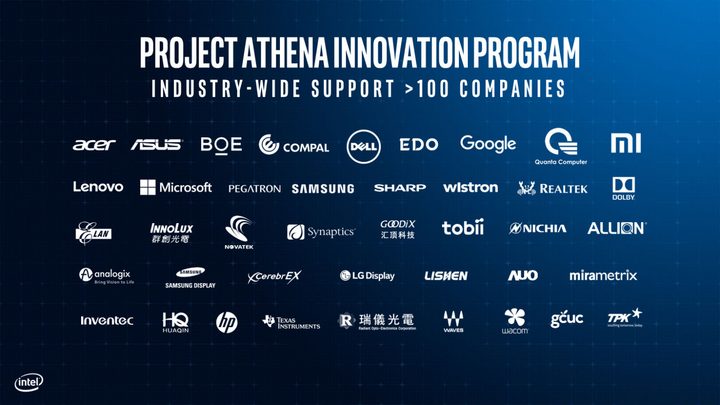
Image used with permission by copyright holder

Intel says the verified components include “solid-state drives, touch controllers, embedded controllers, and display panels, which can often have the greatest effect on a device’s performance and power consumption.”

Elsewhere, Intel claims Project Athena verifies six “innovation vectors,” which include “instant action, performance and responsiveness, intelligence, battery life, connectivity, and form factor.” That’s quite a wide variety of areas, covering most of the important aspects of a high-end laptop. If manufacturers want the new badge, they’re expected to align the systems with Intel’s specifications. This is only the first year of what is supposed to be a multiyear project for Intel, and is akin to its push for the Ultrabook designation in the 2000s.

The rollout of Project Athena also coincides nicely with Intel’s launch of its new 10th-gen mobile processors. This year’s processors are split into two distinct lines: 14nm Comet Lake and 10nm Ice Lake, though the choice of processors doesn’t seem to affect whether or not a laptop is awarded with the new badge.

Luke Larsen
Former Senior Editor, Computing
Luke Larsen is the Senior Editor of Computing, managing all content covering laptops, monitors, PC hardware, Macs, and more.
Windows 11’s modern Media Player is somehow worse than the version from 17 years ago
The modern Media Player for Windows 11 is slower and heavier than the classic version
Windows 11 media player user interface

Microsoft has released a new Insider Preview update for the modern Windows 11 Media Player. However, the app is facing criticism after tests revealed it uses more memory and opens local video files more slowly than the classic 17-year-old Windows Media Player.

The update adds some useful fixes, including better captions, clearer codec errors, and improved file recognition. But the biggest complaints remain higher RAM usage and paid codec support for some common video formats. The update is not available to everyone yet. Media Player version 11.2605.14.0 has only arrived on Experimental Insider builds as part of Microsoft’s June 12 Insider Preview releases.

Read more
If you have a Mac, you should try this free and beautifully-designed disk space tool
Radix is a free open-source alternative to paid Mac disk analyzers
File, Electronics, Mobile Phone

Running out of storage on a Mac is common, but Apple’s built-in storage tools are not always great at showing what is actually taking up space. You usually get broad categories, but finding the exact folders, downloads, app files, or old projects causing the problem can still take some work.

Radix is a free, open-source Mac app that tries to make that process clearer. It is a disk space analyzer that scans a folder, drive, or volume and displays the results in an interactive sunburst chart. Rather than digging through folders manually, you get a visual overview of how storage is being used across your drive.

Read more
This free Mac app puts stunning glassy widgets on your lock screen
WidgetScreen brings weather, calendar, battery, and music widgets to your Mac lock screen
Aquatic, Water, Animal

The Mac lock screen has always felt a little underused. You see the time, your wallpaper, and not much else. macOS already supports desktop widgets, but once your Mac is locked, that extra information disappears.

WidgetScreen is trying to fix that in a pretty simple way. The free Mac app, made by UK computer science student Sam Cook, adds glassy widgets to the lock screen so you can quickly check things like the weather, clock, calendar, battery, music playback, countdowns, and system information.

Read more