  1. Home
  2. Cars
  3. News

The next Cadillac Escalade will be capable of changing lanes on its own

Add as a preferred source on Google
 

Cadillac detailed a much more advanced evolution of the semi-autonomous Super Cruise technology currently available on some of its models Tuesday morning. Super Cruise stands out as one of the smartest technologies of its kind on the market in 2020, and the firm will soon improve it by adding a host of new functions like automatic lane changing.

Recommended Videos

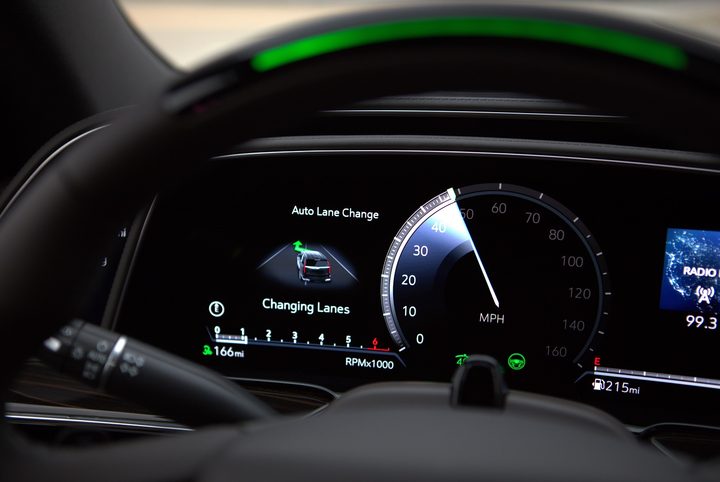
As its name implies, automatic lane changing allows the car to move into the next lane while the driver’s hands are off the steering wheel. With Super Cruise engaged, motorists need to request the change by tapping or engaging the turn signal stalk in the direction they want to move in. Signal left to merge into the next lane to the left, for example.

The car doesn’t dart into a gap in the traffic flow like a human might. Once the driver requests a lane change, the on-board cameras and sensors begin scanning the lane to determine if there is enough space for the car to merge, and they also track approaching vehicles to determine whether there is sufficient time to move over. If both conditions are met, the car signals and carefully moves over by reading the lane markings painted on the pavement.

Cadillac noted the driver doesn’t need to touch the steering wheel but is still expected to initiate and monitor the lane-changing process. The digital instrument cluster keeps motorists informed of what the car is doing at any given moment. It shows messages like “looking for an opening” or “changing lanes” so none of it comes as a surprise.
Cadillac Super Cruise graphics
Image used with permission by copyright holder

Super Cruise also gains more accurate maps covering approximately 200,000 miles of North America’s highways and improved driving software. Cadillac pointed out engaging the feature is now easier and more intuitive, too.

“This is our most extensive update we’ve made to Super Cruise since its debut,” summed up Mario Maiorana, the technology’s chief engineer, in a statement. The CT6, Cadillac’s former flagship, first received the technology in 2017. The company pointed out the changes were made possible by a new digital platform that provides more electrical bandwidth and additional data processing power. Super Cruise is Cadillac-exclusive for the time being, but the digital platform was developed by General Motors for all of its brands, so a similar feature might appear elsewhere.

The CT4 and the CT5 respectively launched to replace the ATS and the CTS will inaugurate the next evolution of Super Cruise when they reach American showrooms during the second half of 2020. The next-generation Escalade scheduled to make its global debut on February 4 and expected in stores by the end of the year will also be available with the technology. Super Cruise will be an extra-cost option on all three models, but pricing hasn’t been announced yet. Looking ahead, most of Cadillac’s upcoming cars will be offered with this suite of semi-autonomous driving aids.

Ronan Glon
Ronan Glon is an American automotive and tech journalist based in southern France. As a long-time contributor to Digital…
China has new EV safety rules ready. The US needs to follow in its footsteps
Mandatory battery fire protections and hard power cutoffs show what a tougher EV safety playbook could look like in the U.S.
EV

China's EV safety rules are about to make automakers prove their cars can fail safely, not merely warn people before trouble spreads.

Starting July 1, 2026, two mandatory national standards will require stronger battery safeguards and a physical one-touch way to cut high-voltage power during an emergency. The pressure points are the ones drivers, firefighters, insurers, and regulators can't brush aside for much longer, including battery fires, crash damage, smoke exposure, and rescue access after a severe incident.

Read more
Mercedes’s Chinese partner made an EV that costs under $10,000 and looks deceptively stylish
At around $10,000, the Arcfox Beta T1 has a feature list that embarrasses several $30,000 US EVs.
Car, Transportation, Vehicle

BAIC, the Beijing-based automaker that produces Mercedes-Benz vehicles in China, has launched the refreshed Arcfox Beta T1 on June 16, a compact EV priced roughly between $9,200 and $11,700, depending on the trim.

It's not coming to the United States, but the fact that its most affordable version undercuts the cheapest new car sold here by roughly $13,000 and the cheapest EV by almost $20,000 deserves some attention. What BAIC has built here is a direct indictment of the higher EV costs here in America.

Read more
The world’s biggest battery maker just pumped the brakes on solid-state EV hype
CATL chairman Robin Zeng says the technology is still in lab-phase development, with mass-market deployment unlikely before 2030.
Architecture, Building, Shop

Solid-state batteries have been hyped as the technology that will transform electric vehicles, promising higher energy density, faster charging, and improved safety over the lithium-ion cells powering most cars today. But the head of the world's largest battery maker says buyers should not hold their breath.

CATL chairman Dr. Robin Zeng told Caijing Magazine (via CarNewsChina) that large-scale commercialization of solid-state batteries will not be achievable before 2030. The company has set a threshold of 1 million vehicles as the production volume required to justify mass deployment, a figure that remains out of reach for the foreseeable future. When solid-state cells do reach the market, Zeng said initial integration will be limited to premium vehicles priced above 250,000 yuan (roughly $37,000).

Read more