  1. Home
  2. Emerging Tech
  3. News

NASA suspends work on Space Launch System and Orion, may delay moon mission

Add as a preferred source on Google

Following outbreaks of coronavirus, officially called COVID-19, at and around a number of its facilities, NASA has announced it is suspending both its Space Launch System and Orion projects. The suspension is described as temporary but it is not yet known how long it will go on for.

“NASA will temporarily suspend production and testing of Space Launch System and Orion hardware,” NASA administrator Jim Bridenstine announced in a statement. “The NASA and contractors teams will complete an orderly shutdown that puts all hardware in a safe condition until work can resume. Once this is complete, personnel allowed on site will be limited to those needed to protect life and critical infrastructure.

Recommended Videos

“We realize there will be impacts to NASA missions, but as our teams work to analyze the full picture and reduce risks we understand that our top priority is the health and safety of the NASA workforce.”
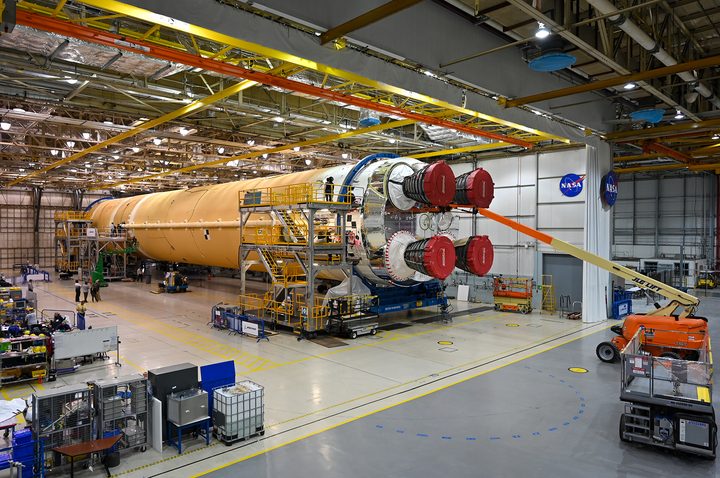
The Space Launch System (SLS) rocket core stage is prepared for shipping.
The Space Launch System (SLS) rocket core stage being prepared for shipping. NASA/Steven Seipel

The Space Launch System (SLS) is NASA’s next-generation rocket system for launching heavy payloads and deep space missions such as the Moon to Mars project. But it has suffered from multiple delays and a ballooning budget over the years, although assembly of the rocket was finally completed last year. Orion is the spacecraft currently in development for carrying astronauts to the moon, to be launched on SLS. It recently completed space environment testing and was set to be shipped to Kennedy Space Center for launch preparations.

The suspension of the production and testing of the rocket and craft may mean that the aimed 2024 launch date for the Artemis mission to the moon could be pushed back.

NASA has confirmed that an employee from the Stennis Space Center has been taken ill, as well as there being a rising number of COVID-19 cases in the community around this center and the Michoud Assembly Facility. The agency requested last week that employees work from home, before updating this request to a requirement on Wednesday.

Despite these issues, however, NASA has said that it still intends to go ahead with its May mission to send astronauts to the International Space Station (ISS) aboard a SpaceX Crew Dragon capsule. This would mark the first time American astronauts have been launched from American soil since the shuttering of the Space Shuttle program in 2011.

Georgina Torbet
Georgina has been the space writer at Digital Trends space writer for six years, covering human space exploration, planetary…
The best new ChatGPT feature is one most people will never use
Logo, Emblem, Symbol

For years, the biggest conversation around AI has been what these tools can do. They can browse the web, analyze documents, connect to your apps, conduct research, and increasingly act on your behalf. But as AI systems become more capable, another question has become harder to ignore: what happens when an AI assistant is tricked into handing over information it shouldn’t?

OpenAI’s new Lockdown Mode is its latest answer to that problem. Available across all ChatGPT account types, Lockdown Mode is an optional security setting designed for people and organizations handling sensitive information. The trade-off is that you get stronger protection against certain forms of data theft, but you lose access to some of ChatGPT’s most powerful features.

Read more
An app that lets anyone control a robot from their phone, no coding required
Sounds cool, right? Forget doomscrolling, now your phone can operate a robot arm instead
Representative Image

A team of researchers at Georgia Tech has developed a new smartphone-based system that could dramatically simplify how people interact with robots. Called COBALT, the platform allows users with little to no computing experience to remotely control robot arms from virtually anywhere in the world using just a phone and an internet connection.

The project, developed at Georgia Tech’s People, AI & Robotics (PAIR) Lab, transforms smartphones into motion controllers for robotic arms. Users simply move their phones in different directions, and the robot mirrors those movements in real time. Basic tasks such as grabbing, moving, and releasing objects can be performed through simple on-screen controls, making the experience feel more like playing a mobile game than operating industrial machinery.

Read more
Coursera wants users to learn through shorter, faster content
Coursera wants online learning to feel more like TikTok
Coursera

Online learning platform Coursera is taking a page straight out of TikTok’s playbook. The company has launched a new AI-powered feed designed to serve short-form educational content in a scrollable, personalized format, signaling a major shift in how digital learning platforms may try to keep users engaged.

The feature introduces bite-sized video lessons, clips, and explainers curated through artificial intelligence based on a user’s interests, learning habits, career goals, and previous course activity. Instead of committing to hour-long lectures or full certification programs upfront, users can now discover short educational snippets designed to make learning feel more casual, accessible, and addictive.

Read more