  1. Home
  2. Space
  3. Emerging Tech
  4. News

NASA’s troubled next-generation rocket is finally assembled

Add as a preferred source on Google

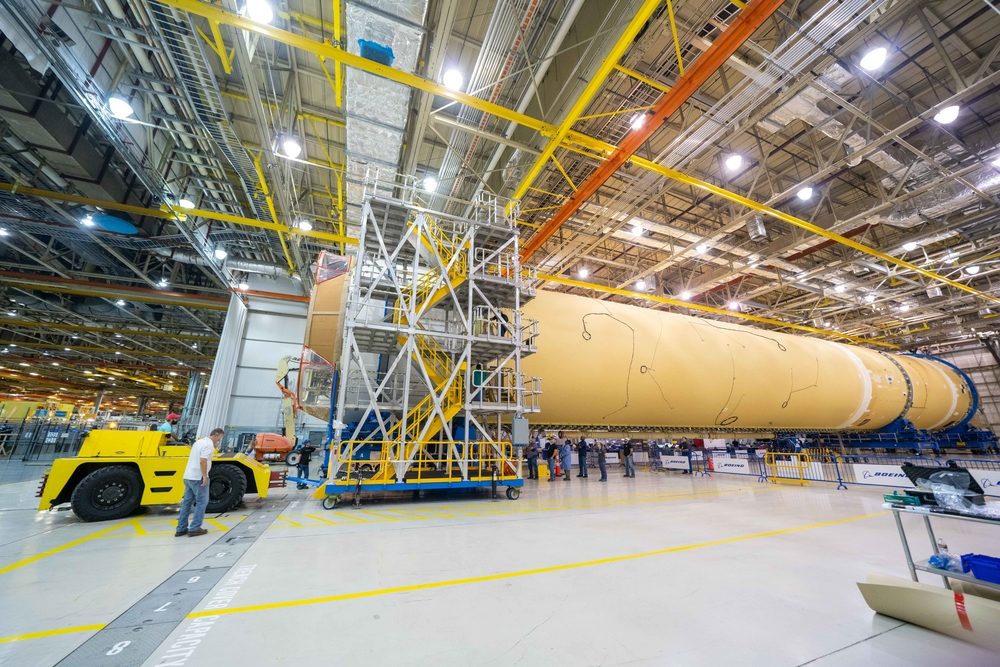
NASA finished assembling the main structural components for the Space Launch System (SLS) rocket core stage on September 19. Engineers at NASA’s Michoud Assembly Facility in New Orleans fully integrated the last piece of the 212-foot-tall core stage by adding the engine section to the rest of the previously assembled structure. NASA/Steven Seipel

NASA’s Space Launch System (SLS) should be the next generation of rocket, suitable for launching extremely heavy payloads and traveling to deep space on missions such as the planned Moon to Mars mission that begins with the Artemis project. But the SLS project has been troubled, suffering from delays and ballooning costs. Progress is being made, however, and recently NASA shared an update on the status of the rocket.

Recommended Videos

All five sections which comprise the main structural component of the rocket stage have now been joined by engineers at NASA’s Michoud Assembly Facility in New Orleans. The stage should produce a hefty 2 million pounds of thrust in addition to the two solid rocket boosters which produce a combined 8.8 million pounds of thrust. For reference, a current-generation rocket like a SpaceX Falcon 9 produces about 5 million pounds of thrust at takeoff from its combined 27 Merlin engines.

The core stage of the SLS is 212 feet tall and was completed when the engine section was bolted on. This section is attached to the tank for holding the liquid hydrogen fuel and will house four RS-25 rockets as well as the solid rocket boosters. With the stage now assembled, there’s more work to do to including attaching the engines themselves and connecting them to the propulsion system.

“NASA has achieved a historic first milestone by completing the final join of the core stage structure for NASA’s Space Launch System, the world’s most powerful rocket,” Julie Bassler, the NASA SLS stages manager, said in a statement. “Now, to complete the stage, NASA will add the four RS-25 engines and complete the final integrated avionics and propulsion functional tests. This is an exciting time as we finish the first-time production of the complex core stage that will provide the power to send the Artemis I mission to the Moon.”

NASA expects that the core stage will complete final assembly in December this year, at which point it will be sent to the Stennis Space Center in Mississippi for a first round of testing.

Georgina Torbet
Georgina has been the space writer at Digital Trends space writer for six years, covering human space exploration, planetary…
Blue Origin successfully re-uses a New Glenn rocket for the first time ever
Blue Origin achieves first New Glenn reflight despite payload setback
Blue Origin

Blue Origin has achieved a major milestone in its spaceflight ambitions by successfully reusing a booster from its heavy-lift New Glenn rocket for the first time. The historic launch, conducted on April 19, marks a significant step forward for Jeff Bezos’ space company as it seeks to compete with rivals like SpaceX in the rapidly evolving commercial launch market.

A Milestone With A Mixed Outcome

Read more
Stunning close-up footage shows NASA’s moon rocket roaring to space
On its first crewed flight, NASA's lunar rocket displays its awesome power.
NASA's SLS rocket roars skyward at the start of the Artemis II mission on April 1, 2026.

As NASA’s Artemis II astronauts journey back to Earth following their breathtaking close encounter with the moon earlier this week, the space agency has just shared some stunning footage (below) of the rocket launch that sent the crew on its way on April 1.

The close-up tracking shot shows the awesome power of the Space Launch System (SLS) rocket’s four core RS-25 engines together and its two solid rocket boosters as the 98-meter-tall vehicle roars away from the launchpad at the Kennedy Space Center in Florida.

Read more
How to watch NASA’s moon crew splash down at end of historic mission
The Orion spacecraft's final moments before splashdown will be the most perilous of the entire mission.
Earth and the moon as seen from the Orion spacecraft during the Artemis II mission in April 2026.

The Artemis II astronauts have looped around the moon, captured some extraordinary imagery (above), set a slew of records, and are now on their way back to Earth.

The 10-day mission will reach its climax on Friday, April 10, during a dramatic homecoming that will see the Orion spacecraft enter our planet’s atmosphere at a speed of nearly 25,000 miles per hour.

Read more