1. Home
  2. Space
  3. News

NASA astronauts offer Thanksgiving messages from the space station

Add as a preferred source on Google
 

A day ahead of Thanksgiving, astronauts aboard the International Space Station (ISS) have offered personal messages for folks back on the ground. The space station inhabitants also revealed how they’ll be celebrating the special day inside the orbiting laboratory 250 miles above Earth.

Recommended Videos

Happy Thanksgiving from the International Space Station! This year, the crew hopes celebrate by watching football, sharing a meal together, and calling loved ones at home.

The crew shares what they're most thankful for, and what's on the menu for the big day. pic.twitter.com/Z69bLJnNBj

— NASA's Johnson Space Center (@NASA_Johnson) November 23, 2020

Four Americans are currently aboard the space station, including Victor Glover, Shannon Walker, and Michael Hopkins, who arrived there a week ago aboard the Crew Dragon spacecraft. Kate Rubins, who arrived last month aboard a Soyuz spacecraft, is also part of the current Expedition 64 crew.

In a short video posted online (above), Rubins said it would be “awesome and special” to be able to celebrate Thanksgiving in space with an international crew that includes two Russian cosmonauts and a Japanese astronaut.

“We’re grateful to be up here,” Rubins said, “We’re very thankful for everybody that helps us out on the ground and supports us. I’m personally incredibly grateful that I have these wonderful new crewmates … and I’m just grateful that we are all able to share this moment with you.”

Rubins noted that the Americans on board the station will also be taking time out to speak with family and friends back on Earth.

The three other U.S. astronauts followed with their own messages, while Soichi Noguchi of Japan’s JAXA space agency revealed he’d brought along a few of his own nation’s dishes for the crew’s Thanksgiving meal — food that you certainly wouldn’t ordinarily associate with the American holiday (watch the video to find out what he has in store for them). Hopkins confirmed they’ll also be enjoying the more traditional dishes, albeit space versions.

For two of the Expedition 64 crew members, this isn’t their first time spending Thanksgiving aboard the space station, as both Walker and Hopkins have experienced the holiday in space on previous missions.

The Expedition 64 crew will spend their Thanksgiving in space, but for @NASA_Astronauts Shannon Walker and Mike Hopkins, it's their second Thanksgiving aboard the @Space_Station!

Thanksgiving history on station: https://t.co/FbQ34bPDGB. pic.twitter.com/yoZQC6WiE6

— NASA's Johnson Space Center (@NASA_Johnson) November 24, 2020

This month, NASA and its international partners have also been celebrating 20 years of continuous human habitation aboard the International Space Station. Check out this collection of astronaut videos showing how inhabitants of the orbiting outpost work, rest, and play.

Trevor Mogg
Contributing Editor
Not so many moons ago, Trevor moved from one tea-loving island nation that drives on the left (Britain) to another (Japan)…
Lightsails have hit another speed bump on the road to interstellar travel
The coolest interstellar travel idea may get betrayed by the light pushing it
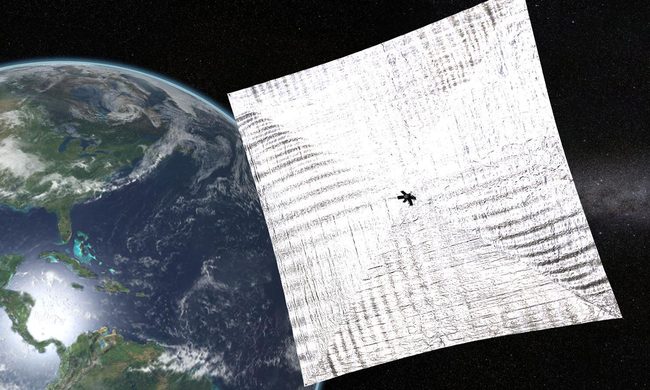
LightSail in Earth orbit

Laser-powered lightsails are one of the coolest answers to spaceflight. It might not be as sci-fi-sounding as a warp drive, but now, its practicality has also come under question. Using lightsails, a spacecraft could unfurl an ultra-thin reflective sail and let a powerful laser push it toward another star, without relying on fuel.

The tech was simple and elegant--except it's also more complicated than it sounds. A new preprint from researchers Chao Shen and Jiaze Li of the Harbin Institute of Technology suggests that relativistic lightsails may run into a hidden propulsion problem once they start moving extremely fast.

Read more
The galaxy has an exoplanet size mystery, and NASA’s EVE mission wants to solve it
This planet-hunting mission wants to catch baby worlds before they grow up
Artist’s Illustration of Exoplanets Orbiting Barnard’s Star

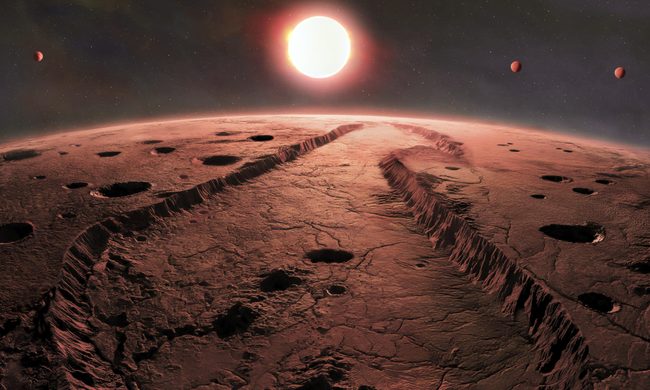
Mankind venturing into space ended up creating more questions than it answered, and one of the dilemmas is related to the planet sizes. Astronomers have found plenty of rocky super-Earths and plenty of puffier sub-Neptunes, but far fewer planets with a radius of about 1.8 times Earth’s.

That gap is known as the radius valley, and a proposed mission called the Early eVolution Explorer, or EVE, wants to figure out why it exists. NASA has a simple plan: look at planets while they are still young. The mission concept, detailed in a new arXiv preprint and covered by Phys.org, would focus on newly formed star clusters to see what small planets look like before billions of years of evolution.

Read more
We just got a hot signal that a Tesla and SpaceX merger could happen, after all
Tesla

For years, the idea of Tesla and SpaceX becoming a single company has lived somewhere between ambitious business theory and Elon Musk fan fiction. The two companies already share DNA, leadership influence, engineering talent, and long-term goals. But every time the topic surfaced, it felt more like an interesting thought experiment than a realistic possibility. Now, one of the most important people at SpaceX has added fresh fuel to the conversation.

Speaking in a recent CNBC interview, SpaceX President and COO Gwynne Shotwell was asked about the possibility of closer ties between Tesla and SpaceX. Her response wasn’t a flat-out denial. In fact, she suggested that bringing the two companies together could make life a little easier for Musk. That may sound like an offhand comment, but coming from Shotwell, it’s noteworthy. She’s been at SpaceX since its earliest days and remains one of the company's most influential executives.

Read more