  1. Home
  2. Space
  3. News

James Webb Space Telescope suffers another launch delay

Add as a preferred source on Google

The launch of the James Webb Space Telescope has been pushed to no earlier than December 22 following an incident that occurred as the observatory was being attached to the rocket that will carry it to space.

The space observatory — the most powerful of its kind ever built — was set to launch from Europe’s spaceport in Kourou, French Guiana, on December 18.
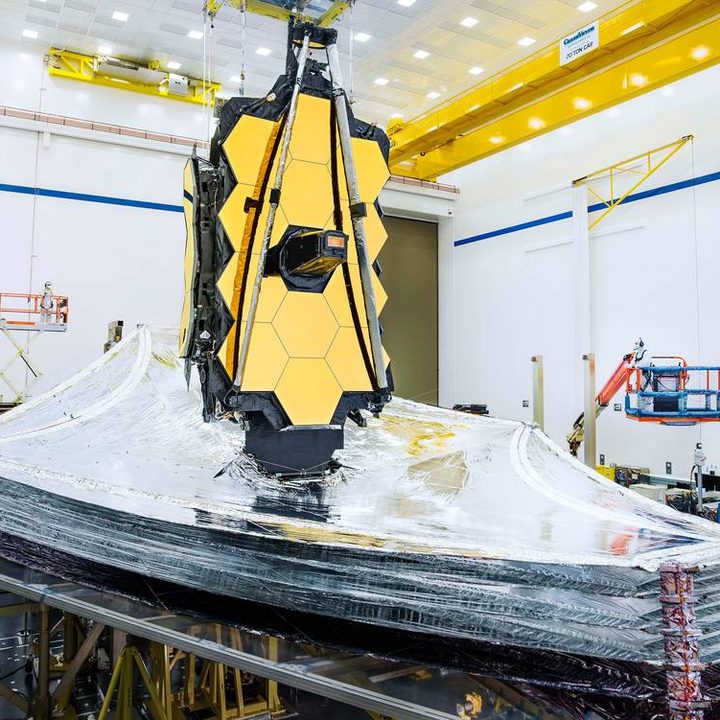
James Webb Space Telescope
After successfully assembling the entire observatory of NASA’s James Webb Space Telescope, technicians and engineers moved on to fully deploy and tension all five layers of its tennis court-sized sunshield, which is designed to keep its optics and sensors in the shade and away from interference. NASA/Chris Gunn

“Technicians were preparing to attach Webb to the launch vehicle adapter, which is used to integrate the observatory with the upper stage of the Ariane 5 rocket,” NASA explained in a message posted on Monday, November 22. “A sudden, unplanned release of a clamp band — which secures Webb to the launch vehicle adapter — caused a vibration throughout the observatory.”

Recommended Videos

A NASA-led anomaly review board has been convened to investigate the incident, and additional testing will take place to check for any damage to the observatory. An update from NASA is expected at the end of the week once all of the tests have been carried out.

It’s not the first delay to hit the James Webb Space Telescope. Development on the project began in 1996 with a launch date originally targeted for 2007. But various problems along the way — among them the coronavirus pandemic — saw several mission dates missed.

The James Webb Space Telescope is the result of an international collaboration between NASA, and the European and Canadian space agencies. Said to be 100 times more powerful than the Hubble Space Telescope, the space-based observatory will perform a detailed exploration of everything from our own solar system to the most distant observable galaxies in the early universe. It’s hoped the mission will help us better understand the origins of the universe and our place within it.

The telescope features a 6.5-meter-diameter golden mirror made up of 18 hexagonal segments that will enable it to explore deep space in great detail. It also includes a tennis court-sized sunshield, which, like the mirror, will be folded for launch, with both sections automatically unfolding following deployment in space.

For a more in-depth look at the James Webb Space Telescope and the aims of the upcoming mission, take a look at this Digital Trends article explaining everything you need to know.

Trevor Mogg
Contributing Editor
Not so many moons ago, Trevor moved from one tea-loving island nation that drives on the left (Britain) to another (Japan)…
Scientists have found a hidden galaxy inside the Milky Way, and they’re calling it Loki
A lost dwarf galaxy may be hiding inside the Milky Way.
milky-way-hidden-galaxy-loki

Our home galaxy has a secret buried inside. A new study published in the Monthly Notices of the Royal Astronomical Society suggests that the Milky Way swallowed an ancient dwarf galaxy billions of years ago, and its stellar remains are still embedded within ours.

Researchers have named this lost galaxy Loki, after the Norse trickster god, and the name is quite fitting because it remained hidden in plain sight for a very long time.

Read more
NASA aims September launch for Roman space telescope and it’s going to be a huge shift
An earlier target for Roman means one of NASA’s most ambitious observatories is getting close, with the potential to open a huge new era in space discovery
Machine, Wheel, Astronomy

NASA is now aiming to launch the Nancy Grace Roman Space Telescope as soon as early September 2026, a faster timeline than its earlier commitment to fly no later than May 2027. That alone makes this one of the agency’s most important missions to watch over the next few months.

The reason is simple, Roman is built to scan vast parts of the sky with sharp infrared vision.

Read more
Blue Origin successfully re-uses a New Glenn rocket for the first time ever
Blue Origin achieves first New Glenn reflight despite payload setback
Blue Origin

Blue Origin has achieved a major milestone in its spaceflight ambitions by successfully reusing a booster from its heavy-lift New Glenn rocket for the first time. The historic launch, conducted on April 19, marks a significant step forward for Jeff Bezos’ space company as it seeks to compete with rivals like SpaceX in the rapidly evolving commercial launch market.

A Milestone With A Mixed Outcome

Read more