
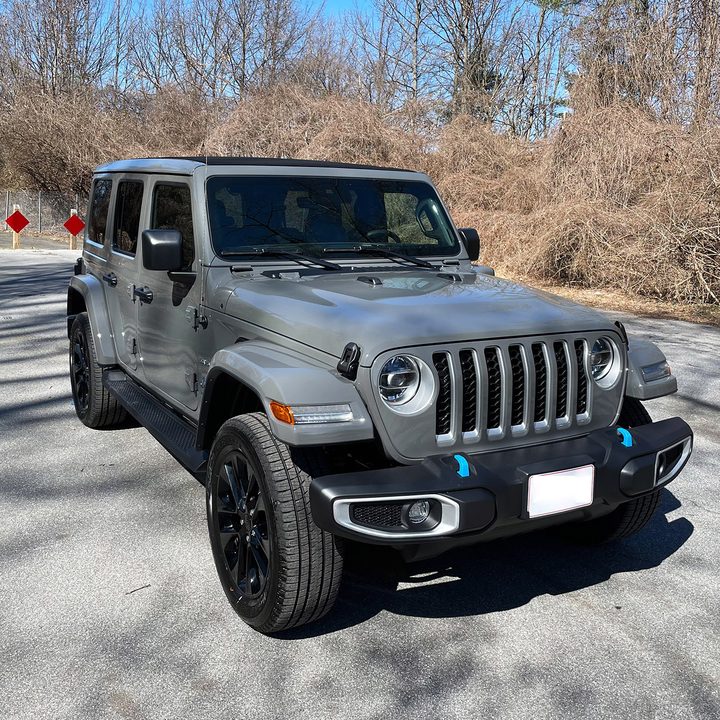
I just bought a 2022 Jeep Wrangler. It weighs well over 5,000 pounds without passengers or cargo, is shaped like a filing cabinet, and as a result of the first two attributes gets truly terrible gas mileage. On the freeway, I’m lucky to return 20 mpg — well under the 2021 new car average of 25.7. But it’s fantastic, and I love it — particularly because the federal government gave me $7,500 to buy it.
You may recognize that $7,500 figure is the same as the federal EV tax credit — it sure is. That’s because this Wrangler is a “4xe” model with a plug-in hybrid powertrain, though the fact that this truck qualifies for the same $7,500 credit as an all-battery EV is downright laughable. Frankly, the government should be ashamed of this situation.
A matter of politics
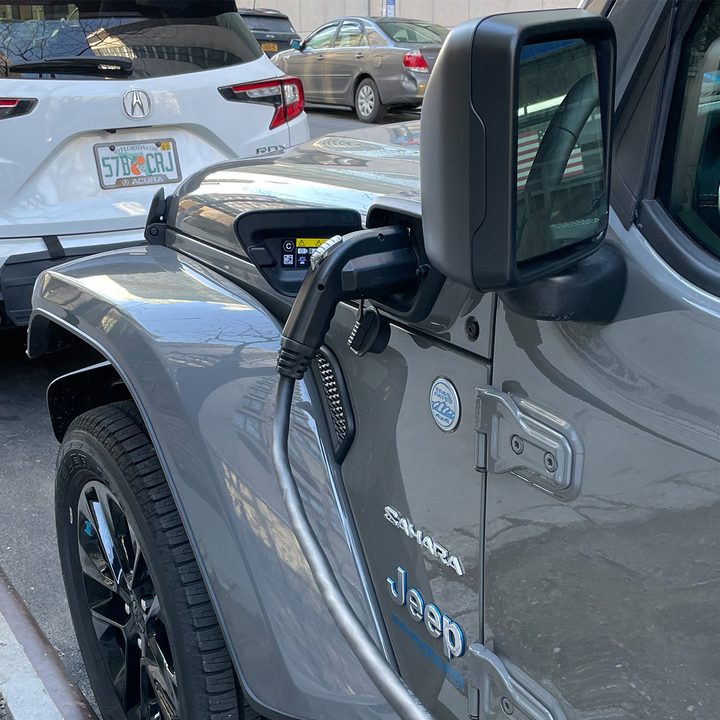
Though it somehow qualifies for the full EV credit, the Wrangler 4xe is not a full battery EV — and even worse, it’s possibly the worst-performing plug-in hybrid electric vehicle (PHEV) available. It can drive just 20 miles on battery (in ideal conditions) before the gas engine kicks in, which is … well, not great. Most PHEVs nowadays return 30 to 40 miles of EV range, and even large SUVs like the BMW X5 offer more than 25.
But at least it has some EV-only range. So that’s good, right? Well, here’s the best part: Thanks to a heavy battery and motor, the 4xe actually gets worse Environmental Protection Agency (EPA)-rated fuel economy than the standard gasoline-only Wrangler. The PHEV is EPA rated for just 20 mpg, while the gas-only Wrangler is rated for 22.
Yes, there is a benefit to having a plug-in Jeep. Just like any other PHEV, if you charge at home and make (very) short trips purely on battery, you can increase your average fuel economy substantially. But in this case the gains are so small it’s almost insulting. Most people are making trips longer than 20 miles roundtrip, and don’t have a Level 2 charger at home to fill back up quickly enough to make multiple battery-only trips a day. So, you’re likely going to be burning more gas in this hybrid than the already-inefficient gas-only Wrangler.
The battery-only range of this truck is so low it’s almost insulting.
Though the federal Gas Guzzler Tax is only levied on cars, not SUVs or trucks, the government’s own threshold for a “gas guzzler” is 22.5 mpg. My green-hued Jeep with a charge port on the fender is, indeed, a gas guzzler. So, why is the government providing an exorbitant “EV” rebate to buy one?
Well, politics is a great starting point. The Biden administration has been pushing incredibly hard to promote EVs and related infrastructure as part of its green initiatives, and that includes tax incentives. Stellantis (parent company of Jeep, Dodge, Chrysler and many others), in turn, is also incredibly motivated to sell PHEVs for (at the very least) the political capital it provides them. Having made-in-America brands like Jeep producing cars with batteries just sweetens the deal for everyone. So, with those factors in play, the government has no reason to pull the plug on such a program. Even if it’s doing little-to-nothing to help the environment.
A broken policy
The worst effect of this bone-headed policy is that the government has helped the Wrangler 4xe become the bestselling PHEV in the U.S. — and I suspect it will continue to be for some time. It’s not bestselling because of its hybrid powertrain or efficiency; it’s best-selling because the government is giving folks $7,500 off what is already a super-desirable vehicle (and an expensive one at that). All for a truck that is one of the least efficient in its size class.
This is what really irks me. I honestly wouldn’t even consider buying a Jeep Wrangler without this EV credit. (Which is so weird to say, as someone who took advantage of this system). Wranglers are quite expensive for what they are — the MSRP of my truck is north of $60,000 — and as I’ve made incredibly clear here, they’re terribly inefficient.
But even with gas at $4 per gallon, that $7,500 rebate is enough to cover 110 full tanks of gas. Or, put another way, enough fuel for me to drive some 37,000 miles, even if I never use the truck’s battery. All on the government’s dime. That works out great for me! But it is decidedly not a great deal for the environment, or U.S. taxpayers.
When I can get a government incentive to buy a 5,500-pound 4WD truck that gets 20 mpg, but not an all-electric Tesla Model 3, your tax policy is utterly broken.
Layer in another silly fact: Not even all EVs qualify for this $7,500 EV credit, as some brands have sold beyond the maximum number of cars eligible. So in this completely backwards world, if I want to go buy a Tesla Model 3 or Chevy Bolt EUV — modestly sized all-electric vehicles — I won’t get a dime of support from the government. But I do get a $7,500 handout for buying a 5,500-pound 4WD truck that struggles to get 20 mpg on the freeway.
Now I’m far from a proponent of tax credits to incentivize vehicle purchases. If anything, we should have more taxes on vehicles, provided the money is being used to improve our road infrastructure and public transit systems.
But if you must offer EV tax credits, they should be limited to pure EVs and perhaps PHEVs so long as they offer a considerable EV-only driving range. Having this simple “does it have a battery and a plug? OK, full tax credit!” checkbox system isn’t just useless, it’s actively detrimental to the goal of increasing overall vehicle efficiency and reducing emissions.
Despite this blatantly counterproductive tax rebate system, chances are the government isn’t going to change its tune. It’s actually actively working to expand these exact kinds of tax credits. So, if you want your own gas guzzler, I’d guess you still have a good amount of time to go order a new Jeep with Uncle Sam’s wallet.


