
AMD’s long-awaited RX 7900 XTX is here, and given its price, a lot of gamers have a tough decision between the RTX 7900 XTX and Nvidia’s RTX 4080. Both are among the best graphics cards you can buy, but one of them is clearly better for most people.
The RX 7900 XTX simply offers a better value, and although the RTX 4080 has better features and ray tracing support, AMD still comes out on top given how much cheaper its GPU is. I’ll break down specs, performance, ray tracing, and more here, but make sure to read my RTX 4080 review and RX 7900 XTX review for a complete look at these graphics cards.
Breaking down specs

It’s tough comparing the specs of the RX 7900 XTX and RTX 4080 because a lot of them don’t mean anything. For example, AMD’s GPU includes more ray tracing cores, but as I’ll dig into later, Nvidia still provides much better ray tracing performance. Still, there are some important differences between the RX 7900 XTX and RTX 4080 based on the spec sheet.
| RX 7900 XTX | RTX 4080 | |
| Architecture | RDNA 3 | Ada Lovelace |
| Process | TSMC 5nm + 6nm | TSMC N4 |
| AI accelerators | 192 | N/A |
| Ray tracing accelerators | 96 | N/A |
| Ray tracing cores | N/A | 76 3rd-gen |
| Tensor cores | N/A | 304 4th-gen |
| Memory | 24GB GDDR6 | 16GB GDDR6X |
| Memory speed | 20Gbps | 21Gbps |
| Memory bus size | 384-bit | 256-bit |
| Boost clock speed | 2.3GHz | 2.5GHz |
| Connection support | DisplayPort 2.1 | DisplayPort 1.4a |
| Total board power | 355W | 320W |
| List price | $1,000 | $1,200 |
First, is memory. AMD’s RX 7900 XTX includes 24GB of memory compared to only 16GB of the RTX 4080. However, Nvidia is using faster GDDR6X memory. For gaming, at least, the balance of speed and bus width means the RTX 4080 and RX 7900 XTX are largely equal, but VRAM-heavy applications will definitely see a benefit from the boosted capacity on the RX 7900 XTX.
The connection standard is important to note, too. Nvidia stuck with DisplayPort 1.4 for the RTX 4080, which is still capable of driving high-end displays like the 4K Samsung Odyssey Neo G8 at 240Hz. The RX 7900 XTX supports DisplayPort 2.1, which could be important for PC gamers in the future.
In particular, VR gamers and those wanting to drive the first 8K gaming monitors will need DisplayPort 2.1. The difference between DisplayPort 1.4 and 2.1 isn’t important now. In six months to a year from now, though, it could be a vital difference if you want to pair your high-end GPU with an equally high-end monitor.
It all comes down to pricing

Pricing is the main factor that separates the RTX 4080 and RX 7900 XTX. The RTX 4080 launched at a list price of $1,200, though most board partner cards sell for around $1,300 to $1,400. The RX 7900 XTX runs $1,000, but it’s not clear how much board partner cards will go for right now. In all likelihood, they’ll sell for around $100 over the list price.
Somewhere around $200 to $300 separates the two GPUs, with as much as $400 being possible depending on which models you pick. The important thing is that the RX 7900 XTX is significantly cheaper. Even at $200 over list price, you’ll still spend more on the cheapest RTX 4080 than you’ll spend on an RX 7900 XTX.
Rumors say Nvidia could cut the price of the RTX 4080 in the future. That’s unconfirmed right now, though, and even if Nvidia reduces prices, that doesn’t mean models you can actually buy will follow suit. The price you pay is generally different than the price set in the world of graphics cards, and on that front, AMD wins. Our month-over-month tracking of GPU prices has consistently shown AMD cards selling for less than Nvidia, and this generation shouldn’t be any different.
Comparable performance in most games
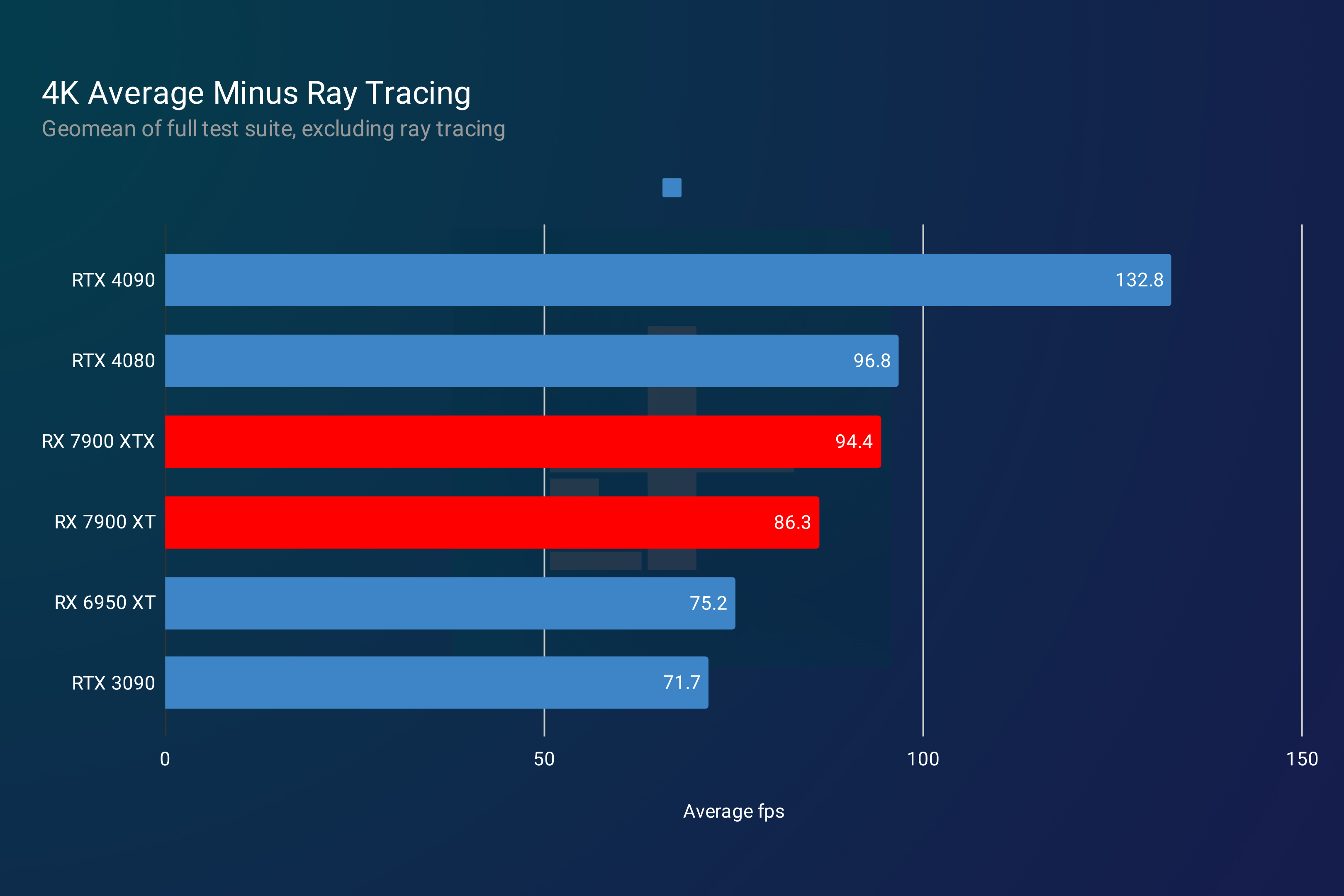
Across our suite of games, the RX 7900 XTX ends up a mere 2% slower than the RTX 4080. That includes some wins and some severe losses for AMD’s card, with the two GPUs duking it out depending on the title. It’s safe to say they perform at the same level, with the RX 7900 XTX offering a far better value.
Although the RX 7900 XTX offers a far better value, it still trades blows with the RTX 4080. In some games, like Cyberpunk 2077 and Red Dead Redemption 2, AMD’s card actually provides better performance than the RTX 4080 — and for less money. In titles like Forza Horizon 5 and Horizon Zero Dawn, though, Nvidia leads by a solid margin.

Jumping down to 1440p, the dynamic between the RX 7900 XTX and RTX 4080 remains the same but with different circumstances. Where the RX 7900 XTX leads, it pushes further ahead, and where the RTX 4080 lead at 4K, the gap is closer at 1440p.

AMD notches another win in Assassin’s Creed Valhalla, and it jumps from a 6% lead in Cyberpunk 2077 at 4K to a 14% lead at 1440p. On the other end, the lead of around 12% for the RTX 4080 in Horizon Zero Dawn shrinks to 8% at 1440p.
In raw gaming performance, the RTX 4080 and RX 7900 XTX are evenly matched, with either card taking a slight lead depending on the game you’re playing. That puts all the emphasis on price, and on that front, AMD is the clear winner.
Ray tracing and DLSS could make a difference

The RX 7900 XTX and RTX 4080 start to diverge when you factor in ray tracing. Nvidia has the market cornered with ray tracing, and AMD’s RX 7900 XTX doesn’t change that. You can see in the chart above that the RTX 4080 consistently provides better ray tracing performance at 4K.
AMD is a lot more competitive this generation than it was in previous generations, but Nvidia has a lead in overall ray tracing performance. That may be important for some, but the more important feature that separates the RTX 4080 is Deep Learning Super Sampling (DLSS).
DLSS provides upscaling, and AMD has its FidelityFX Super Resolution (FSR) feature that is just slightly below what DLSS offers. However, the RTX 4080 also supports DLSS Frame Generation. This generates new frames to boost your frame rate in demanding games like Portal RTX and Cyberpunk 2077, and it allows the RTX 4080 to provide much higher performance than the RX 7900 XTX can manage in supported games.

AMD is working on FSR 3, which includes a frame generation feature as well, but we don’t know much about it at this point. It’s best not to base your buying decision on FSR 3 because we’re still likely many months off from its release, and we have no idea how it performs or looks.
DLSS Frame Generation and ray tracing help justify the RTX 4080’s higher price. However, those additions aren’t important for everyone. If you don’t care much about ray tracing and are looking for the best raw performance at the best value, AMD’s RX 7900 XTX still wins.
RX 7900 XTX for most, RTX 4080 for some

AMD’s RX 7900 XTX is the better GPU for most people. It offers performance similar to the RTX 4080 while costing less, and that’s hard to argue with. You’re getting a much better value without sacrificing performance — or, at the very least, those sacrifices are balanced out by performance gaps seen with the RTX 4080.
Some gamers want the bleeding edge of tech, and for that bunch, the RTX 4080 is still the way to go. It’s expensive, but AMD doesn’t have a compelling answer for DLSS Frame Generation or high ray tracing performance right now. The RX 7900 XTX is capable of ray tracing, but if you want to crank all ray tracing sliders just to say you did, Nvidia is the way to go.


