
On a recent trip to New York, I got another opportunity to look at Hisense’s 2023 TV lineup and learned a little more about when they might be hitting store shelves. But perhaps more important is that I learned a few intriguing things about how Hisense is operating, how it is positioning itself in the market, and why Hisense’s brand might just be about to have a rather massive breakthrough.
The event I traveled to in NYC was a pretty big, probably very expensive shindig to announce that Hisense has now partnered with the NBA. And while that’s cool for Hisense, it’s not why I thought I was flying from one coast to the other. Fortunately, I ended up getting some good intel out of the trip, as well as another look at the 2023 lineup, including the stunning UX model that debuted at CES.
And I want to share this info — because I think Hisense is about to make some big moves.
Putting the ball in Hisense’s court
The National Basketball Association did something like $10 billion in revenue last season. So this partnership Hisense recently brokered has massive potential. Normally, I tend to dismiss these kinds of “partnerships.” But recently, we learned that TCL has partnered with the NFL. And with Hisense answering back, it’s hard not to see something brewing.
I think it’s pretty clear that while TCL and Hisense are the No. 2 and No. 3 brands in terms of sales in North America (not necessarily in that order), that does not mean they enjoy the kind of brand recognition and mindshare that, say, Samsung, Sony, and LG do. And that makes it hard for those brands to secure dominance in the U.S. market. Samsung is just way out ahead of them.
But maybe not for long.
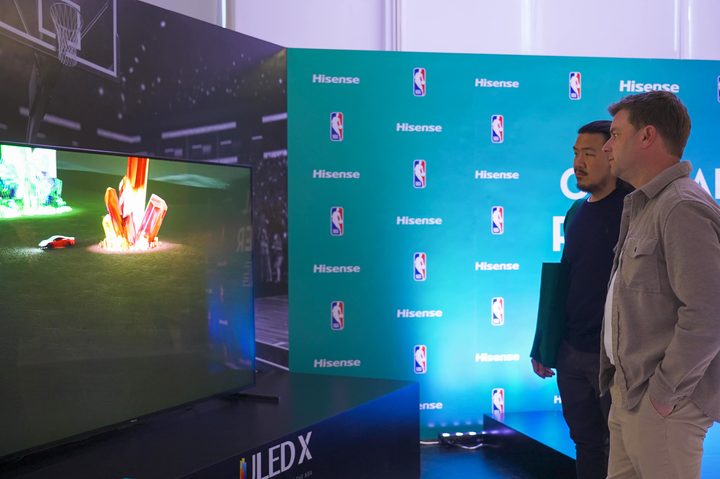
We love our football and basketball here. And if every time someone in North America watches a football game,they get exposed to the TCL brand, or when watching an NBA game, they get exposed to the Hisense brand, all of a sudden, when they walk into a store to look at TVs, those brands are more familiar. I cannot overstate how huge that’s going to be for TCL and Hisense.
TCL and Hisense already were likely to become the next LG and Samsung. But I didn’t feel like I had a read on when that might happen. Until now.
I think that change is going to start happening now.
Keeping it real … ish
How is Hisense differentiating itself going forward? I know it isn’t just relying on plastering its logo everywhere.
You know how some other TV manufacturers don’t put the actual refresh rate of their panels on the box or even in the specs section on product pages? Instead of being clear about a 60Hz or 120Hz panel, they print something annoying and arguably misleading, like “480Hz clear motion.”
Well, Hisense says it isn’t going to play that game anymore. If its TV has a 60Hz panel, the box says so. If it has 120Hz, it will say that. And, by the way, both the U7K and U8K this year have 144Hz panels. Straight-up.
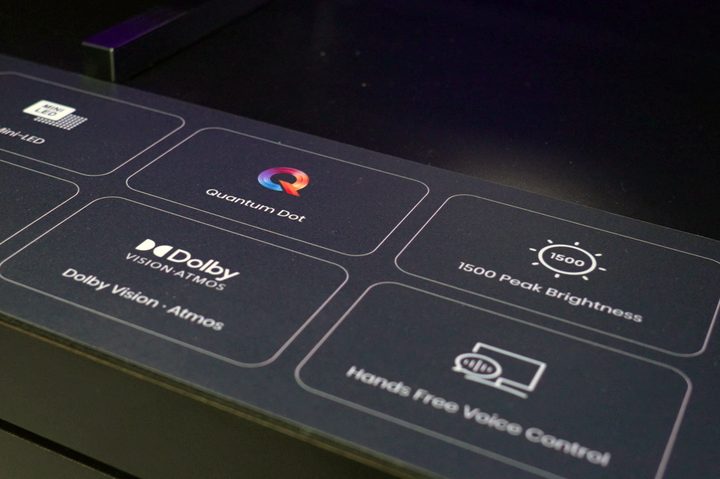
Hisense also is done playing coy with mini-LED as a premium-only technology. The U6K, which starts at $500, has a mini-LED backlight system, and it’s all mini-LED up from there. And along the same lines, Hisense is clearly marking its boxes with the peak brightness ratings for its TVs – nobody else does that. Not only is Hisense putting it right out there — which, honestly, is a bit of flex on its own — but it is using conservative numbers. For example, the U7K may say 1,500 nits (OK, technically the box doesn’t say “nits”), but it’s going to go much higher than that. We’ve seen that play out here when I measure the TVs. I asked Hisense America’s president, David Gold, about that, and he said Hisense would rather underpromise and overdeliver than go the much more common route of overpromising and underdelivering. And from a brand perspective, I have a lot of respect for that.
Spy wary
I think those are all pretty solid strategies. But will they be enough to earn Hisense universal love and acceptance in North America — especially in the U.S.? I mean, at the end of the day, Hisense is a China-based brand. And in a world where we hear a lot about spying — I mean, Congress is trying to ban TikTok — a lot of folks in the U.S. may look at China-made tech products as being risky.
Can Hisense get over that hump? To be clear, the Hisense TVs we get here are made in Mexico, and they run Google or Roku OS, which are made by U.S. companies. But there will be worries. I read them in the comments all the time.
I think the 2023 TVs will be the highest-value TVs we’ve seen from Hisense yet.
I think Hisense has a pretty good shot. It says it’s already the No. 2 brand in North America by units shipped, though admittedly that’s just for the first two months of 2023, so we’ll see if that sticks. But clearly, Hisense has got a big upward trajectory going for itself. And ultimately, I think that will benefit us as consumers.
Hisense America already has taken the reins and gotten the products it knows we want from corporate in China. I think we will continue to see better and better TVs year after year. And along those lines, I think the 2023 TVs will be the highest-value TVs we’ve seen from Hisense yet. Maybe the best of the bunch this year. We’ll see.
The proof is in the pudding
If Hisense can push the U7K and U8K performance up past the U7H and U8H levels we saw last year while keeping the prices about the same or even lower, that’s going to be formidable. And from what I’ve seen so far, I think it has made some considerable progress. The processing definitely looks better this year. I’m going to hold off until I can test these things, but I’m more optimistic than pessimistic right now.
Then there’s the UX. This TV caught a lot of attention at CES because it promised some big things. The only problem was that Hisense was noncommittal about whether it would bring that TV to the U.S. The worry? That a really expensive, albeit hot-rod, TV from Hisense maybe wasn’t something that North American buyers were ready for.


I think Hisense is right to be worried. And it seems as if it is still a bit worried. Because the good news is that the UX will be available in the U.S. The bad news is that there will not be very many of them.
It’s like Hisense is doing a limited run — a special limited edition only for special folks. Maybe it’s trying to create demand with scarcity. But whatever the motivation, it will be hard to get your hands on Hisense’s ridiculously bright and beautiful-looking UX TV. And if you do, you’ll be taking home an 85-inch TV because that’s the only size in which it is available.
So when will we see these TVs in the U.S.? Well, the U6, U7, and 8K models are due “this summer.” Hisense tells me it will be the early part of the third quarter. So we have to wait a bit longer, but not as long as August. I’m thinking late May or early June maybe. As for the UX? Who knows. That could be an end-of-year thing — and heaven knows how expensive it will end up being.
So that’s the deal on Hisense. I think it may end up being a big year for the company, and I’m looking forward to reviewing its TVs to see whether that gut instinct plays out to be true.


