
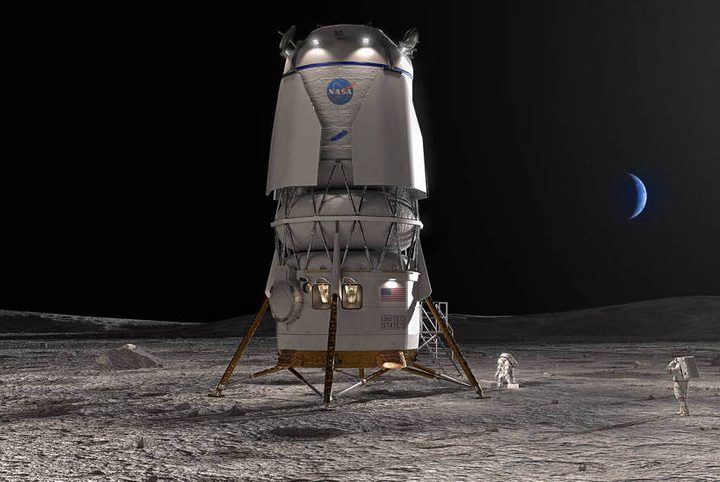
NASA has selected Blue Origin to build a human lunar landing system for the Artemis V mission, which is currently targeted for 2029.
The award, worth $3.4 billion, means that NASA should have two separate human landing systems for moon missions by the end of the decade, with SpaceX already developing its own Starship HLS lander.
NASA’s Artemis program, which began last November with an uncrewed test of NASA’s new SLS rocket and Orion spacecraft, will explore parts of the moon never visited by humans and build a permanent base on the moon for astronauts to live and work. The first crewed mission to Mars could also be launched from the lunar surface sometime in the 2030s.
Amazon founder Jeff Bezos, who set up Blue Origin 23 years ago, tweeted his delight at winning the contract: “Honored to be on this journey with NASA to land astronauts on the moon — this time to stay.”
Currently, Blue Origin’s main flight successes involve sending paying passengers on 10-minute “space tourism” trips to about 62 miles above Earth using a single-stage suborbital New Shepard rocket. The moon mission is, therefore, a considerably more ambitious undertaking.
The first crewed lunar landing in five decades is set to take place in 2025 using a modified SpaceX Starship spacecraft in the Artemis III mission. Artemis IV will also deploy SpaceX’s system.
Artemis V will use NASA’s SLS rocket to send four astronauts to lunar orbit aboard the Orion spacecraft. After Orion docks with the Gateway, — NASA’s planned moon-orbiting station — two astronauts will transfer to Blue Origin’s Blue Moon human landing system and travel to the lunar surface for a week-long stay in the moon’s South Pole region where they’ll carry out science and exploration activities.
“Artemis V is at the intersection of demonstrating NASA’s initial lunar exploration capabilities and establishing the foundational systems to support recurring complex missions in lunar orbit and on the surface as part of the agency’s moon to Mars exploration approach,” the space agency said in a post on its website.
The latest award follows complaints from Blue Origin in 2021 when NASA handed SpaceX its first Artemis contract for a crewed lunar lander, choosing Elon Musk’s more established spaceflight company over Bezos’s. Among Blue Origin’s concerns was that going with one provider instead of two provided a significant head-start to the single-source supplier and exposed NASA to a greater risk of mission delays.
But now, Blue Origin, which is partnering for the project with Boeing, Lockheed Martin, Draper, Astrobotic, and Honeybee Robotics, is able to contribute in a major way to the Artemis program.
“Today we are excited to announce Blue Origin will build a human landing system as NASA’s second provider to deliver Artemis astronauts to the lunar surface,” NASA chief Bill Nelson said. “We are in a golden age of human spaceflight, which is made possible by NASA’s commercial and international partnerships. Together, we are making an investment in the infrastructure that will pave the way to land the first astronauts on Mars.”


