1. Home
  2. Space
  3. News

Crater confusion caused Japan’s Hakuto lunar mission to fail

Add as a preferred source on Google

Japan’s ispace startup last month very nearly succeeded in becoming the first team to land a privately funded spacecraft on the moon.

But the mission ended in failure when the $90 million lander — Hakuto — lost touch with mission controllers before crash landing on the lunar surface, bringing the endeavor to an abrupt end.

Recommended Videos

The Tokyo-based team behind ispace remained positive, however, saying that all of the test mission’s stages besides the final one were a success, providing it with plenty of data that will give it a good chance of succeeding next time around.

Some of that data was used in its post-mission analysis, which investigated the precise cause of the crash landing. In a news release from ispace, the company said that an error occurred with the lander’s altitude measurement.

“While the lander estimated its own altitude to be zero, or on the lunar surface, it was later determined to be at an altitude of approximately 5 kilometers (3.11 miles) above the lunar surface,” ispace said.

“After reaching the scheduled landing time, the lander continued to descend at a low speed until the propulsion system ran out of fuel. At that time, the controlled descent of the lander ceased, and it is believed to have free-fallen to the moon’s surface.”

The most likely reason for the lander’s erroneous altitude estimation, ispace said, was a software issue.

It said that as the lander was navigating to the planned touchdown location, the altitude measured by the onboard sensors rose sharply when it passed over a large cliff — believed to be a crater rim — approximately 3 kilometers (1.86 miles) in elevation.

“According to the analysis of the flight data, a larger-than-expected discrepancy occurred between the measured altitude value and the estimated altitude value set in advance,” ispace said. “The onboard software determined in error that the cause of this discrepancy was an abnormal value reported by the sensor, and thereafter the altitude data measured by the sensor was intercepted.”

A complicating factor was the team’s decision to select a new landing site for Hakuto that it thought would be more interesting for scientists. Preparations for the new site failed to adequately take into account the lunar environment on the navigation route, resulting in the software misjudging the lander’s altitude on its final approach, ispace explained.

The company said lessons learned from the mission will be incorporated into its next attempt to successfully land on the lunar surface, though a date has yet to be set for that mission.

Last week, NASA published the first images of what it believes to be parts of the wreckage of the Hakuto lander, captured by the space agency’s Lunar Reconnaissance Orbiter as it passed overhead.

NASA is inking contracts with private firms — ispace among them — to develop landers capable of transporting cargo to the lunar surface as part of its Artemis program.

Trevor Mogg
Contributing Editor
Not so many moons ago, Trevor moved from one tea-loving island nation that drives on the left (Britain) to another (Japan)…
Lightsails have hit another speed bump on the road to interstellar travel
The coolest interstellar travel idea may get betrayed by the light pushing it
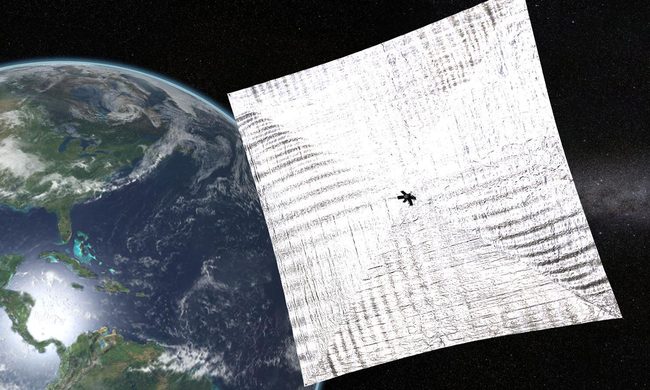
LightSail in Earth orbit

Laser-powered lightsails are one of the coolest answers to spaceflight. It might not be as sci-fi-sounding as a warp drive, but now, its practicality has also come under question. Using lightsails, a spacecraft could unfurl an ultra-thin reflective sail and let a powerful laser push it toward another star, without relying on fuel.

The tech was simple and elegant--except it's also more complicated than it sounds. A new preprint from researchers Chao Shen and Jiaze Li of the Harbin Institute of Technology suggests that relativistic lightsails may run into a hidden propulsion problem once they start moving extremely fast.

Read more
The galaxy has an exoplanet size mystery, and NASA’s EVE mission wants to solve it
This planet-hunting mission wants to catch baby worlds before they grow up
Artist’s Illustration of Exoplanets Orbiting Barnard’s Star

Mankind venturing into space ended up creating more questions than it answered, and one of the dilemmas is related to the planet sizes. Astronomers have found plenty of rocky super-Earths and plenty of puffier sub-Neptunes, but far fewer planets with a radius of about 1.8 times Earth’s.

That gap is known as the radius valley, and a proposed mission called the Early eVolution Explorer, or EVE, wants to figure out why it exists. NASA has a simple plan: look at planets while they are still young. The mission concept, detailed in a new arXiv preprint and covered by Phys.org, would focus on newly formed star clusters to see what small planets look like before billions of years of evolution.

Read more
We just got a hot signal that a Tesla and SpaceX merger could happen, after all
Tesla

For years, the idea of Tesla and SpaceX becoming a single company has lived somewhere between ambitious business theory and Elon Musk fan fiction. The two companies already share DNA, leadership influence, engineering talent, and long-term goals. But every time the topic surfaced, it felt more like an interesting thought experiment than a realistic possibility. Now, one of the most important people at SpaceX has added fresh fuel to the conversation.

Speaking in a recent CNBC interview, SpaceX President and COO Gwynne Shotwell was asked about the possibility of closer ties between Tesla and SpaceX. Her response wasn’t a flat-out denial. In fact, she suggested that bringing the two companies together could make life a little easier for Musk. That may sound like an offhand comment, but coming from Shotwell, it’s noteworthy. She’s been at SpaceX since its earliest days and remains one of the company's most influential executives.

Read more